

Fine Art Poster
From £28
A giclée print on 200gsm matte fine art paper, using a twelve-colour process for accurate, fade-resistant colour. Supplied unframed, delivered flat or rolled.



Archival giclée
Frames arrive ready to hang
Secure checkout
Made to order
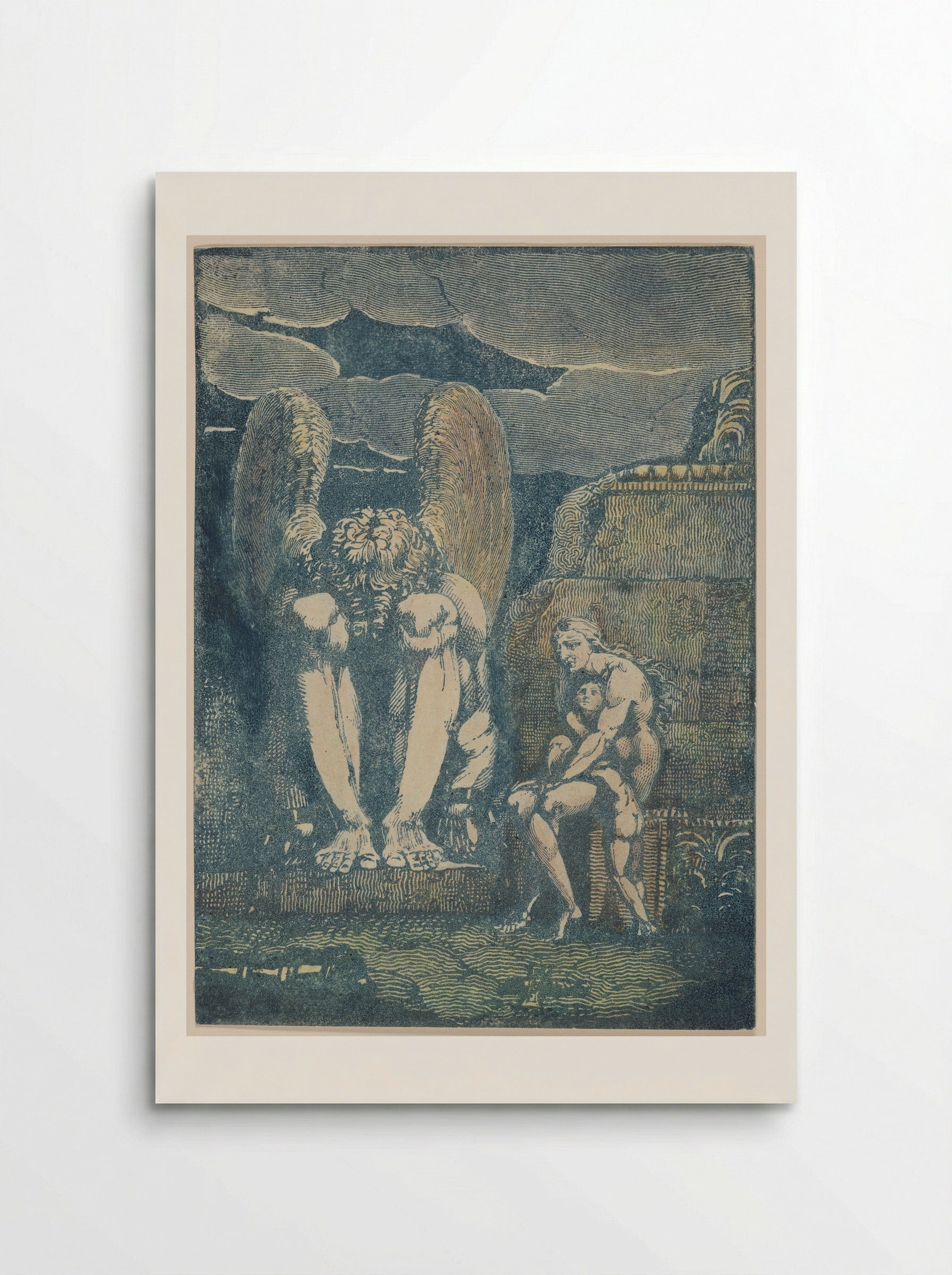
A haunting relief etching by William Blake, serving as the frontispiece to his 1793 prophetic book, depicting a bowed, winged figure beside a mother and child.
This print serves as the frontispiece to William Blake's 1793 prophetic book, 'America a Prophecy'. The composition presents a stark, allegorical scene that reflects the artist's preoccupation with political revolution and spiritual liberation. On the left, a massive, winged figure sits in a hunched, dejected posture, its head bowed and wings partially furled. This figure is often interpreted as a representation of the oppressive forces of the old world or the fallen state of humanity. To the right, a woman sits upon a stone structure, cradling a small child. Their forms are rendered with the muscular, elongated anatomy characteristic of Blake's figures. The background features heavy, swirling clouds and a rugged, architectural element, suggesting a landscape of desolation. The print employs Blake's signature relief etching technique, which allowed him to integrate text and image on the same copper plate. The application of watercolour adds a layer of atmospheric depth, with cool blue and green tones dominating the palette. Blake's work often defies conventional classification, blending classical influences with his own idiosyncratic mythology. In this specific image, the contrast between the monumental, suffering figure and the human pair creates a tension that permeates the entire volume. The print is a fine example of the artist's ability to convey complex political and theological ideas through visual metaphor. It remains a significant piece within his larger body of illuminated books, demonstrating his technical skill as both a printmaker and a visionary poet. The work invites contemplation of the cyclical nature of history and the human capacity for endurance amidst upheaval.
Because every print is made to order, we don't offer change-of-mind returns, refunds or exchanges. If your order arrives faulty, damaged or incorrect, we'll replace it free of charge — just contact us within 48 hours of delivery. See our refunds page for full details.
We ship worldwide, printing at the production hub nearest to your delivery address. Delivery times and costs vary by destination — you'll see the options available to you at checkout.
Each print is produced to order using 12-colour giclée printing on FSC-certified archival paper. Designed in Britain and printed at your nearest production hub to reduce waste and speed up delivery.
Specific Features
Every Solis piece is made to order with archival, gallery-quality materials built to last.
Care & Cleaning
To keep your artwork looking its best:
Materials & Sizing
Museum-grade giclée on FSC-certified archival matte paper, with framed and canvas options.

Artist Biography
Made to order
Every piece is printed to order. These are the five finishes, and what makes each one different.
From £28
A giclée print on 200gsm matte fine art paper, using a twelve-colour process for accurate, fade-resistant colour. Supplied unframed, delivered flat or rolled.

From £45
The same fine art print in a solid wood frame with UV-protective acrylic glaze and rigid backing. Five frame colours. Arrives ready to hang.

From £85
A deeper solid wood frame: 33mm deep with a 20mm face and Perspex glaze. The print sits unmounted for a clean gallery presentation. Black, white or natural.

From £30
Hand-stretched canvas with neat gallery-wrapped edges, giving the artwork surface texture and depth. Arrives ready to hang.

From £135
Stretched canvas set in a floating wood frame, our most substantial finish. Arrives ready to hang.
Why Choose Us ?
Damage-free delivery guarantee
Fast Shipping
Museum-Quality Materials
You May Also Like
We use cookies to measure our marketing and see which prints people love.We use cookies to measure our marketing.
By continuing to browse, you agree · Privacy Policy