

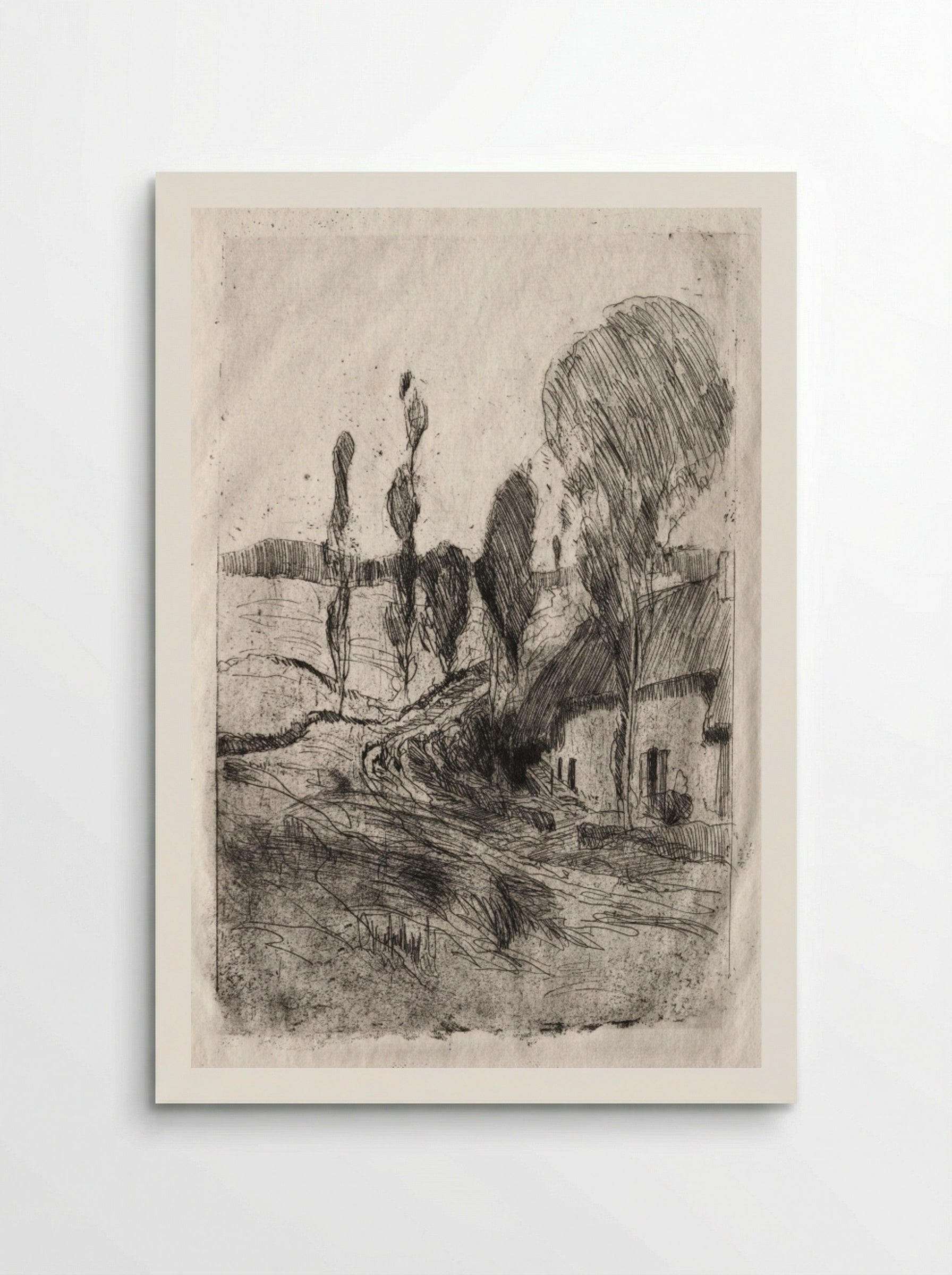
French Landscape - John Henry Twachtman
Archival giclée
Frames arrive ready to hang
Secure checkout
Made to order
Description
A delicate etching by American Impressionist John Henry Twachtman, capturing a quiet rural scene with expressive line work and atmospheric light.
This etching by John Henry Twachtman captures a rural scene, likely produced during his formative years in Europe. Twachtman, a central figure in American Impressionism, spent significant time in France and the Netherlands, where he absorbed the tonalist approach to printmaking and painting. The work demonstrates his characteristic economy of line, using varied pressure to suggest the texture of the thatched cottage and the surrounding foliage. The composition relies on a delicate balance between the foreground structure and the verticality of the trees. Twachtman employs a series of rapid, rhythmic marks to define the contours of the terrain and the density of the tree canopy. The sky remains largely unworked, allowing the paper surface to provide a sense of atmospheric light. This technique reflects his interest in the subjective experience of a place, prioritising mood and light over precise topographical detail. Twachtman's approach to etching often involved experimentation with plate tone and wiping techniques, which allowed for soft, painterly effects. In this piece, the ink sits lightly on the paper, creating a sense of quietude. The cottage, partially obscured by the trees, provides a human element to the rural setting without dominating the frame. The work is an example of his ability to translate the fleeting qualities of light and atmosphere into the medium of print. It remains a clear representation of his transition from the darker, Munich-influenced style of his early career toward the lighter, more ethereal aesthetic that defined his later work in Connecticut.
Return policy
Because every print is made to order, we don't offer change-of-mind returns, refunds or exchanges. If your order arrives faulty, damaged or incorrect, we'll replace it free of charge — just contact us within 48 hours of delivery. See our refunds page for full details.
Shipping
We ship worldwide, printing at the production hub nearest to your delivery address. Delivery times and costs vary by destination — you'll see the options available to you at checkout.
Manufacturing
Each print is produced to order using 12-colour giclée printing on FSC-certified archival paper. Designed in Britain and printed at your nearest production hub to reduce waste and speed up delivery.
French Landscape - John Henry Twachtman

Artist Biography
John Henry Twachtman
He was born in Cincinnati in 1853, studied there under Frank Duveneck, then enrolled at the Academy of Fine Arts in Munich in 1875, where he acquired the dark, heavy manner of the Munich school. A trip to Venice with Duveneck and William Merritt Chase in 1878 began to loosen him. By 1883 he was in Paris at the Academie Julian, and the brownish palette was gone. Whistler's tonal subtlety and the Impressionists' light replaced it; Theodore Robinson and Childe Hassam encouraged the shift further.
He bought a farm in Greenwich, Connecticut, in 1890, and it became his primary subject. The waterfall, the pool, the hemlock trees and the snow-covered fields appeared in compositions influenced by Japanese prints, with high horizon lines and flattened perspectives that anticipated abstract thinking. His winter paintings are studies in whiteness that sit somewhere between Impressionism and Tonalism, quieter than either label suggests.
In 1898 he became a founding member of The Ten, a group of American artists dissatisfied with the conservative exhibition system. He also founded an informal art school at Cos Cob, Connecticut, and was known for practical jokes and irreverent wit. He died in 1902, at forty-nine. The recognition he expected in his lifetime came after it.
Our Features
Designed for Lasting Impact
Specific Features
Every Solis piece is made to order with archival, gallery-quality materials built to last.
- Museum-grade giclée printing for rich, fade-resistant colour
- Archival matte fine-art paper, FSC-certified
- Multiple sizes and framing options available
- Frames in black, natural wood, dark wood or white
- Framed prints arrive ready to hang
Care & Cleaning
To keep your artwork looking its best:
- Dust gently with a soft, dry cloth
- Avoid prolonged direct sunlight
- Never use liquid cleaners on the print or canvas surface
- Keep in a dry, room-temperature space
- Handle prints with clean, dry hands
Materials & Sizing
Museum-grade giclée on FSC-certified archival matte paper, with framed and canvas options.
- Paper sizes: A4, A3, A2, A1, A0 and B2 (50×70 cm)
- Canvas: XS (20×30 cm) to Large (60×90 cm)
- Frames: black, natural wood, dark wood or white
Why Choose Us ?
Damage-free delivery guarantee
Fast Shipping
Museum-Quality Materials
Artist Biography
John Henry Twachtman
He was born in Cincinnati in 1853, studied there under Frank Duveneck, then enrolled at the Academy of Fine Arts in Munich in 1875, where he acquired the dark, heavy manner of the Munich school. A trip to Venice with Duveneck and William Merritt Chase in 1878 began to loosen him. By 1883 he was in Paris at the Academie Julian, and the brownish palette was gone. Whistler's tonal subtlety and the Impressionists' light replaced it; Theodore Robinson and Childe Hassam encouraged the shift further.
He bought a farm in Greenwich, Connecticut, in 1890, and it became his primary subject. The waterfall, the pool, the hemlock trees and the snow-covered fields appeared in compositions influenced by Japanese prints, with high horizon lines and flattened perspectives that anticipated abstract thinking. His winter paintings are studies in whiteness that sit somewhere between Impressionism and Tonalism, quieter than either label suggests.
In 1898 he became a founding member of The Ten, a group of American artists dissatisfied with the conservative exhibition system. He also founded an informal art school at Cos Cob, Connecticut, and was known for practical jokes and irreverent wit. He died in 1902, at forty-nine. The recognition he expected in his lifetime came after it.
You May Also Like