

Fine Art Poster
From £28
A giclée print on 200gsm matte fine art paper, using a twelve-colour process for accurate, fade-resistant colour. Supplied unframed, delivered flat or rolled.

Archival giclée
Frames arrive ready to hang
Secure checkout
Made to order
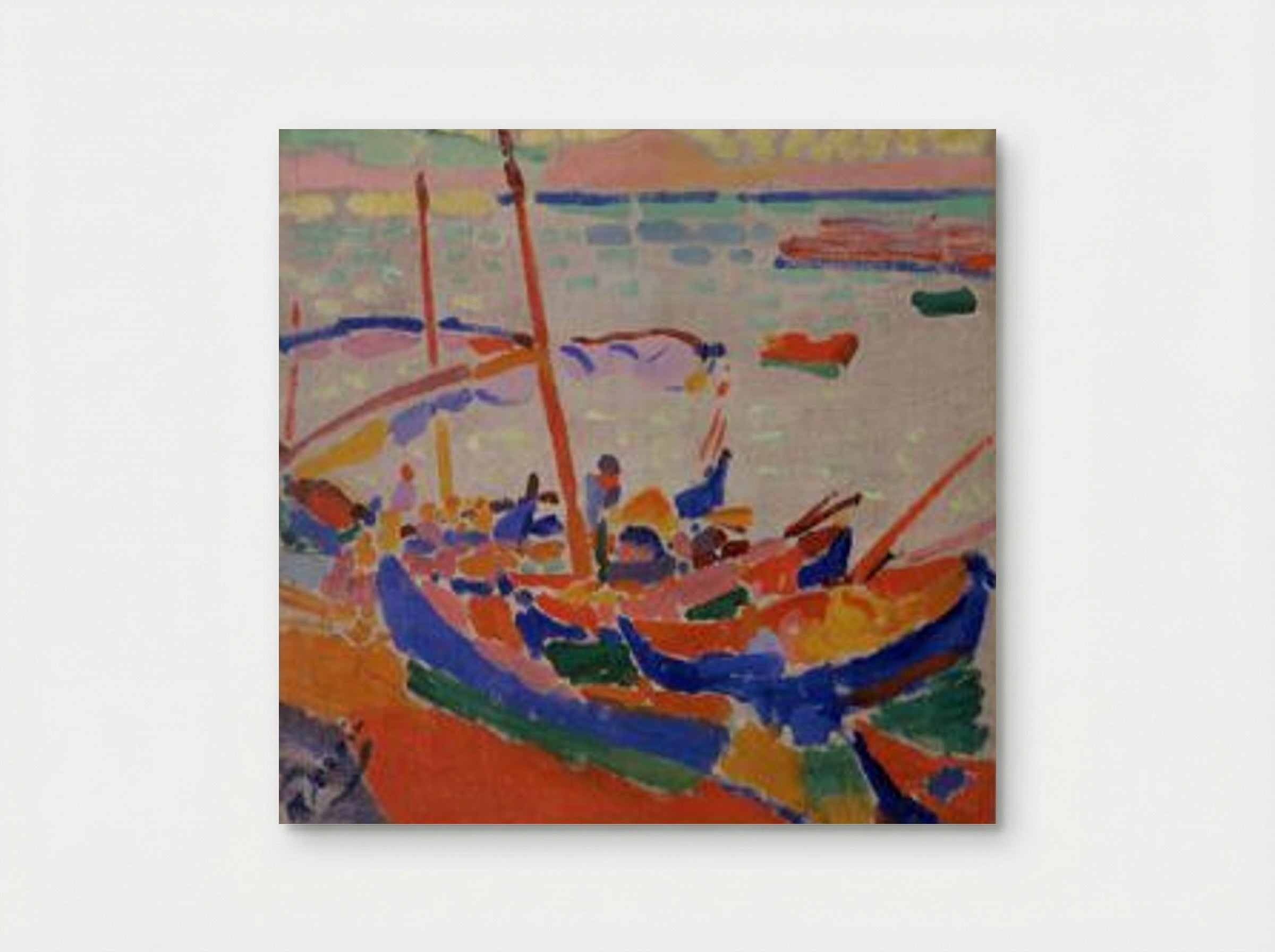
A seminal Fauvist work by André Derain, capturing the Mediterranean harbour of Collioure through bold, non-naturalistic colour and expressive brushwork.
André Derain painted this work during the summer of 1905, a period he spent in the Mediterranean coastal town of Collioure alongside Henri Matisse. This collaboration resulted in the development of a radical approach to colour and form, which critics later labelled Fauvism. The term, derived from the French word for wild beasts, refers to the aggressive, non-naturalistic application of paint seen in this composition. In this depiction of fishing boats, Derain rejects traditional perspective and local colour. Instead, he employs broad, unblended strokes of pure pigment to construct the scene. The hulls of the boats are rendered in bold blues, oranges, and greens, while the water is suggested through rhythmic, horizontal dashes of lighter tones. The masts are simplified into vertical lines that divide the canvas, creating a sense of structure within the otherwise fluid arrangement of colour. The canvas remains partially visible in areas, allowing the texture of the support to interact with the paint. This work demonstrates the shift away from the observational accuracy of Impressionism towards an expressive, subjective interpretation of the subject. Derain focuses on the interaction of complementary colours to generate energy and movement. By prioritising the autonomy of the paint on the surface, he moves the viewer away from a literal reading of the harbour and towards an appreciation of the visual mechanics of the image itself. The composition is balanced through the distribution of these chromatic blocks, creating a sense of harmony that relies on the relationship between the hues rather than the representation of light or shadow. This piece remains a primary example of the early twentieth-century movement that prioritised the emotional and decorative potential of colour over descriptive realism.
Because every print is made to order, we don't offer change-of-mind returns, refunds or exchanges. If your order arrives faulty, damaged or incorrect, we'll replace it free of charge — just contact us within 48 hours of delivery. See our refunds page for full details.
We ship worldwide, printing at the production hub nearest to your delivery address. Delivery times and costs vary by destination — you'll see the options available to you at checkout.
Each print is produced to order using 12-colour giclée printing on FSC-certified archival paper. Designed in Britain and printed at your nearest production hub to reduce waste and speed up delivery.

Artist Biography
Our Features
Designed for Lasting Impact
Every Solis piece is made to order with archival, gallery-quality materials built to last.
To keep your artwork looking its best:
Museum-grade giclée on FSC-certified archival matte paper, with framed and canvas options.
Made to order
Every piece is printed to order. These are the five finishes, and what makes each one different.
From £28
A giclée print on 200gsm matte fine art paper, using a twelve-colour process for accurate, fade-resistant colour. Supplied unframed, delivered flat or rolled.

From £45
The same fine art print in a solid wood frame with UV-protective acrylic glaze and rigid backing. Five frame colours. Arrives ready to hang.
Why Choose Us ?
Damage-free delivery guarantee
Fast Shipping
Museum-Quality Materials
Artist Biography
André Derain
You May Also Like
We use cookies to measure our marketing and see which prints people love.We use cookies to measure our marketing.
By continuing to browse, you agree · Privacy Policy