

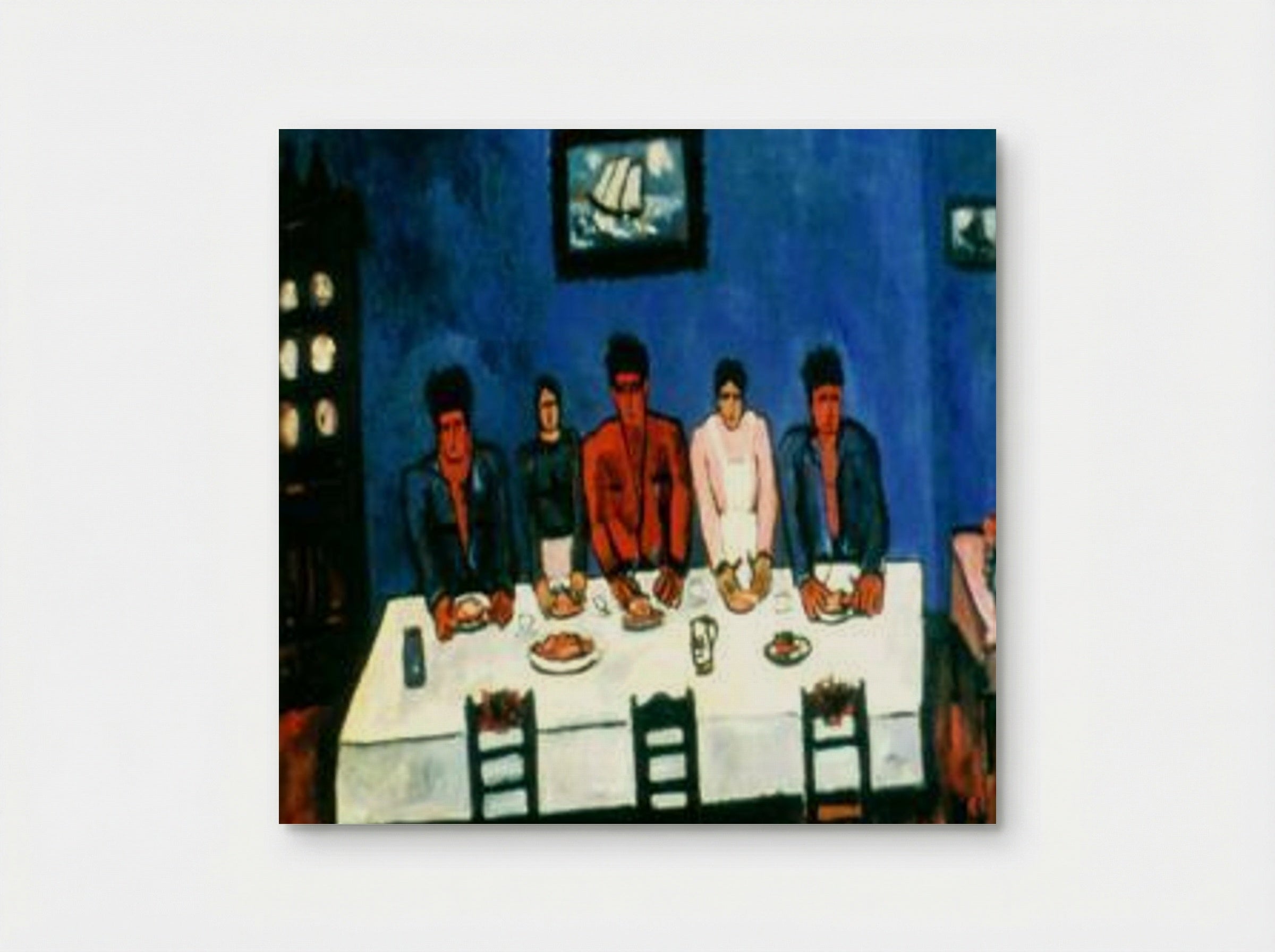
Fisherman's Last Supper - Marsden Hartley
Archival giclée
Frames arrive ready to hang
Secure checkout
Made to order
Description
A somber memorial to a Nova Scotian fishing family, this 1940-1941 painting by Marsden Hartley uses the structure of the Last Supper to honour two brothers lost at sea.
Marsden Hartley painted this work between 1940 and 1941. It is part of a series dedicated to the Mason family, with whom Hartley lived in Blue Rocks, Nova Scotia. The composition references the biblical Last Supper but focuses on a specific tragedy. In 1936, two brothers from the family died at sea during a storm. Hartley uses this religious framework to commemorate their lives. The figures sit behind a long table covered with a white cloth. Hartley employs heavy black outlines to define the forms. The palette is dominated by a deep blue wall. This colour choice creates a somber atmosphere. A small painting of a schooner hangs on the wall behind the group. This detail refers to the maritime life of the subjects. The style is deliberate and blunt. Hartley moved away from his earlier abstract experiments toward a more direct, expressive realism. The hands of the figures are large and simplified. Their expressions are stoic. The arrangement of the chairs in the foreground adds a sense of structure to the lower half of the canvas. This painting is held in the collection of the Northern Illinois University Art Museum. It represents Hartley's late period. During this time, he focused on regional subjects and personal loss. The work avoids sentimentality. Instead, it is a stark image of communal mourning. The flat application of paint and the lack of traditional perspective align with Hartley's interest in folk art traditions.
Return policy
Because every print is made to order, we don't offer change-of-mind returns, refunds or exchanges. If your order arrives faulty, damaged or incorrect, we'll replace it free of charge — just contact us within 48 hours of delivery. See our refunds page for full details.
Shipping
We ship worldwide, printing at the production hub nearest to your delivery address. Delivery times and costs vary by destination — you'll see the options available to you at checkout.
Manufacturing
Each print is produced to order using 12-colour giclée printing on FSC-certified archival paper. Designed in Britain and printed at your nearest production hub to reduce waste and speed up delivery.
Fisherman's Last Supper - Marsden Hartley

Artist Biography
Marsden Hartley
Returning to the United States, Hartley sought to capture the essence of the American landscape and its people. He embraced a more representational style, focusing on the rugged beauty of his native Maine and the working-class communities he encountered. His "Dogtown" series, depicting the desolate landscape of a former settlement, showcases his ability to find beauty in the stark and unforgiving. These works are not mere landscapes; they are meditations on memory, loss, and the enduring power of nature.
Despite facing personal struggles and periods of obscurity, Hartley remained committed to his artistic vision. His willingness to experiment with different styles and subjects, from abstract symbolism to representational landscapes, makes him a truly unique and compelling figure. Marsden Hartley died in 1943, leaving behind a body of work that continues to challenge and inspire, inviting viewers to contemplate the complexities of identity, place, and the human condition.
Our Features
Designed for Lasting Impact
Specific Features
Every Solis piece is made to order with archival, gallery-quality materials built to last.
- Museum-grade giclée printing for rich, fade-resistant colour
- Archival matte fine-art paper, FSC-certified
- Multiple sizes and framing options available
- Frames in black, natural wood, dark wood or white
- Framed prints arrive ready to hang
Care & Cleaning
To keep your artwork looking its best:
- Dust gently with a soft, dry cloth
- Avoid prolonged direct sunlight
- Never use liquid cleaners on the print or canvas surface
- Keep in a dry, room-temperature space
- Handle prints with clean, dry hands
Materials & Sizing
Museum-grade giclée on FSC-certified archival matte paper, with framed and canvas options.
- Paper sizes: A4, A3, A2, A1, A0 and B2 (50×70 cm)
- Canvas: XS (20×30 cm) to Large (60×90 cm)
- Frames: black, natural wood, dark wood or white
Why Choose Us ?
Damage-free delivery guarantee
Fast Shipping
Museum-Quality Materials
Artist Biography
Marsden Hartley
Returning to the United States, Hartley sought to capture the essence of the American landscape and its people. He embraced a more representational style, focusing on the rugged beauty of his native Maine and the working-class communities he encountered. His "Dogtown" series, depicting the desolate landscape of a former settlement, showcases his ability to find beauty in the stark and unforgiving. These works are not mere landscapes; they are meditations on memory, loss, and the enduring power of nature.
Despite facing personal struggles and periods of obscurity, Hartley remained committed to his artistic vision. His willingness to experiment with different styles and subjects, from abstract symbolism to representational landscapes, makes him a truly unique and compelling figure. Marsden Hartley died in 1943, leaving behind a body of work that continues to challenge and inspire, inviting viewers to contemplate the complexities of identity, place, and the human condition.
You May Also Like