

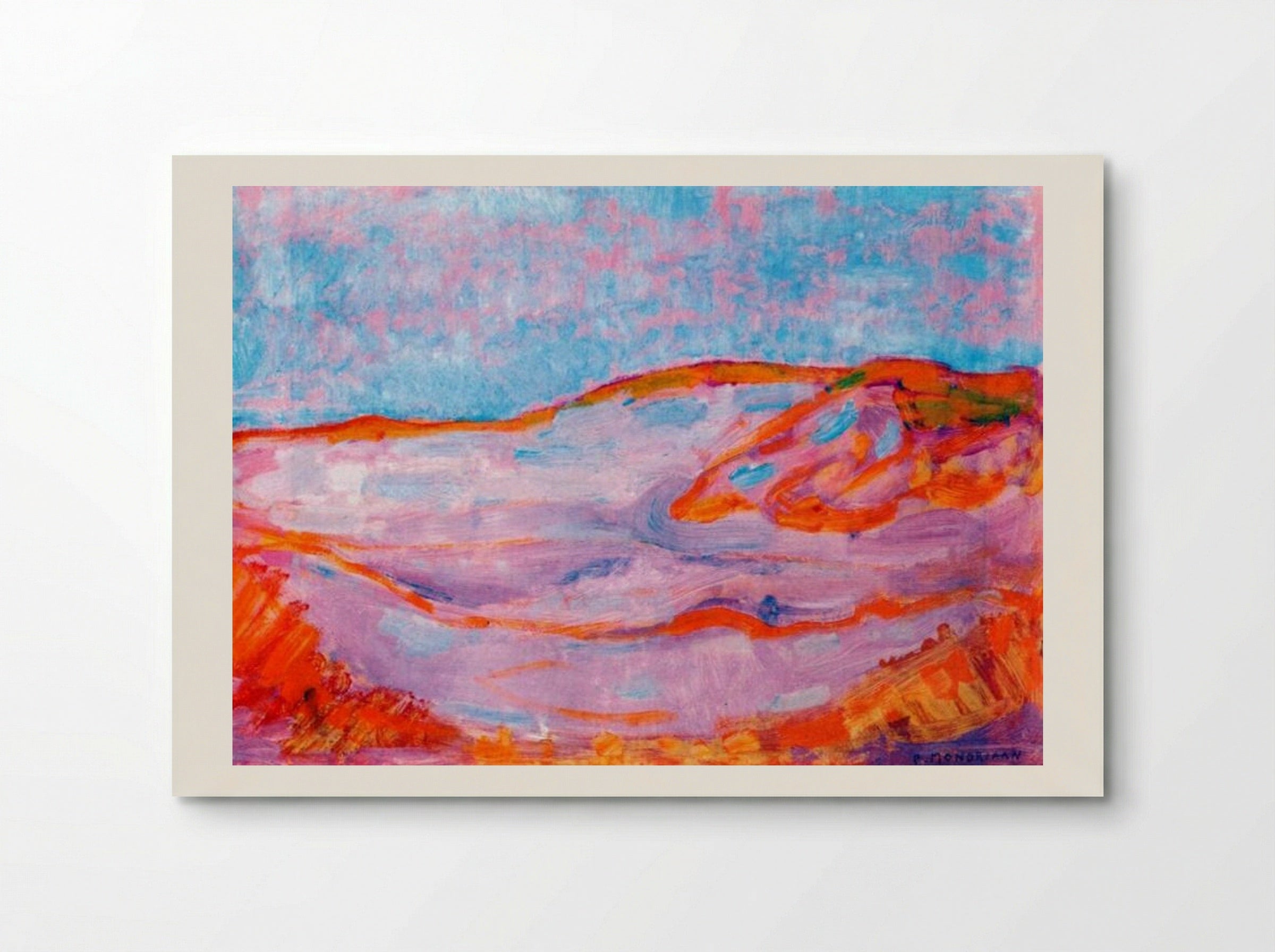
Dune IV - Piet Mondrian
Archival giclée
Frames arrive ready to hang
Secure checkout
Made to order
Description
A 1909 oil painting by Piet Mondrian, depicting the Dutch dunes through expressive, non-naturalistic colour and rhythmic brushwork.
Dune IV, painted by Piet Mondrian in 1909, captures a specific period in the artist's career before his transition into the geometric abstraction for which he is widely recognised. During this time, Mondrian spent summers in the coastal town of Domburg, where he produced a series of studies focusing on the dunes and the sea. This work demonstrates his engagement with the Fauvist and Luminist movements, characterised by a departure from naturalistic colour palettes in favour of expressive, non-representational hues. The composition is dominated by sweeping, rhythmic brushstrokes that define the undulating forms of the sand dunes. Mondrian employs a palette of intense oranges, purples, and blues, which creates a sense of energy rather than a literal depiction of the Dutch coastline. The application of paint is thick and visible, revealing the physical process of the artist's hand. By simplifying the forms into broad areas of colour, Mondrian begins to move away from traditional representation, focusing instead on the structural qualities of the scene. This piece offers a glimpse into the experimental nature of Mondrian's early work. It shows his interest in the relationship between colour and form, a concern that would eventually lead him to the reductionist style of his later years. The painting functions as a study of light and movement, where the subject matter serves as a vehicle for exploring the expressive potential of paint on canvas. The absence of fine detail allows the viewer to focus on the interplay of the warm, fiery tones against the cooler, atmospheric blues of the sky. It is a clear example of the artist's early efforts to synthesise his observations of the natural world with a more subjective, emotional approach to painting.
Return policy
Because every print is made to order, we don't offer change-of-mind returns, refunds or exchanges. If your order arrives faulty, damaged or incorrect, we'll replace it free of charge — just contact us within 48 hours of delivery. See our refunds page for full details.
Shipping
We ship worldwide, printing at the production hub nearest to your delivery address. Delivery times and costs vary by destination — you'll see the options available to you at checkout.
Manufacturing
Each print is produced to order using 12-colour giclée printing on FSC-certified archival paper. Designed in Britain and printed at your nearest production hub to reduce waste and speed up delivery.
Dune IV - Piet Mondrian

Artist Biography
Piet Mondrian
Mondrian's move towards abstraction was gradual but decisive. He was influenced by Cubism after moving to Paris, but he ultimately distilled his art to its most essential elements. This radical simplification led to the birth of De Stijl, a Dutch artistic movement that sought universal harmony through pure abstraction. Mondrian believed that by reducing painting to its fundamental components – line, colour, and form – he could reveal a deeper, more spiritual reality.
Though he lived and worked in Europe for much of his life, Mondrian eventually settled in New York City during World War II. His final paintings, such as "Broadway Boogie Woogie," reflect the vibrant energy of his new urban environment. This iconic work, with its pulsating rhythms and dynamic composition, stands as a testament to Mondrian's enduring quest to capture the essence of modern life through the language of pure abstraction. His legacy continues to inspire artists and designers today.
Our Features
Designed for Lasting Impact
Specific Features
Every Solis piece is made to order with archival, gallery-quality materials built to last.
- Museum-grade giclée printing for rich, fade-resistant colour
- Archival matte fine-art paper, FSC-certified
- Multiple sizes and framing options available
- Frames in black, natural wood, dark wood or white
- Framed prints arrive ready to hang
Care & Cleaning
To keep your artwork looking its best:
- Dust gently with a soft, dry cloth
- Avoid prolonged direct sunlight
- Never use liquid cleaners on the print or canvas surface
- Keep in a dry, room-temperature space
- Handle prints with clean, dry hands
Materials & Sizing
Museum-grade giclée on FSC-certified archival matte paper, with framed and canvas options.
- Paper sizes: A4, A3, A2, A1, A0 and B2 (50×70 cm)
- Canvas: XS (20×30 cm) to Large (60×90 cm)
- Frames: black, natural wood, dark wood or white
Why Choose Us ?
Damage-free delivery guarantee
Fast Shipping
Museum-Quality Materials
Artist Biography
Piet Mondrian
Mondrian's move towards abstraction was gradual but decisive. He was influenced by Cubism after moving to Paris, but he ultimately distilled his art to its most essential elements. This radical simplification led to the birth of De Stijl, a Dutch artistic movement that sought universal harmony through pure abstraction. Mondrian believed that by reducing painting to its fundamental components – line, colour, and form – he could reveal a deeper, more spiritual reality.
Though he lived and worked in Europe for much of his life, Mondrian eventually settled in New York City during World War II. His final paintings, such as "Broadway Boogie Woogie," reflect the vibrant energy of his new urban environment. This iconic work, with its pulsating rhythms and dynamic composition, stands as a testament to Mondrian's enduring quest to capture the essence of modern life through the language of pure abstraction. His legacy continues to inspire artists and designers today.
You May Also Like