

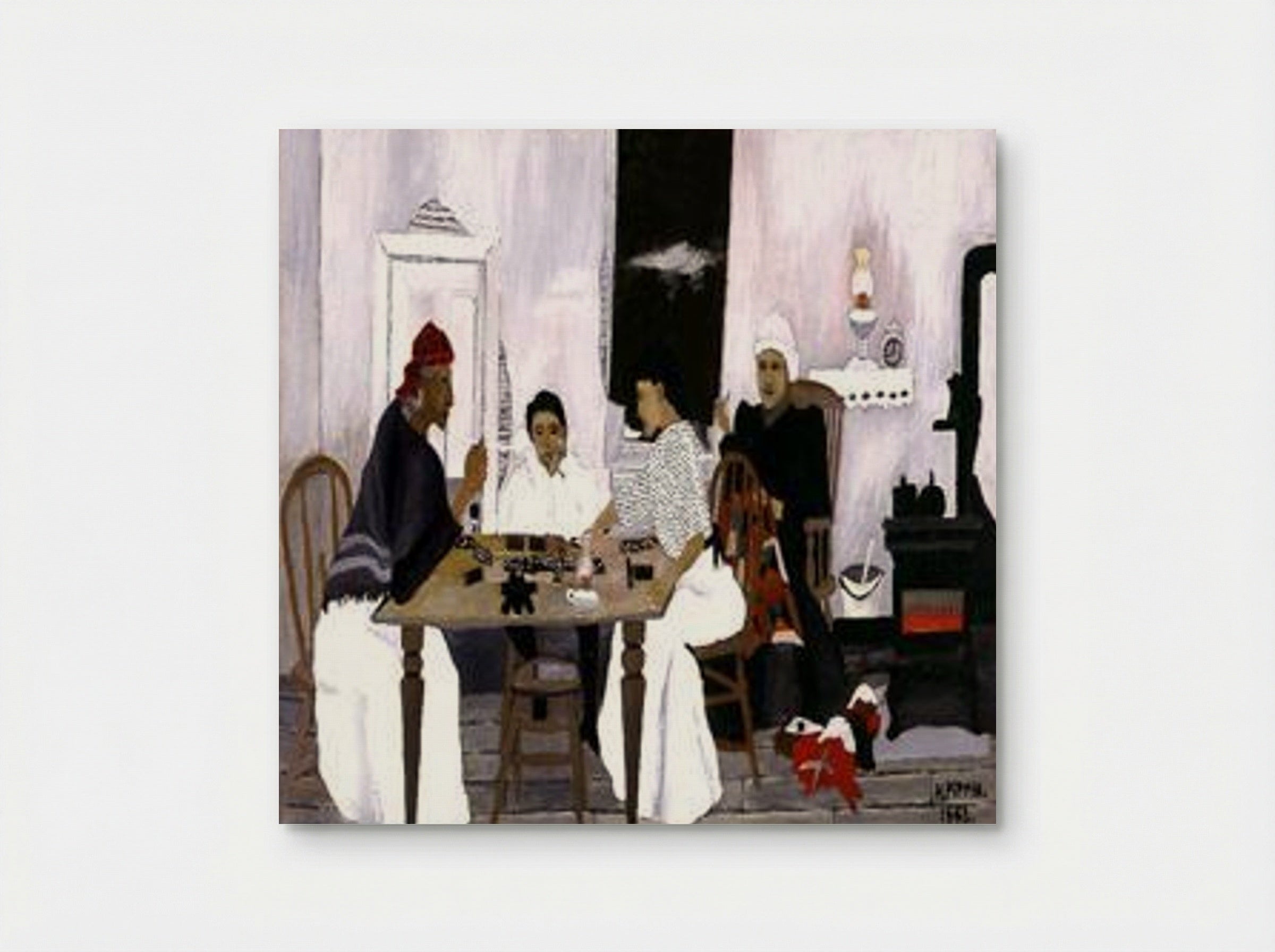
Domino Players - Horace Pippin
Archival giclée
Ready to hang
Secure checkout
Made to order
Description
Horace Pippin's "Domino Players" (1943) depicts a group of figures engrossed in a game of dominoes within a simple, intimate domestic setting. The painting captures a moment of everyday life with sincerity and warmth.
Horace Pippin's "Domino Players", painted in 1943, presents a domestic scene with four figures engaged in a game of dominoes. Pippin, a self-taught artist, often depicted scenes from his life and community, imbuing them with a sense of intimacy and authenticity. The composition is simple yet effective, drawing the viewer into the quiet concentration of the game. The figures are rendered with a directness and honesty, their faces showing the intensity of the moment. Pippin's use of colour is restrained, with muted tones creating a sense of warmth and familiarity. The setting is a modest interior, with a stove, a window, and simple furnishings providing a backdrop to the central activity. The details of the room, such as the patterned wallpaper and the objects on the mantelpiece, add to the sense of lived-in reality. The painting captures a moment of everyday life, elevated by Pippin's artistic vision and his ability to find beauty in the ordinary. "Domino Players" is a window into a specific time and place, offering a glimpse into the social and cultural fabric of African American life in the mid-20th century. Pippin's work is celebrated for its sincerity and its ability to connect with viewers on a human level.
Return policy
Because every print is made to order, we don't offer change-of-mind returns, refunds or exchanges. If your order arrives faulty, damaged or incorrect, we'll replace it free of charge — just contact us within 48 hours of delivery. EU customers have a 14-day cooling-off right. See our refunds page for full details.
Shipping
We ship worldwide, printing at the production hub nearest to your delivery address. Delivery times and costs vary by destination — you'll see the options available to you at checkout.
Manufacturing
Each print is produced to order using 12-colour giclée printing on FSC-certified archival paper. Designed in Britain and printed at your nearest production hub to reduce waste and speed up delivery.
Domino Players - Horace Pippin
Our Features
Designed for Lasting Impact
Specific Features
Every Solis piece is made to order with archival, gallery-quality materials built to last.
- Museum-grade giclée printing for rich, fade-resistant colour
- Archival matte fine-art paper, FSC-certified
- Choose poster, framed print, canvas or framed canvas
- Frames in black, natural wood, dark wood or white
- Framed prints arrive ready to hang
Care & Cleaning
To keep your artwork looking its best:
- Dust gently with a soft, dry cloth
- Avoid prolonged direct sunlight
- Never use liquid cleaners on the print or canvas surface
- Keep in a dry, room-temperature space
- Handle prints with clean, dry hands
Materials & Sizing
Museum-grade giclée on FSC-certified archival matte paper, with framed and canvas options.
- Paper sizes: A4, A3, A2, A1, A0 and B2 (50×70 cm)
- Canvas: XS (20×30 cm) to Large (60×90 cm)
- Frames: black, natural wood, dark wood or white
Why Choose Us ?
100% Satisfaction Guarantee
Fast Shipping
Museum-Quality Materials

Artist Biography
Horace Pippin
He was born in West Chester, Pennsylvania, in 1888; his grandparents had been enslaved. As a boy in Goshen, New York, he won a box of crayons in a competition sponsored by an art supplier. That was the extent of his formal art education. After the war, he settled back in West Chester and began painting in the early 1930s, using his left hand to prop up his injured right arm. He worked on canvas, fabric, and cigar boxes, and burned images into wood panels with a hot poker. He also tried bee sting therapy for his wound, trading fish pepper seeds to his Quaker friend H. Ralph Weaver in exchange for bees.
Pippin produced roughly 140 works over twenty years. His subjects ranged from war memories to biblical scenes, landscapes and domestic interiors. The style was self-taught and non-academic: flat, bold colour within firm outlines, with a structural clarity that recalls American folk art and Edward Hicks's peaceable kingdom paintings. In 1943, the collector Albert C. Barnes and curator Christian Brinton began championing his work, bringing it to major exhibitions in Philadelphia and New York.
He became the first Black artist to be the subject of a published monograph, Selden Rodman's Horace Pippin, A Negro Painter in America (1947). He died in West Chester in 1946, at fifty-eight. The New York Times called him the most important Black painter in American history.
You May Also Like