

Fine Art Poster
From £28
A giclée print on 200gsm matte fine art paper, using a twelve-colour process for accurate, fade-resistant colour. Supplied unframed, delivered flat or rolled.



Archival giclée
Frames arrive ready to hang
Secure checkout
Made to order
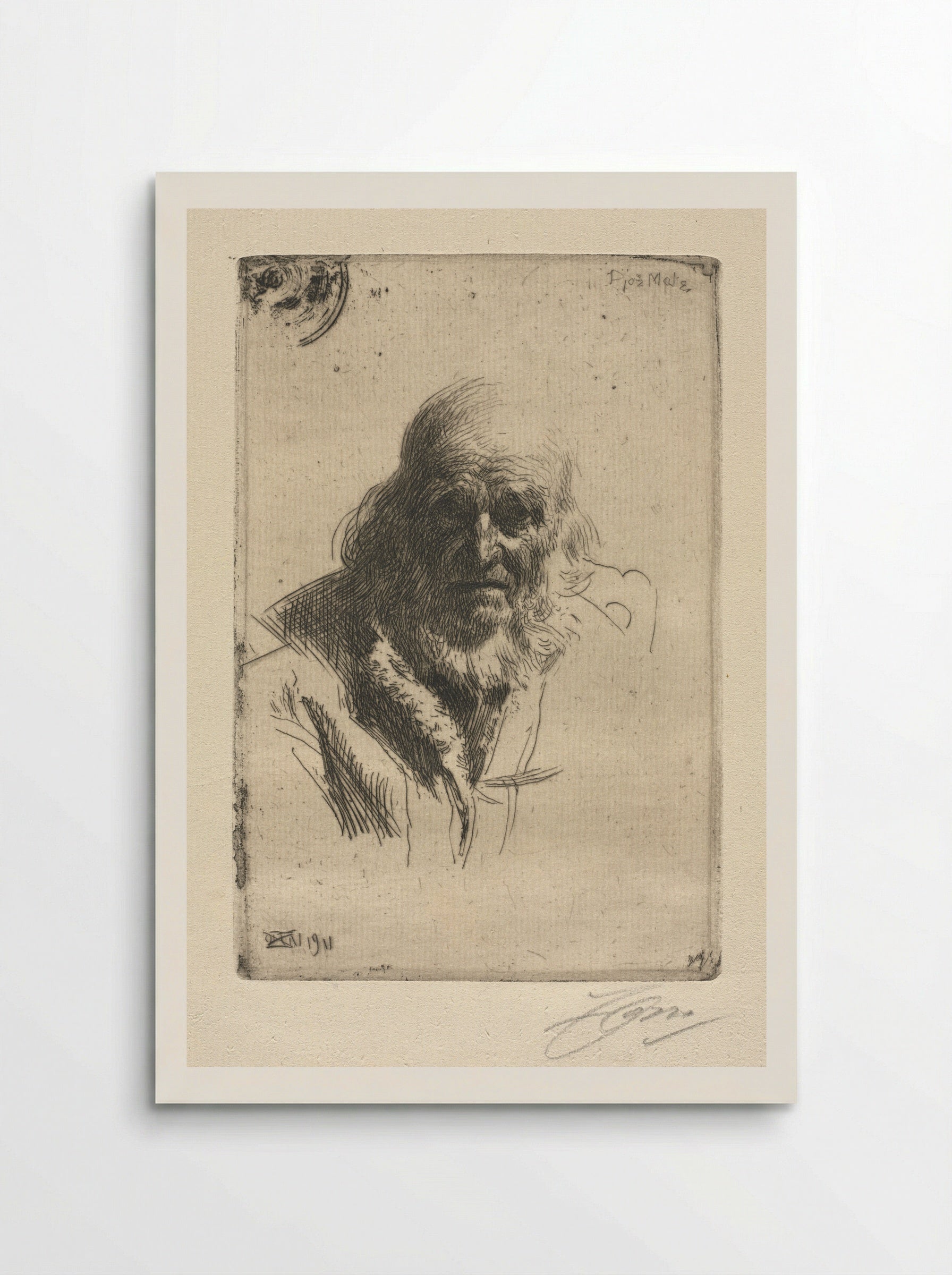
A striking 1911 etching by Anders Zorn, capturing the weathered features of Djos Mats with masterful, expressive line work.
Anders Zorn, a Swedish artist of international standing, produced this etching in 1911. The subject, Djos Mats, is a local figure from Zorn's home region of Dalarna. Zorn frequently returned to his roots in Mora, documenting the faces and lives of the rural population with a direct, unvarnished approach. This print captures the weathered features of an elderly man, rendered through Zorn's characteristic economy of line. Zorn was a master of the etching medium, often using rapid, confident strokes to define form and shadow. In this portrait, the heavy cross-hatching around the eyes and brow creates a sense of depth and gravity. The light source appears to come from above, casting the upper portion of the face into shadow while leaving the lower features more defined. The artist's signature is visible in the lower right, alongside the date 1911 in the lower left corner. The plate mark remains visible, providing a tactile quality to the print that reflects the physical process of intaglio printing. Unlike the polished, academic portraits of his contemporaries, Zorn’s work here focuses on the texture of age and the character of the individual. The background is kept minimal, ensuring the viewer's attention remains fixed on the subject's expression. This work demonstrates Zorn's ability to convey personality through a limited palette of black ink on paper. It is a fine example of his late-career graphic output, where his technical skill allowed for a spontaneous, almost sketch-like quality that retains a high degree of anatomical accuracy. The print offers a glimpse into the social fabric of early twentieth-century Sweden, documenting a specific individual with both empathy and technical precision.
Because every print is made to order, we don't offer change-of-mind returns, refunds or exchanges. If your order arrives faulty, damaged or incorrect, we'll replace it free of charge — just contact us within 48 hours of delivery. See our refunds page for full details.
We ship worldwide, printing at the production hub nearest to your delivery address. Delivery times and costs vary by destination — you'll see the options available to you at checkout.
Each print is produced to order using 12-colour giclée printing on FSC-certified archival paper. Designed in Britain and printed at your nearest production hub to reduce waste and speed up delivery.

Artist Biography
Our Features
Designed for Lasting Impact
Every Solis piece is made to order with archival, gallery-quality materials built to last.
To keep your artwork looking its best:
Museum-grade giclée on FSC-certified archival matte paper, with framed and canvas options.
Made to order
Every piece is printed to order. These are the five finishes, and what makes each one different.
From £28
A giclée print on 200gsm matte fine art paper, using a twelve-colour process for accurate, fade-resistant colour. Supplied unframed, delivered flat or rolled.

From £45
The same fine art print in a solid wood frame with UV-protective acrylic glaze and rigid backing. Five frame colours. Arrives ready to hang.

From £85
A deeper solid wood frame: 33mm deep with a 20mm face and Perspex glaze. The print sits unmounted for a clean gallery presentation. Black, white or natural.

From £30
Hand-stretched canvas with neat gallery-wrapped edges, giving the artwork surface texture and depth. Arrives ready to hang.

From £135
Stretched canvas set in a floating wood frame, our most substantial finish. Arrives ready to hang.
Why Choose Us ?
Damage-free delivery guarantee
Fast Shipping
Museum-Quality Materials
Artist Biography
Anders Zorn
You May Also Like
We use cookies to measure our marketing and see which prints people love.We use cookies to measure our marketing.
By continuing to browse, you agree · Privacy Policy