

Fine Art Poster
From £28
A giclée print on 200gsm matte fine art paper, using a twelve-colour process for accurate, fade-resistant colour. Supplied unframed, delivered flat or rolled.



Archival giclée
Frames arrive ready to hang
Secure checkout
Made to order
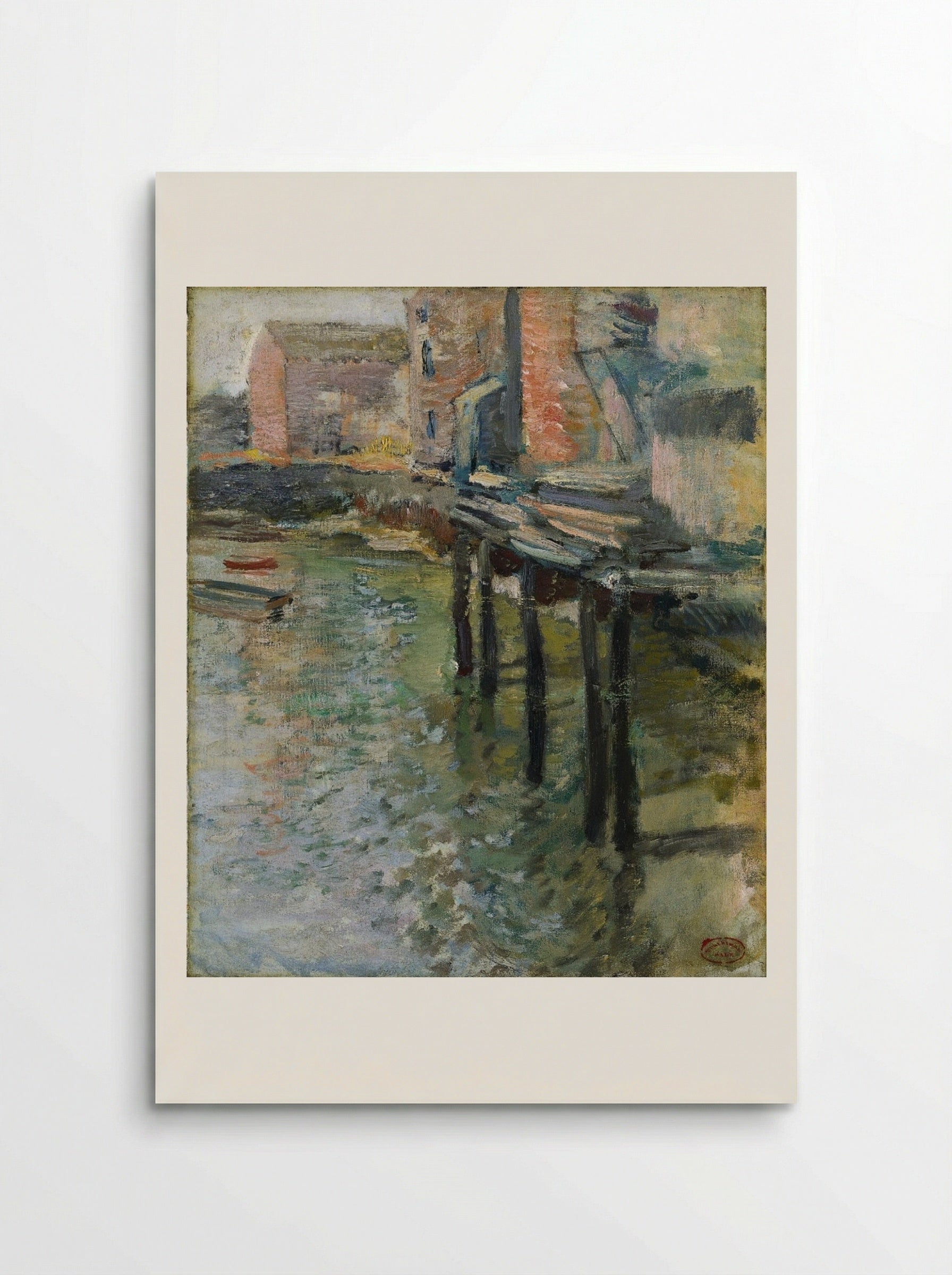
A contemplative study of the old mill at Cos Cob, capturing the quiet atmosphere of the New England coast through muted tones and textured brushwork.
John Henry Twachtman was a central figure in the development of American Impressionism. This work depicts the old mill at Cos Cob, Connecticut, a location that became a primary subject for the artist during the final decade of his life. Twachtman moved to the area in 1889, finding the quiet, tidal waters and weathered structures of the Mianus River to be ideal subjects for his experiments with light and atmosphere. The composition focuses on the interplay between the structural rigidity of the wooden wharf and the fluid, shifting surface of the water. Twachtman employs a muted palette, favouring soft greys, greens, and earthy tones to capture the overcast conditions typical of the New England coast. His brushwork is deliberate, creating a textured surface that suggests the decay of the wooden pilings and the gentle ripples on the water. Unlike the high-chroma works of his French contemporaries, Twachtman’s approach here is restrained and contemplative. The painting reflects the artist's interest in tonalism, where the mood of the scene takes precedence over precise topographical detail. The wharf acts as a vertical anchor, drawing the eye across the frame, while the reflections in the water dissolve the distinction between the solid architecture and the environment. This piece captures the quietude of a site that had transitioned from a busy industrial hub to a place of stillness. By focusing on the mundane aspects of the wharf, Twachtman elevates the scene through his sensitive handling of paint and light, demonstrating his ability to find beauty in the overlooked corners of the American countryside.
Because every print is made to order, we don't offer change-of-mind returns, refunds or exchanges. If your order arrives faulty, damaged or incorrect, we'll replace it free of charge — just contact us within 48 hours of delivery. See our refunds page for full details.
We ship worldwide, printing at the production hub nearest to your delivery address. Delivery times and costs vary by destination — you'll see the options available to you at checkout.
Each print is produced to order using 12-colour giclée printing on FSC-certified archival paper. Designed in Britain and printed at your nearest production hub to reduce waste and speed up delivery.

Artist Biography
Our Features
Designed for Lasting Impact
Every Solis piece is made to order with archival, gallery-quality materials built to last.
To keep your artwork looking its best:
Museum-grade giclée on FSC-certified archival matte paper, with framed and canvas options.
Made to order
Every piece is printed to order. These are the five finishes, and what makes each one different.
From £28
A giclée print on 200gsm matte fine art paper, using a twelve-colour process for accurate, fade-resistant colour. Supplied unframed, delivered flat or rolled.

From £45
The same fine art print in a solid wood frame with UV-protective acrylic glaze and rigid backing. Five frame colours. Arrives ready to hang.

From £85
A deeper solid wood frame: 33mm deep with a 20mm face and Perspex glaze. The print sits unmounted for a clean gallery presentation. Black, white or natural.

From £30
Hand-stretched canvas with neat gallery-wrapped edges, giving the artwork surface texture and depth. Arrives ready to hang.

From £135
Stretched canvas set in a floating wood frame, our most substantial finish. Arrives ready to hang.
Why Choose Us ?
Damage-free delivery guarantee
Fast Shipping
Museum-Quality Materials
Artist Biography
John Henry Twachtman
You May Also Like
Cookies show us which prints people love, so we hang the right art. Help us fill it?
Essential cookies only if you prefer · Privacy Policy