

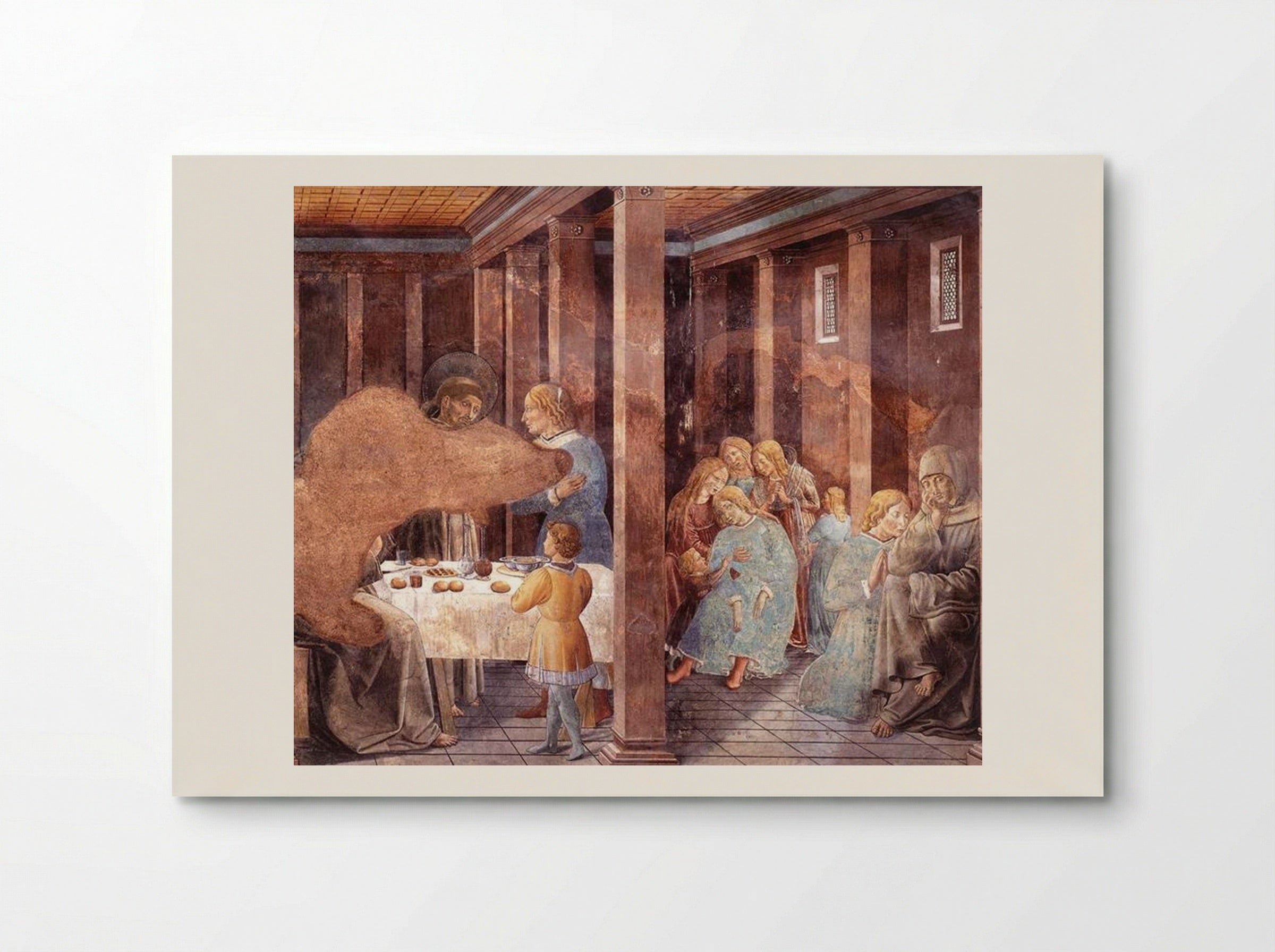
Death of the Knight of Celano - Benozzo Gozzoli
Archival giclée
Frames arrive ready to hang
Secure checkout
Made to order
Description
This fresco by Benozzo Gozzoli depicts the 'Death of the Knight of Celano', a scene from the life of St. Francis of Assisi. The composition, divided into two groups, showcases the artist's Early Renaissance style and muted colour palette.
Benozzo Gozzoli's fresco, 'Death of the Knight of Celano', is a work from the Early Renaissance, painted in the mid-15th century. Gozzoli, an Italian painter, was a student of Fra Angelico and is known for his decorative fresco cycles, particularly those in the Medici Chapel in Florence. This fresco is part of a series depicting the life of St. Francis of Assisi. The scene illustrates a story from the saint's life, where St. Francis witnesses the death of a knight who, according to legend, was condemned to hell but was saved by the saint's prayers. The composition is divided into two distinct groups within an architectural setting. On the left, St. Francis is depicted at a table, seemingly interceding for the dying knight. To the right, a group of mourners surrounds the knight's body. The figures are rendered with a degree of naturalism, typical of the Early Renaissance, with attention paid to their expressions and gestures. The colour palette is muted, dominated by earth tones and softened blues, which contribute to the solemn atmosphere of the scene. The architectural setting, with its columns and arches, provides a structured backdrop for the narrative.
Return policy
Because every print is made to order, we don't offer change-of-mind returns, refunds or exchanges. If your order arrives faulty, damaged or incorrect, we'll replace it free of charge — just contact us within 48 hours of delivery. See our refunds page for full details.
Shipping
We ship worldwide, printing at the production hub nearest to your delivery address. Delivery times and costs vary by destination — you'll see the options available to you at checkout.
Manufacturing
Each print is produced to order using 12-colour giclée printing on FSC-certified archival paper. Designed in Britain and printed at your nearest production hub to reduce waste and speed up delivery.
Death of the Knight of Celano - Benozzo Gozzoli

Artist Biography
Benozzo Gozzoli
Gozzoli trained first as a goldsmith's apprentice under Lorenzo Ghiberti, whose Gates of Paradise doors for the Baptistery shaped his love of dense narrative and decorative precision. He then worked as an assistant to Fra Angelico, absorbing Renaissance spatial conventions without Fra Angelico's devotional gravity. Scholars have been blunt about his limitations: Ernst Gombrich called him a 'minor master' who applied new perspective methods 'gaily without worrying overmuch about their difficulty.' The Procession's rocky landscape still rises flat from bottom to top, indebted more to Ghiberti's bas-relief language than to Masaccio's pictorial space.
None of that troubled his patrons. The subject of the Magi was popular among wealthy Florentines precisely because it licensed the painting of costly brocades, gleaming gold, and thoroughbred horses in quantities that declared the patron's status. The Medici chapel, small enough that access felt like a privilege, was used for family mass and for receiving visiting ambassadors. The procession of kings served as a perfect backdrop for those audiences.
Gozzoli went on to paint extensive fresco cycles at Montefalco (1452, the life of St Francis) and at the Campo Santo in Pisa (from 1469, Old Testament narratives covering thousands of square feet). Neither matches the Medici chapel for concentrated ambition, but both confirm his command of large-scale narrative pageantry. He died at Pistoia in 1497, working almost to the end.
Our Features
Designed for Lasting Impact
Specific Features
Every Solis piece is made to order with archival, gallery-quality materials built to last.
- Museum-grade giclée printing for rich, fade-resistant colour
- Archival matte fine-art paper, FSC-certified
- Multiple sizes and framing options available
- Frames in black, natural wood, dark wood or white
- Framed prints arrive ready to hang
Care & Cleaning
To keep your artwork looking its best:
- Dust gently with a soft, dry cloth
- Avoid prolonged direct sunlight
- Never use liquid cleaners on the print or canvas surface
- Keep in a dry, room-temperature space
- Handle prints with clean, dry hands
Materials & Sizing
Museum-grade giclée on FSC-certified archival matte paper, with framed and canvas options.
- Paper sizes: A4, A3, A2, A1, A0 and B2 (50×70 cm)
- Canvas: XS (20×30 cm) to Large (60×90 cm)
- Frames: black, natural wood, dark wood or white
Why Choose Us ?
Damage-free delivery guarantee
Fast Shipping
Museum-Quality Materials
Artist Biography
Benozzo Gozzoli
Gozzoli trained first as a goldsmith's apprentice under Lorenzo Ghiberti, whose Gates of Paradise doors for the Baptistery shaped his love of dense narrative and decorative precision. He then worked as an assistant to Fra Angelico, absorbing Renaissance spatial conventions without Fra Angelico's devotional gravity. Scholars have been blunt about his limitations: Ernst Gombrich called him a 'minor master' who applied new perspective methods 'gaily without worrying overmuch about their difficulty.' The Procession's rocky landscape still rises flat from bottom to top, indebted more to Ghiberti's bas-relief language than to Masaccio's pictorial space.
None of that troubled his patrons. The subject of the Magi was popular among wealthy Florentines precisely because it licensed the painting of costly brocades, gleaming gold, and thoroughbred horses in quantities that declared the patron's status. The Medici chapel, small enough that access felt like a privilege, was used for family mass and for receiving visiting ambassadors. The procession of kings served as a perfect backdrop for those audiences.
Gozzoli went on to paint extensive fresco cycles at Montefalco (1452, the life of St Francis) and at the Campo Santo in Pisa (from 1469, Old Testament narratives covering thousands of square feet). Neither matches the Medici chapel for concentrated ambition, but both confirm his command of large-scale narrative pageantry. He died at Pistoia in 1497, working almost to the end.
You May Also Like