

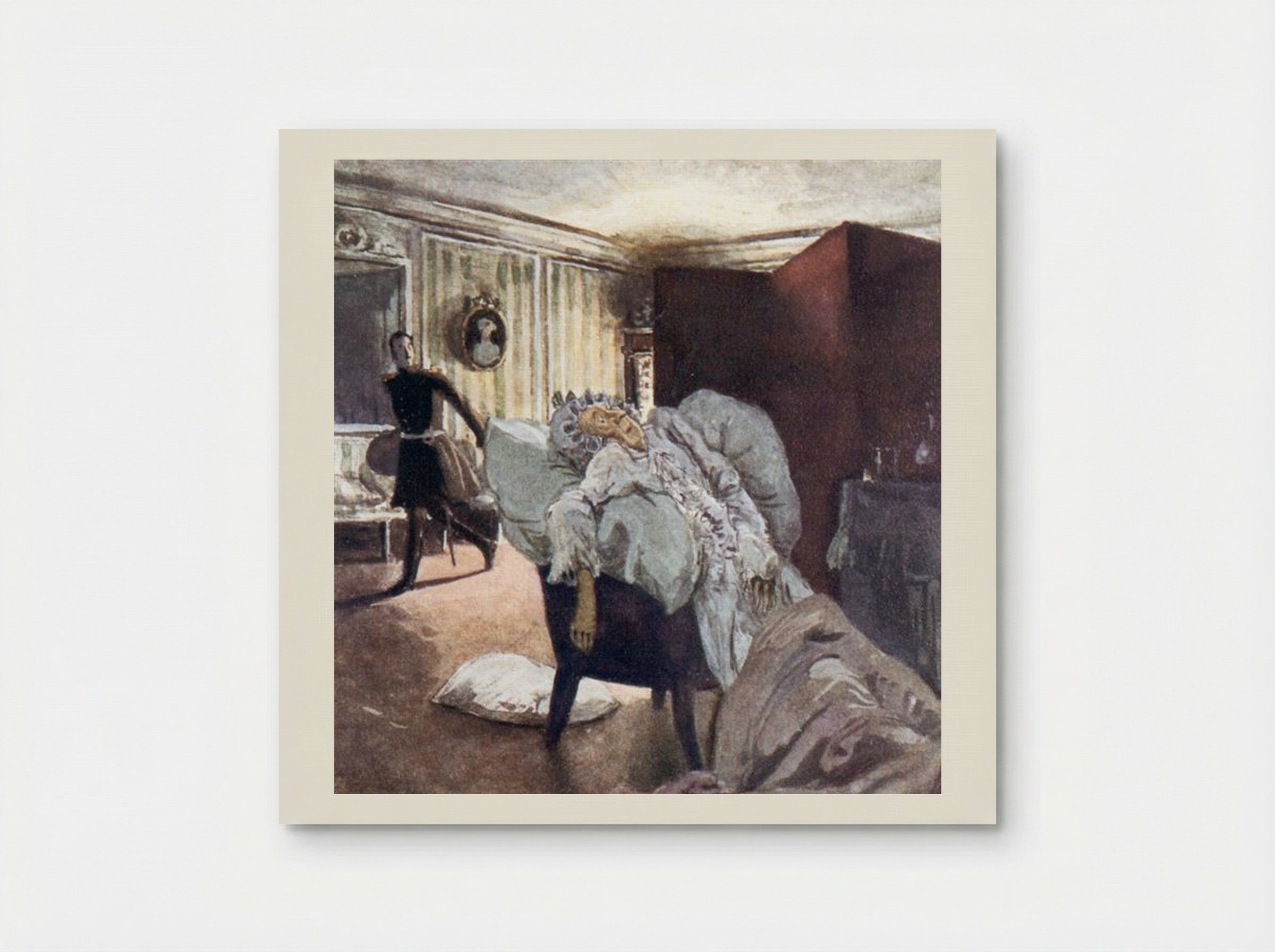
Death of the Countess - Alexandre Benois
Archival giclée
Frames arrive ready to hang
Secure checkout
Made to order
Description
A watercolour and gouache work by Alexandre Benois titled 'Death of the Countess', depicting a man in military uniform standing over a deceased woman in a chair.
Alexandre Benois (1870-1960) was a Russian artist, art critic, historian, and stage designer who played a significant role in the Ballets Russes. He was a founding member of the Mir iskusstva (World of Art) movement, which sought to promote aestheticism and integrate art into all aspects of life. Benois was influenced by French Rococo art and the Italian Renaissance. He is known for his historical paintings, book illustrations, and theatre designs. 'Death of the Countess' depicts a scene with a man in military uniform standing over a deceased woman in a chair. The setting is an interior room with striped wallpaper and sparse furnishings. The colour palette is muted, dominated by greys, browns, and creams. The composition is somewhat theatrical, with the figures arranged to convey a sense of drama and finality. The work is executed in watercolour and gouache, giving it a soft, textured appearance.
Return policy
Because every print is made to order, we don't offer change-of-mind returns, refunds or exchanges. If your order arrives faulty, damaged or incorrect, we'll replace it free of charge — just contact us within 48 hours of delivery. See our refunds page for full details.
Shipping
We ship worldwide, printing at the production hub nearest to your delivery address. Delivery times and costs vary by destination — you'll see the options available to you at checkout.
Manufacturing
Each print is produced to order using 12-colour giclée printing on FSC-certified archival paper. Designed in Britain and printed at your nearest production hub to reduce waste and speed up delivery.
Care and materials
Specific Features
Every Solis piece is made to order with archival, gallery-quality materials built to last.
- Museum-grade giclée printing for rich, fade-resistant colour
- Archival matte fine-art paper, FSC-certified
- Multiple sizes and framing options available
- Frames in black, natural wood, dark wood or white
- Framed prints arrive ready to hang
Care & Cleaning
To keep your artwork looking its best:
- Dust gently with a soft, dry cloth
- Avoid prolonged direct sunlight
- Never use liquid cleaners on the print or canvas surface
- Keep in a dry, room-temperature space
- Handle prints with clean, dry hands
Materials & Sizing
Museum-grade giclée on FSC-certified archival matte paper, with framed and canvas options.
- Paper sizes: A4, A3, A2, A1, A0 and B2 (50×70 cm)
- Canvas: XS (20×30 cm) to Large (60×90 cm)
- Frames: black, natural wood, dark wood or white
Death of the Countess - Alexandre Benois
Artist Biography
Alexandre Benois
Born in 1870 in St Petersburg into a family of architects and artists, Benois was largely self-taught after a brief, dissatisfying spell as an unregistered student at the Academy of Arts. He studied law at university and educated himself through trips to Italy, Spain, and France. By the 1890s he was Russia's pre-eminent art critic, and in 1898 he co-founded the journal Mir iskusstva (World of Art) with Sergei Diaghilev, backed by Princess Tenisheva and the industrialist Savva Mamontov. The journal opposed the didactic social realism of the Peredvizhniki and insisted that Russian art engage seriously with European modernism.
As a painter, Benois worked primarily in watercolour and gouache until 1905. His Russian history series of 1907-10, commissioned by publisher Iosif Knoebel, depicted Petrine and Catherinian court life with careful archival precision; his three editions of illustrations for Pushkin's Bronze Horseman (1903, 1905, 1916-22) remain defining images of the poem. Theatre absorbed him most fully. He wrote the libretto for Stravinsky's Petrouchka (1911), designed the first Ballets Russes Paris season, and headed the Moscow Arts Theatre's art production section from 1913 to 1915.
From 1918 to 1926 he directed the Picture Gallery at the Hermitage, a formidable institutional role through years of revolutionary upheaval. He left Russia permanently in 1926, settling in Paris the following year, and spent his final decades producing more than sixty theatre and opera productions across La Scala, the Paris Opéra, and major houses in London and New York. He died in Paris in February 1960.
Why Choose Us ?
Damage-free delivery guarantee
Fast Shipping
Museum-Quality Materials
You May Also Like