

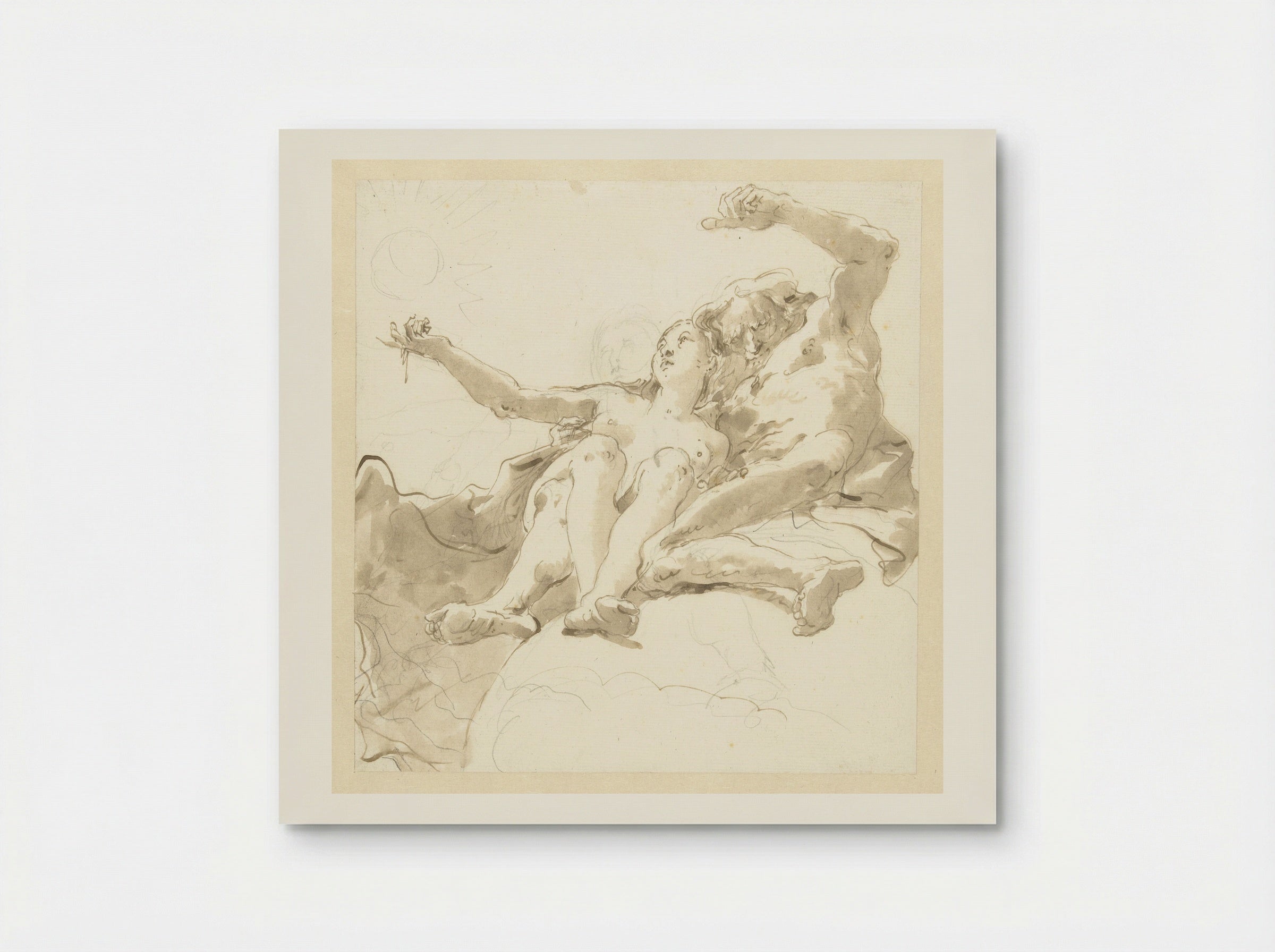
De Waarheid en de Tijd - Giovanni Battista Tiepolo
Archival giclée
Frames arrive ready to hang
Secure checkout
Made to order
Description
A pen and ink wash drawing by Giovanni Battista Tiepolo, 'De Waarheid en de Tijd' depicts allegorical figures of Truth and Time in dynamic poses, showcasing the artist's mastery of line and shading.
This drawing by Giovanni Battista Tiepolo depicts two allegorical figures, Truth and Time. Executed in pen and brown ink with wash on paper, the artwork displays Tiepolo's mastery of line and shading to create a sense of depth and movement. The composition features a nude female figure, representing Truth, being carried or revealed by an older, winged male figure, symbolising Time. The figures are set against a lightly sketched background, with a radiant sun or halo above Truth's head. Tiepolo, a Venetian painter and printmaker, was one of the most important artists of the 18th century. He is celebrated for his decorative ceiling paintings and large-scale historical works. This drawing exemplifies his skill in capturing dynamic poses and dramatic lighting effects, characteristic of the Rococo period. The use of brown ink and wash allows for subtle gradations of tone, enhancing the three-dimensionality of the figures. The subject matter, dealing with abstract concepts, was common in allegorical art of the time, reflecting the intellectual interests of the era.
Return policy
Because every print is made to order, we don't offer change-of-mind returns, refunds or exchanges. If your order arrives faulty, damaged or incorrect, we'll replace it free of charge — just contact us within 48 hours of delivery. See our refunds page for full details.
Shipping
We ship worldwide, printing at the production hub nearest to your delivery address. Delivery times and costs vary by destination — you'll see the options available to you at checkout.
Manufacturing
Each print is produced to order using 12-colour giclée printing on FSC-certified archival paper. Designed in Britain and printed at your nearest production hub to reduce waste and speed up delivery.
Care and materials
Specific Features
Every Solis piece is made to order with archival, gallery-quality materials built to last.
- Museum-grade giclée printing for rich, fade-resistant colour
- Archival matte fine-art paper, FSC-certified
- Multiple sizes and framing options available
- Frames in black, natural wood, dark wood or white
- Framed prints arrive ready to hang
Care & Cleaning
To keep your artwork looking its best:
- Dust gently with a soft, dry cloth
- Avoid prolonged direct sunlight
- Never use liquid cleaners on the print or canvas surface
- Keep in a dry, room-temperature space
- Handle prints with clean, dry hands
Materials & Sizing
Museum-grade giclée on FSC-certified archival matte paper, with framed and canvas options.
- Paper sizes: A4, A3, A2, A1, A0 and B2 (50×70 cm)
- Canvas: XS (20×30 cm) to Large (60×90 cm)
- Frames: black, natural wood, dark wood or white
De Waarheid en de Tijd - Giovanni Battista Tiepolo

Artist Biography
Giovanni Battista Tiepolo
He was born in Venice in 1696, the youngest of six children. His father died about a year later, leaving his mother to raise the family in difficult circumstances. At fourteen he was apprenticed to Gregorio Lazzarini, a painter of eclectic style. His early work was dark and heavy, but after his marriage to Maria Cecilia Guardi in 1719, his palette brightened and his touch became lighter and more fluid. The transformation was radical: the sombre young painter became the most luminous colourist of the eighteenth century.
His ceiling fresco at the Wurzburg Residence (1750 to 1753), painted for the Prince-Bishop, is the largest fresco in the world and the supreme achievement of Baroque illusionistic decoration. He travelled there with his sons Domenico and Lorenzo, who served as assistants throughout his career. Tiepolo and his wife had nine children in total; four daughters and three sons survived to adulthood.
In 1755 he was elected Director of the Accademia in Venice. In 1762 he moved with his sons to Madrid at the invitation of Charles III of Spain to decorate the Royal Palace. The Spanish court favoured the cooler Neoclassicism of Anton Raphael Mengs, and Tiepolo found himself outmanoeuvred. He died in Madrid in 1770, at seventy-four, his Rococo exuberance already passing out of fashion.
Why Choose Us ?
Damage-free delivery guarantee
Fast Shipping
Museum-Quality Materials
You May Also Like