

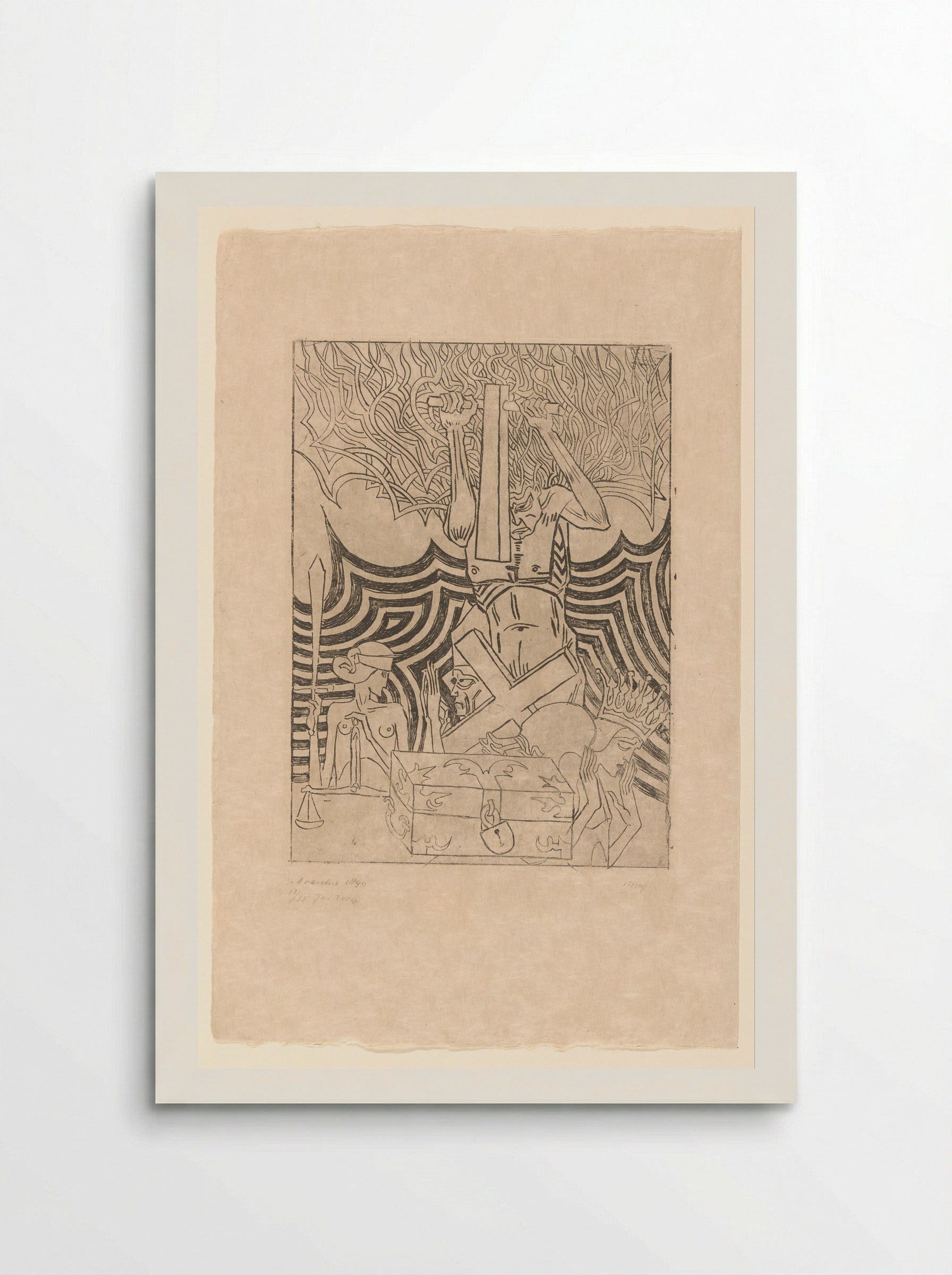
De Anarchie - Jan Toorop
Archival giclée
Frames arrive ready to hang
Secure checkout
Made to order
Description
A striking Symbolist etching by Jan Toorop, exploring themes of social disorder through rhythmic lines and allegorical figures.
Jan Toorop, a central figure in Dutch Symbolism, produced this etching in 1890. The work reflects the anxieties of the late nineteenth century, employing a visual language that blends allegory with a distinct, linear aesthetic. The composition features a central, towering figure holding a beam, surrounded by symbolic elements that suggest a collapse of social and moral order. To the left, a figure holding a sword and scales represents a distorted or failing justice, while a crowned figure on the right appears in a state of mourning or resignation. A locked chest sits in the foreground, acting as a barrier between the viewer and the chaotic scene behind it. Toorop uses a highly stylised approach to form. The background is composed of undulating, rhythmic lines that create a sense of agitation and instability. These patterns, which echo the influence of Javanese shadow puppetry (wayang kulit) on the artist, flatten the pictorial space and push the figures into a shallow, stage-like arrangement. The lines are precise and deliberate, characteristic of Toorop's graphic work during this period. The imagery avoids literal representation, opting instead for a dreamlike, unsettling atmosphere that invites interpretation rather than providing a clear narrative. The etching captures the tension between traditional authority and the encroaching forces of social upheaval, a common theme in European art at the turn of the century. This print demonstrates the artist's ability to translate complex philosophical and political ideas into a cohesive, graphic format that relies on the power of line and symbolic juxtaposition.
Return policy
Because every print is made to order, we don't offer change-of-mind returns, refunds or exchanges. If your order arrives faulty, damaged or incorrect, we'll replace it free of charge — just contact us within 48 hours of delivery. See our refunds page for full details.
Shipping
We ship worldwide, printing at the production hub nearest to your delivery address. Delivery times and costs vary by destination — you'll see the options available to you at checkout.
Manufacturing
Each print is produced to order using 12-colour giclée printing on FSC-certified archival paper. Designed in Britain and printed at your nearest production hub to reduce waste and speed up delivery.
Care and materials
Specific Features
Every Solis piece is made to order with archival, gallery-quality materials built to last.
- Museum-grade giclée printing for rich, fade-resistant colour
- Archival matte fine-art paper, FSC-certified
- Multiple sizes and framing options available
- Frames in black, natural wood, dark wood or white
- Framed prints arrive ready to hang
Care & Cleaning
To keep your artwork looking its best:
- Dust gently with a soft, dry cloth
- Avoid prolonged direct sunlight
- Never use liquid cleaners on the print or canvas surface
- Keep in a dry, room-temperature space
- Handle prints with clean, dry hands
Materials & Sizing
Museum-grade giclée on FSC-certified archival matte paper, with framed and canvas options.
- Paper sizes: A4, A3, A2, A1, A0 and B2 (50×70 cm)
- Canvas: XS (20×30 cm) to Large (60×90 cm)
- Frames: black, natural wood, dark wood or white
De Anarchie - Jan Toorop

Artist Biography
Jan Toorop
Toorop's willingness to experiment extended beyond style to subject matter. He captured not only ethereal visions but also the realities of working-class life, as seen in his depictions of labourers in the docks of Rotterdam. This social consciousness, combined with his stylistic versatility, made him a key figure in the development of modern Dutch art. He was a vital link between the Hague School and later movements.
Despite his significance, Toorop remains somewhat under-appreciated outside the Netherlands. His impact on artists such as Gustav Klimt is well-documented, and his synthesis of Eastern and Western influences feels remarkably contemporary. Owning a Jan Toorop print is not just acquiring a beautiful image; it's possessing a piece of art history, a testament to the power of cross-cultural dialogue and artistic innovation.
Why Choose Us ?
Damage-free delivery guarantee
Fast Shipping
Museum-Quality Materials
You May Also Like