

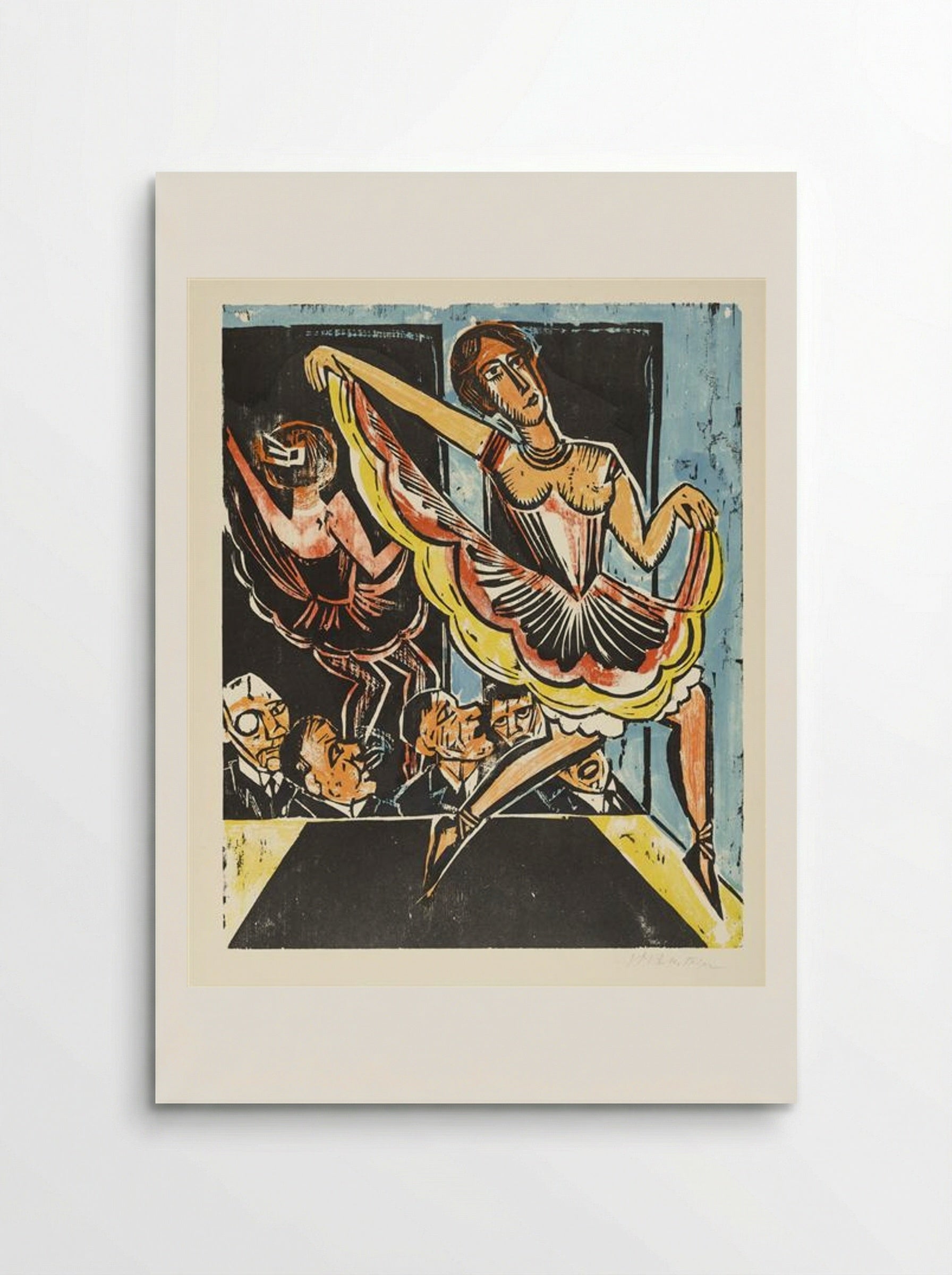
Dancer in the Mirror - Max Pechstein
Archival giclée
Ready to hang
Secure checkout
Made to order
Description
A woodcut by German Expressionist Max Pechstein, 'Dancer in the Mirror' depicts a dancer on stage, observed by a row of men. The print features bold lines and contrasting colours typical of the Expressionist movement.
Max Pechstein (1881-1955) was a German Expressionist painter and printmaker. He was a member of the art groups Die Brücke and Novembergruppe. Pechstein was known for his bold colours and simplified forms, often depicting scenes of modern life and the human figure. His work was condemned by the Nazis as degenerate art, and he was forbidden to paint during that period. 'Dancer in the Mirror' exemplifies Pechstein's Expressionist style. The woodcut depicts a dancer on stage, with her reflection visible in a mirror behind her. Below, a row of men in suits observe the performance. The composition is striking, with strong lines and contrasting colours. The dancer's pose is dynamic, and the faces of the audience are rendered with a sense of caricature. The print's bold use of black, red, yellow, and blue is typical of Expressionist printmaking.
Return policy
Because every print is made to order, we don't offer change-of-mind returns, refunds or exchanges. If your order arrives faulty, damaged or incorrect, we'll replace it free of charge — just contact us within 48 hours of delivery. EU customers have a 14-day cooling-off right. See our refunds page for full details.
Shipping
We ship worldwide, printing at the production hub nearest to your delivery address. Delivery times and costs vary by destination — you'll see the options available to you at checkout.
Manufacturing
Each print is produced to order using 12-colour giclée printing on FSC-certified archival paper. Designed in Britain and printed at your nearest production hub to reduce waste and speed up delivery.
Dancer in the Mirror - Max Pechstein
Our Features
Designed for Lasting Impact
Specific Features
Every Solis piece is made to order with archival, gallery-quality materials built to last.
- Museum-grade giclée printing for rich, fade-resistant colour
- Archival matte fine-art paper, FSC-certified
- Choose poster, framed print, canvas or framed canvas
- Frames in black, natural wood, dark wood or white
- Framed prints arrive ready to hang
Care & Cleaning
To keep your artwork looking its best:
- Dust gently with a soft, dry cloth
- Avoid prolonged direct sunlight
- Never use liquid cleaners on the print or canvas surface
- Keep in a dry, room-temperature space
- Handle prints with clean, dry hands
Materials & Sizing
Museum-grade giclée on FSC-certified archival matte paper, with framed and canvas options.
- Paper sizes: A4, A3, A2, A1, A0 and B2 (50×70 cm)
- Canvas: XS (20×30 cm) to Large (60×90 cm)
- Frames: black, natural wood, dark wood or white
Why Choose Us ?
100% Satisfaction Guarantee
Fast Shipping
Museum-Quality Materials

Artist Biography
Max Pechstein
He was born in Zwickau in 1881 and apprenticed as a decorator from 1896 to 1900 before studying at the Dresden art school. Erich Heckel invited him to join Die Brucke in 1906. Contact with Matisse pushed his palette toward jarring, unmixed colour, but his compositions retained a warmth and legibility that made them easier to sell than the work of his peers.
At the outbreak of the First World War he was interned in Japan and returned to Germany via Shanghai, Manila and New York. He saw action at the Somme and suffered a nervous breakdown. In 1918 he co-founded the Novembergruppe, a left-wing artists' group that demanded artist involvement in postwar social policy.
The Nazis classified his work as degenerate. Over three hundred paintings were seized from German museums. He was banned from exhibiting and dismissed from the Prussian Academy. He produced 421 lithographs, 315 woodcuts and linocuts, and 165 etchings over his career, making him one of the most prolific printmakers of the Expressionist generation. After the war he was rehabilitated, given a professorship in Berlin and elected to the Academy of Arts. He died in Berlin in 1955, at seventy-three.
You May Also Like