

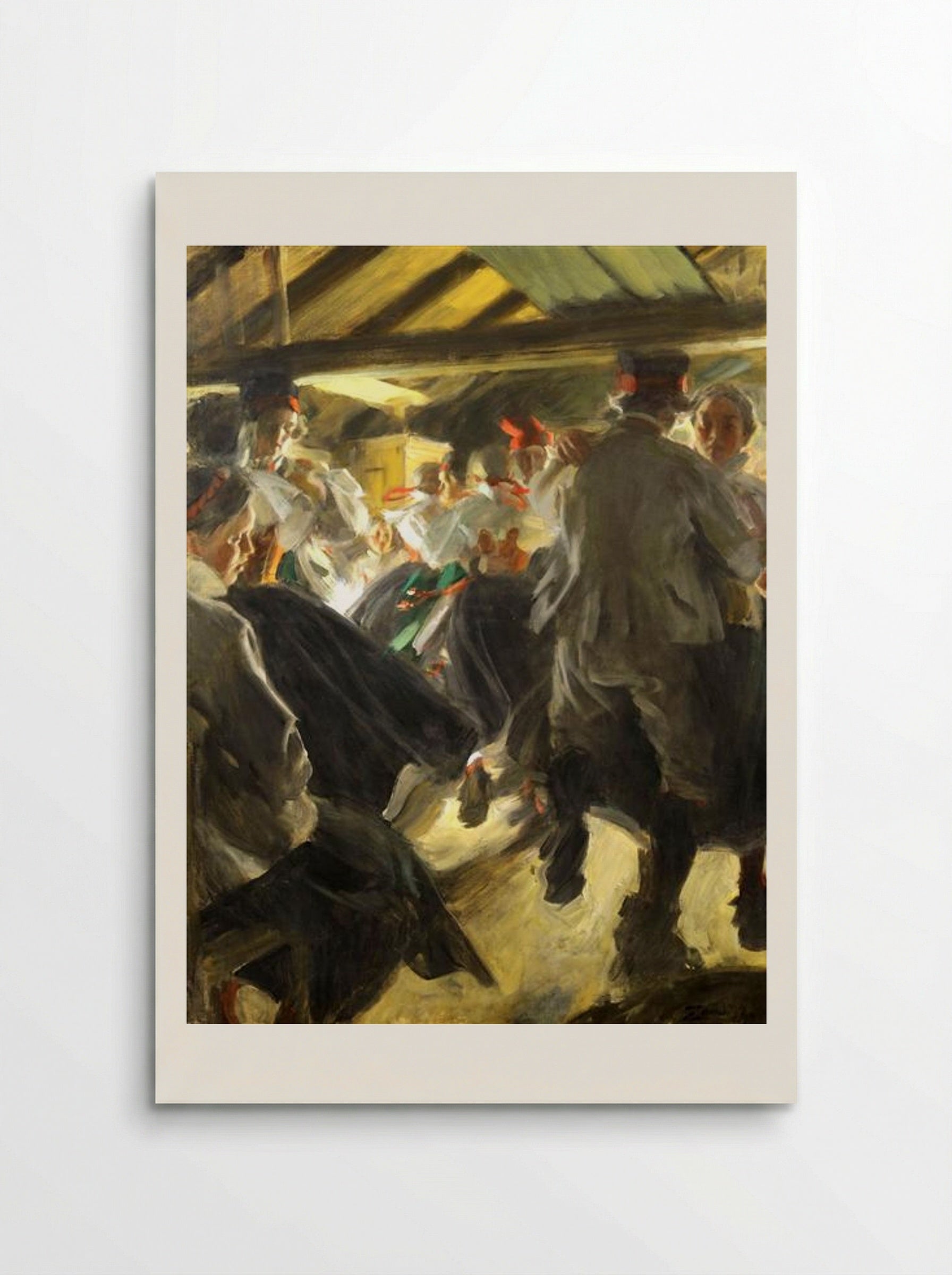
Dance in Gopsmor - Anders Zorn
Archival giclée
Ready to hang
Secure checkout
Made to order
Description
A 1914 oil painting by Anders Zorn depicting a traditional folk dance in a rustic Swedish cottage. This work uses a restricted palette and bold brushwork to capture the movement and light of a rural social gathering.
Anders Zorn painted this scene in 1914 at his wilderness retreat in Gopsmor, Dalarna. The work depicts a traditional folk dance held within a small timber cottage. Zorn established this retreat to escape the pressures of his international portrait commissions and to document the rural customs of his native Sweden. The composition focuses on the physical energy of the dancers. Zorn employs his characteristic broad brushwork to define the spinning forms of the participants. The heavy woollen skirts and jackets are rendered with thick applications of paint that suggest weight and momentum. Light enters from a low angle, creating sharp contrasts against the dark interior of the cabin. This illumination catches the white fabric of the blouses and the polished surface of the wooden floor. Zorn used a restricted palette for this work, consisting primarily of yellow ochre, ivory black, and lead white. Small accents of red appear in the traditional headwear and ribbons, providing points of interest within the earthy tones. The figures in the immediate foreground are partially cropped, which creates a sense of being present inside the crowded room. This technique reflects Zorn's interest in photography and his ability to capture fleeting moments of motion. The painting is a record of the Mora culture that Zorn worked to preserve. By the early twentieth century, these traditional dances were becoming less common. Zorn used his influence and resources to encourage the continuation of these local practices. This work is a significant example of Swedish Impressionism and Zorn's mastery of light and shadow in an interior setting.
Return policy
Because every print is made to order, we don't offer change-of-mind returns, refunds or exchanges. If your order arrives faulty, damaged or incorrect, we'll replace it free of charge — just contact us within 48 hours of delivery. EU customers have a 14-day cooling-off right. See our refunds page for full details.
Shipping
We ship worldwide, printing at the production hub nearest to your delivery address. Delivery times and costs vary by destination — you'll see the options available to you at checkout.
Manufacturing
Each print is produced to order using 12-colour giclée printing on FSC-certified archival paper. Designed in Britain and printed at your nearest production hub to reduce waste and speed up delivery.
Dance in Gopsmor - Anders Zorn
Our Features
Designed for Lasting Impact
Specific Features
Every Solis piece is made to order with archival, gallery-quality materials built to last.
- Museum-grade giclée printing for rich, fade-resistant colour
- Archival matte fine-art paper, FSC-certified
- Choose poster, framed print, canvas or framed canvas
- Frames in black, natural wood, dark wood or white
- Framed prints arrive ready to hang
Care & Cleaning
To keep your artwork looking its best:
- Dust gently with a soft, dry cloth
- Avoid prolonged direct sunlight
- Never use liquid cleaners on the print or canvas surface
- Keep in a dry, room-temperature space
- Handle prints with clean, dry hands
Materials & Sizing
Museum-grade giclée on FSC-certified archival matte paper, with framed and canvas options.
- Paper sizes: A4, A3, A2, A1, A0 and B2 (50×70 cm)
- Canvas: XS (20×30 cm) to Large (60×90 cm)
- Frames: black, natural wood, dark wood or white
Why Choose Us ?
100% Satisfaction Guarantee
Fast Shipping
Museum-Quality Materials

Artist Biography
Anders Zorn
He was born in Mora in 1860, studied at the Royal Swedish Academy of Arts in Stockholm, and worked across Paris, London and the United States. His ability to render water and flesh with loose, confident brushwork set him apart from more academic contemporaries. His etchings, numbering roughly three hundred, are considered among the finest of the period.
He returned to Mora later in life, establishing a museum and open-air museum there. The Zorn Museum remains a major cultural institution in Sweden. He died in Mora in 1920, at sixty.
You May Also Like