

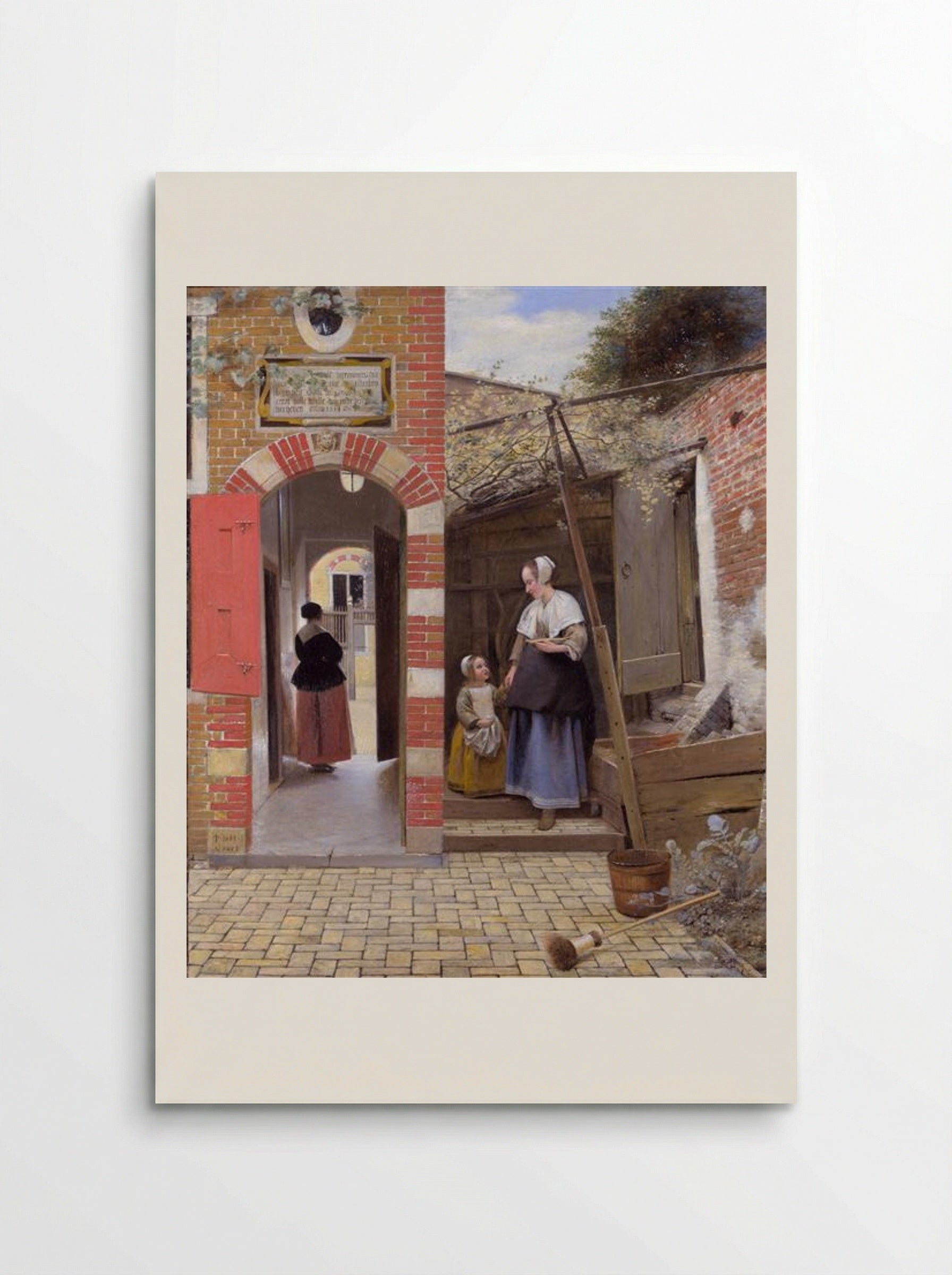
Courtyard of a House in Delft - Pieter de Hooch
Archival giclée
Frames arrive ready to hang
Secure checkout
Made to order
Description
Pieter de Hooch's 'Courtyard of a House in Delft' captures a serene domestic scene with meticulous detail and masterful use of light and perspective, typical of the Dutch Golden Age.
Pieter de Hooch, a Dutch Golden Age painter, is celebrated for his genre scenes depicting domestic life with a focus on light, space, and perspective. Painted in 1658, *Courtyard of a House in Delft* is a quintessential example of his style. The painting presents a view into a typical Delft courtyard, where a woman and child stand near a doorway. The composition is carefully constructed, using the architecture to create a series of receding planes that draw the viewer's eye deeper into the scene. De Hooch's attention to detail is evident in the rendering of the brickwork, the play of light on the cobblestones, and the subtle textures of the clothing. The scene is bathed in a soft, natural light, which enhances the sense of calm and order. The figures are depicted in a simple, unidealised manner, reflecting the everyday reality of 17th-century Dutch life. The painting offers a glimpse into the domestic sphere, portraying the values of cleanliness, order, and family that were central to Dutch culture during this period. De Hooch's mastery of perspective and his ability to capture the nuances of light make this work a significant contribution to Dutch art.
Return policy
Because every print is made to order, we don't offer change-of-mind returns, refunds or exchanges. If your order arrives faulty, damaged or incorrect, we'll replace it free of charge — just contact us within 48 hours of delivery. See our refunds page for full details.
Shipping
We ship worldwide, printing at the production hub nearest to your delivery address. Delivery times and costs vary by destination — you'll see the options available to you at checkout.
Manufacturing
Each print is produced to order using 12-colour giclée printing on FSC-certified archival paper. Designed in Britain and printed at your nearest production hub to reduce waste and speed up delivery.
Care and materials
Specific Features
Every Solis piece is made to order with archival, gallery-quality materials built to last.
- Museum-grade giclée printing for rich, fade-resistant colour
- Archival matte fine-art paper, FSC-certified
- Multiple sizes and framing options available
- Frames in black, natural wood, dark wood or white
- Framed prints arrive ready to hang
Care & Cleaning
To keep your artwork looking its best:
- Dust gently with a soft, dry cloth
- Avoid prolonged direct sunlight
- Never use liquid cleaners on the print or canvas surface
- Keep in a dry, room-temperature space
- Handle prints with clean, dry hands
Materials & Sizing
Museum-grade giclée on FSC-certified archival matte paper, with framed and canvas options.
- Paper sizes: A4, A3, A2, A1, A0 and B2 (50×70 cm)
- Canvas: XS (20×30 cm) to Large (60×90 cm)
- Frames: black, natural wood, dark wood or white
Courtyard of a House in Delft - Pieter de Hooch

Artist Biography
Pieter De Hooch
De Hooch's skill lay in his meticulous observation and his ability to render perspective with astonishing accuracy. He understood how light filtered through windows, danced across tiled floors, and illuminated the faces of women tending to their children or soldiers enjoying a moment of respite. His paintings, such as 'Courtyard of a House in Delft' and 'The Linen Cupboard', are not just depictions of Dutch life; they are invitations to step into a world of quiet contentment and understated elegance.
Though the details of his later life remain somewhat obscure, Pieter de Hooch's legacy endures through his luminous paintings. They offer a glimpse into the values and aesthetics of the Dutch Golden Age, reminding us to appreciate the beauty that can be found in the simplest of moments. His works are a testament to the enduring power of domesticity and the quiet poetry of everyday life.
Why Choose Us ?
Damage-free delivery guarantee
Fast Shipping
Museum-Quality Materials
You May Also Like