

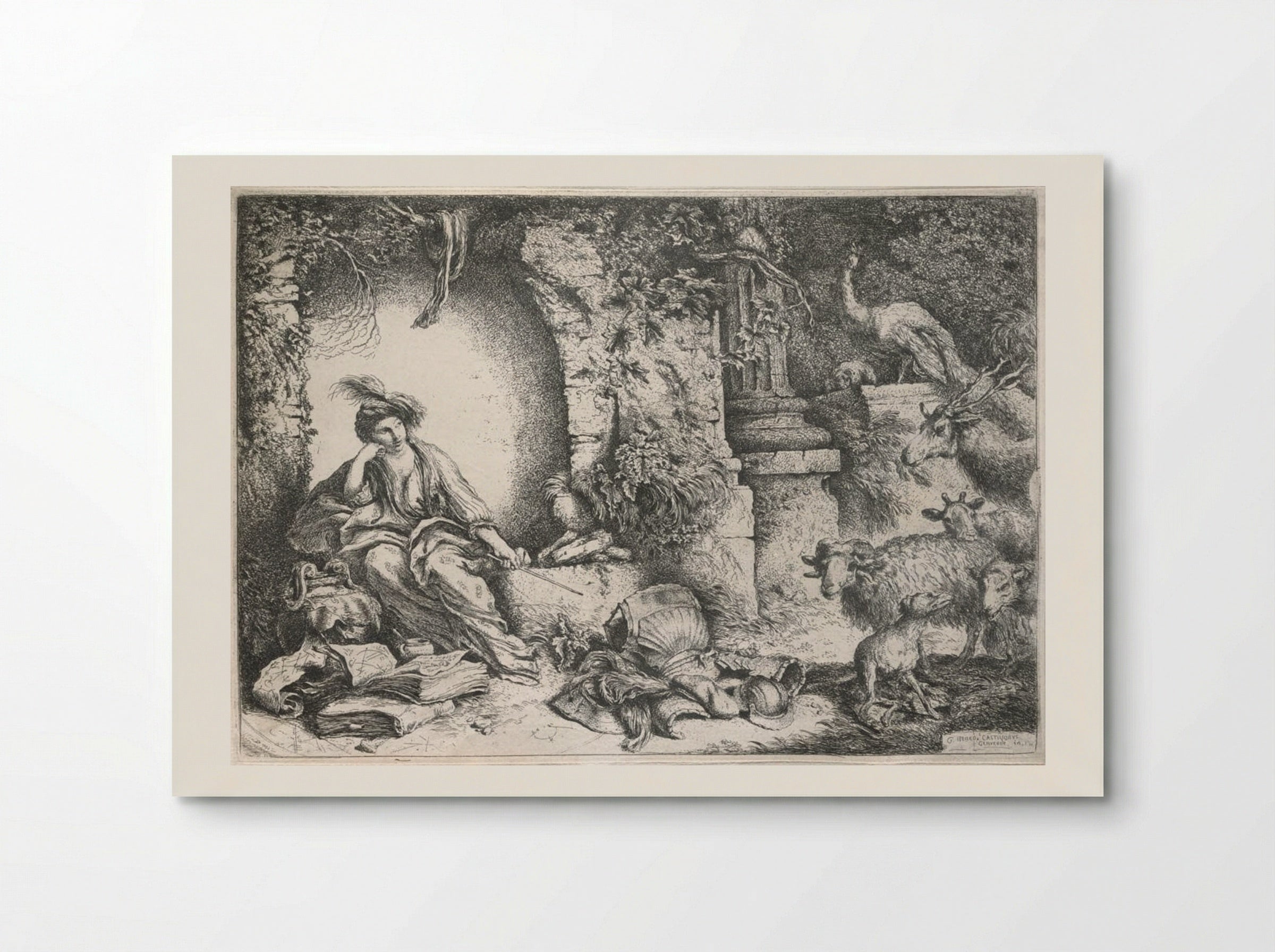
Circe with the Companions of Ulysses as Animals - Giovanni Benedetto Castiglione
Archival giclée
Frames arrive ready to hang
Secure checkout
Made to order
Description
An etching by Giovanni Benedetto Castiglione depicts Circe, from classical mythology, surrounded by the animals that were once Ulysses' companions, transformed by her magic. The composition is characterised by detailed figures and foliage, achieved through fine, dense lines.
This etching by Giovanni Benedetto Castiglione, titled 'Circe with the Companions of Ulysses as Animals', presents a scene drawn from classical mythology. Castiglione, an Italian artist of the Baroque period, was known for his innovative printmaking and his blending of various artistic influences. The print depicts the sorceress Circe seated in a grotto-like setting, surrounded by animals that were once the companions of Ulysses, transformed by her magic. The composition is characterised by a detailed rendering of figures and foliage, achieved through fine, dense lines. Circe, adorned with a feathered hat, reclines with a contemplative expression, a wand in her hand. Books and vessels lie scattered around her, symbols of her knowledge and power. The animals, including sheep, deer, and a peacock, populate the right side of the image, their forms carefully delineated. Architectural ruins and dense vegetation create a backdrop that enhances the scene's dramatic quality. The use of light and shadow adds depth to the composition, typical of Baroque aesthetics. Castiglione's skill as a draughtsman is evident in the precise execution of the figures and the textures of the natural elements. The print exemplifies his interest in narrative and his ability to translate mythological themes into visually compelling works.
Return policy
Because every print is made to order, we don't offer change-of-mind returns, refunds or exchanges. If your order arrives faulty, damaged or incorrect, we'll replace it free of charge — just contact us within 48 hours of delivery. See our refunds page for full details.
Shipping
We ship worldwide, printing at the production hub nearest to your delivery address. Delivery times and costs vary by destination — you'll see the options available to you at checkout.
Manufacturing
Each print is produced to order using 12-colour giclée printing on FSC-certified archival paper. Designed in Britain and printed at your nearest production hub to reduce waste and speed up delivery.
Circe with the Companions of Ulysses as Animals - Giovanni Benedetto Castiglione
Artist Biography
Giovanni Benedetto Castiglione
Castiglione's artistic style combined influences from various sources. He was inspired by the Genoese Baroque tradition, as well as artists like Peter Paul Rubens, Anthony van Dyck, and Rembrandt. His paintings often featured mythological and biblical scenes, as well as genre subjects and animal studies, all rendered with a distinctive painterly touch. He was admired for his ability to capture expressive figures and dramatic compositions.
Today, Castiglione's prints and drawings appeal to collectors who appreciate technical mastery and innovation. His works offer a fascinating glimpse into the artistic exchanges of 17th-century Italy. His singular approach to both painting and printmaking sets him apart from his contemporaries, making his works desirable for those seeking something unique.
Our Features
Designed for Lasting Impact
Specific Features
Every Solis piece is made to order with archival, gallery-quality materials built to last.
- Museum-grade giclée printing for rich, fade-resistant colour
- Archival matte fine-art paper, FSC-certified
- Multiple sizes and framing options available
- Frames in black, natural wood, dark wood or white
- Framed prints arrive ready to hang
Care & Cleaning
To keep your artwork looking its best:
- Dust gently with a soft, dry cloth
- Avoid prolonged direct sunlight
- Never use liquid cleaners on the print or canvas surface
- Keep in a dry, room-temperature space
- Handle prints with clean, dry hands
Materials & Sizing
Museum-grade giclée on FSC-certified archival matte paper, with framed and canvas options.
- Paper sizes: A4, A3, A2, A1, A0 and B2 (50×70 cm)
- Canvas: XS (20×30 cm) to Large (60×90 cm)
- Frames: black, natural wood, dark wood or white
Why Choose Us ?
Damage-free delivery guarantee
Fast Shipping
Museum-Quality Materials
Artist Biography
Giovanni Benedetto Castiglione
Castiglione's artistic style combined influences from various sources. He was inspired by the Genoese Baroque tradition, as well as artists like Peter Paul Rubens, Anthony van Dyck, and Rembrandt. His paintings often featured mythological and biblical scenes, as well as genre subjects and animal studies, all rendered with a distinctive painterly touch. He was admired for his ability to capture expressive figures and dramatic compositions.
Today, Castiglione's prints and drawings appeal to collectors who appreciate technical mastery and innovation. His works offer a fascinating glimpse into the artistic exchanges of 17th-century Italy. His singular approach to both painting and printmaking sets him apart from his contemporaries, making his works desirable for those seeking something unique.
You May Also Like