

Fine Art Poster
From £28
A giclée print on 200gsm matte fine art paper, using a twelve-colour process for accurate, fade-resistant colour. Supplied unframed, delivered flat or rolled.



Archival giclée
Frames arrive ready to hang
Secure checkout
Made to order
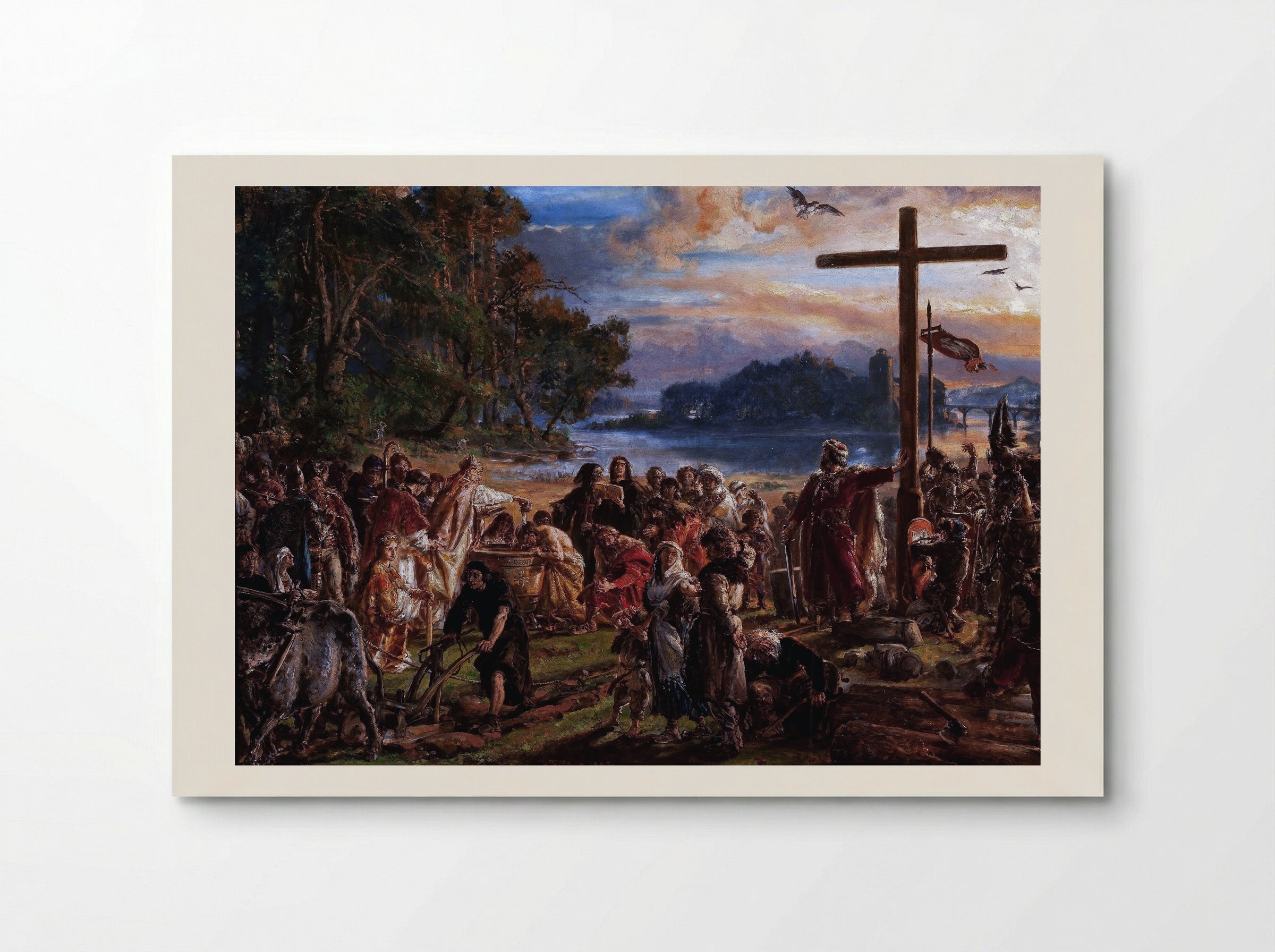
A detailed historical painting by Jan Matejko depicting the baptism of Mieszko I in 965, capturing the intersection of religious ceremony and daily life.
Jan Matejko, a master of Polish historical painting, completed this work in 1889 as part of his series depicting the history of civilisation in Poland. The composition captures the symbolic moment of the baptism of Mieszko I, the first historical ruler of Poland, which occurred in 965. Matejko organises the scene with a dense arrangement of figures, blending religious ceremony with the daily life of the period. To the left, a cleric performs the baptismal rite over a large vessel, while the central figure of Mieszko I stands with his hand raised towards a large wooden cross. The artist employs a dramatic use of light, which filters through the trees and across the water, creating a sense of atmospheric depth. The foreground contains figures engaged in agricultural labour, such as ploughing, which contrasts with the formal religious event taking place nearby. This juxtaposition suggests the integration of the new faith into the existing social fabric of the region. Matejko is known for his attention to period detail, from the garments worn by the nobility to the tools used by the commoners. The palette consists of deep earth tones, ochres, and muted blues, which lend the scene a sombre and serious quality. The sky, filled with clouds and birds, adds a sense of movement to the otherwise static, ceremonial gathering. This painting is part of a larger cycle that Matejko produced to document the cultural and political development of his nation. His approach to historical subjects is characterised by a desire to reconstruct the past with precision, using the canvas to narrate complex events. The work remains a significant example of nineteenth-century European academic painting, reflecting the artist's focus on national identity and historical continuity.
Because every print is made to order, we don't offer change-of-mind returns, refunds or exchanges. If your order arrives faulty, damaged or incorrect, we'll replace it free of charge — just contact us within 48 hours of delivery. See our refunds page for full details.
We ship worldwide, printing at the production hub nearest to your delivery address. Delivery times and costs vary by destination — you'll see the options available to you at checkout.
Each print is produced to order using 12-colour giclée printing on FSC-certified archival paper. Designed in Britain and printed at your nearest production hub to reduce waste and speed up delivery.

Artist Biography
Our Features
Designed for Lasting Impact
Every Solis piece is made to order with archival, gallery-quality materials built to last.
To keep your artwork looking its best:
Museum-grade giclée on FSC-certified archival matte paper, with framed and canvas options.
Made to order
Every piece is printed to order. These are the five finishes, and what makes each one different.
From £28
A giclée print on 200gsm matte fine art paper, using a twelve-colour process for accurate, fade-resistant colour. Supplied unframed, delivered flat or rolled.

From £45
The same fine art print in a solid wood frame with UV-protective acrylic glaze and rigid backing. Five frame colours. Arrives ready to hang.

From £85
A deeper solid wood frame: 33mm deep with a 20mm face and Perspex glaze. The print sits unmounted for a clean gallery presentation. Black, white or natural.

From £30
Hand-stretched canvas with neat gallery-wrapped edges, giving the artwork surface texture and depth. Arrives ready to hang.

From £135
Stretched canvas set in a floating wood frame, our most substantial finish. Arrives ready to hang.
Why Choose Us ?
Damage-free delivery guarantee
Fast Shipping
Museum-Quality Materials
Artist Biography
Jan Matejko
You May Also Like
Cookies show us which prints people love, so we hang the right art. Help us fill it?
Essential cookies only if you prefer · Privacy Policy