

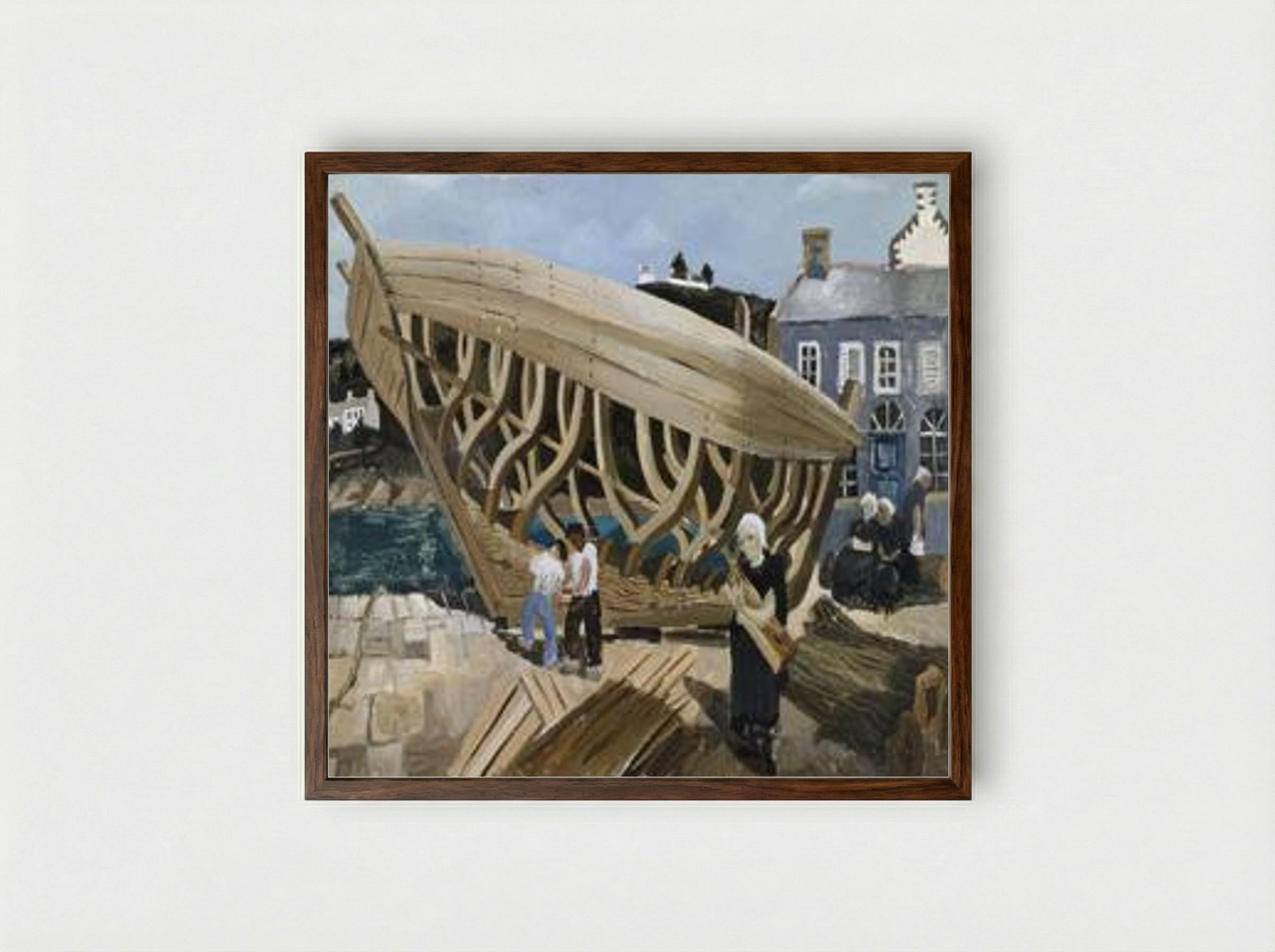
Building the Boat, Tréboul - Christopher Wood
Archival giclée
Ready to hang
Secure checkout
Made to order
Description
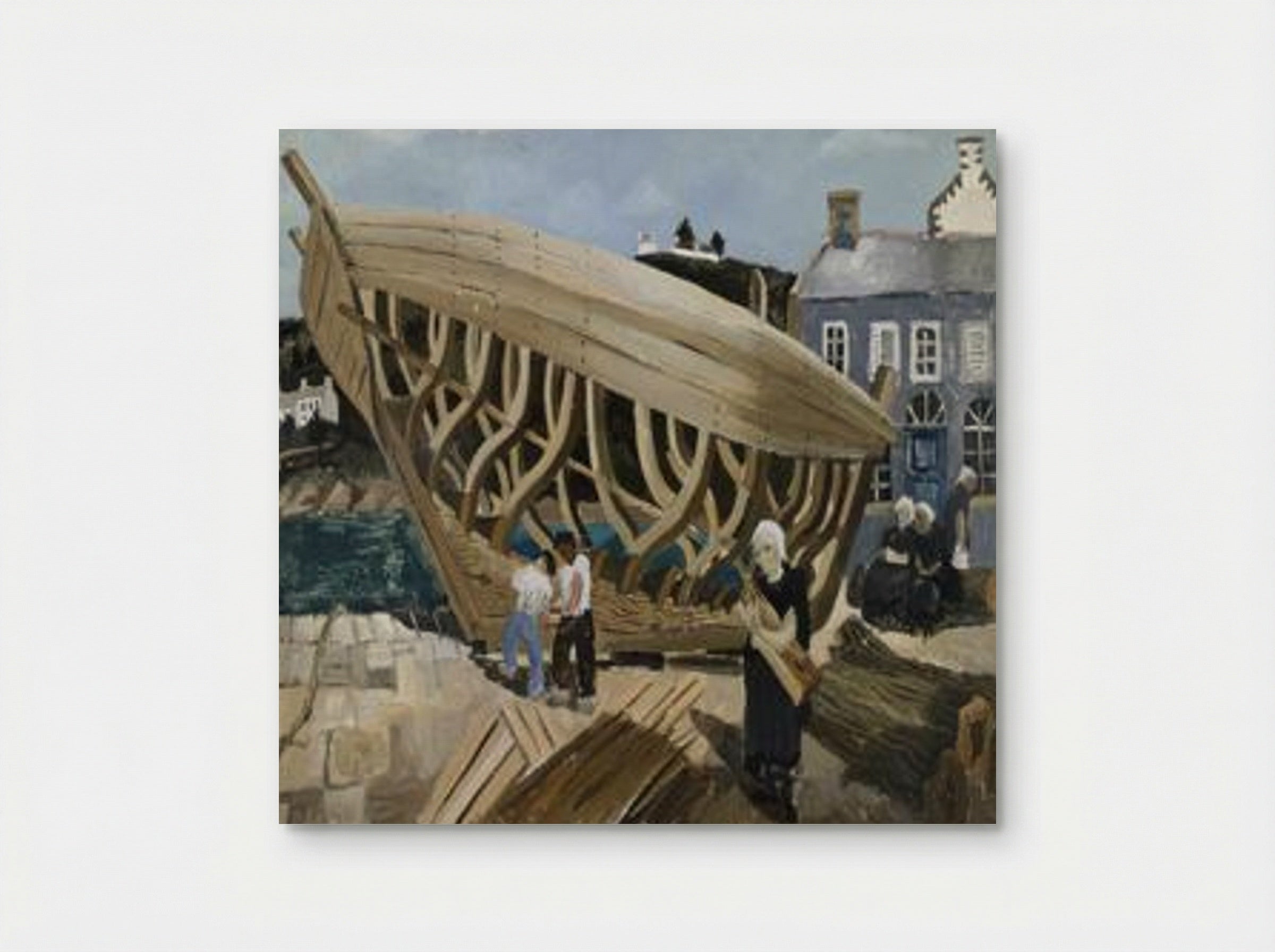
Christopher Wood's 'Building the Boat, Tréboul' captures a shipbuilding scene with a restrained palette and simplified forms. The painting reflects Wood's unique blend of modernism and naive art.
Christopher Wood, also known as 'Kit' Wood, was a British painter known for his association with the St Ives School. His style often combined elements of modernism with a naive or folk-art sensibility. Wood's career, though short, was marked by experimentation and a distinctive personal vision. He travelled extensively, absorbing influences from various artistic circles, including those of Picasso and Cocteau. His life ended tragically at the age of 29. 'Building the Boat, Tréboul' depicts a shipbuilding scene in the French port of Tréboul. The painting features the skeletal frame of a large wooden boat dominating the foreground. Figures are arranged around the boat, some working on its construction, others observing. The colour palette is restrained, with muted blues, browns, and greys creating a somewhat sombre atmosphere. The buildings in the background are rendered in a simplified, almost childlike style, which is characteristic of Wood's approach to form and perspective. The composition is carefully balanced, drawing the eye around the scene and creating a sense of depth despite the flattened perspective.
Return policy
Because every print is made to order, we don't offer change-of-mind returns, refunds or exchanges. If your order arrives faulty, damaged or incorrect, we'll replace it free of charge — just contact us within 48 hours of delivery. EU customers have a 14-day cooling-off right. See our refunds page for full details.
Shipping
We ship worldwide, printing at the production hub nearest to your delivery address. Delivery times and costs vary by destination — you'll see the options available to you at checkout.
Manufacturing
Each print is produced to order using 12-colour giclée printing on FSC-certified archival paper. Designed in Britain and printed at your nearest production hub to reduce waste and speed up delivery.
Building the Boat, Tréboul - Christopher Wood
Our Features
Designed for Lasting Impact
Specific Features
Every Solis piece is made to order with archival, gallery-quality materials built to last.
- Museum-grade giclée printing for rich, fade-resistant colour
- Archival matte fine-art paper, FSC-certified
- Choose poster, framed print, canvas or framed canvas
- Frames in black, natural wood, dark wood or white
- Framed prints arrive ready to hang
Care & Cleaning
To keep your artwork looking its best:
- Dust gently with a soft, dry cloth
- Avoid prolonged direct sunlight
- Never use liquid cleaners on the print or canvas surface
- Keep in a dry, room-temperature space
- Handle prints with clean, dry hands
Materials & Sizing
Museum-grade giclée on FSC-certified archival matte paper, with framed and canvas options.
- Paper sizes: A4, A3, A2, A1, A0 and B2 (50×70 cm)
- Canvas: XS (20×30 cm) to Large (60×90 cm)
- Frames: black, natural wood, dark wood or white
Why Choose Us ?
100% Satisfaction Guarantee
Fast Shipping
Museum-Quality Materials

Artist Biography
Christopher Wood
Born in Knowsley, Liverpool in 1901, Wood abandoned medicine to study at the Académie Julian in Paris from 1921. The social world he entered was remarkable: he moved through Cocteau's circle and was taken up by Diaghilev's Ballets Russes, even designing sets for a production that was never staged. By the mid-1920s he had joined both the London Group and the Seven and Five Society, painting alongside Ben and Winifred Nicholson.
His breakthrough came partly through patronage. Lucy Wertheim began buying his work after his 1929 solo exhibition at Tooth's Gallery on Bond Street and was planning his first major retrospective for October 1930 when he died. His final summers in Brittany produced some of his finest paintings: harbour scenes and chapels rendered with a directness that owed something to Wallis, something to Post-Impressionism, and a great deal to his own particular handling of colour.
Wood never lived to see how thoroughly his reputation would hold. Posthumous exhibitions followed in 1931 and 1932, and works appeared in the 1938 Venice Biennale. His gravestone at Salisbury was carved by Eric Gill. Today his Breton coastal scenes command six-figure sums at auction, reflecting the sustained appeal of that short, fractured career.
You May Also Like