

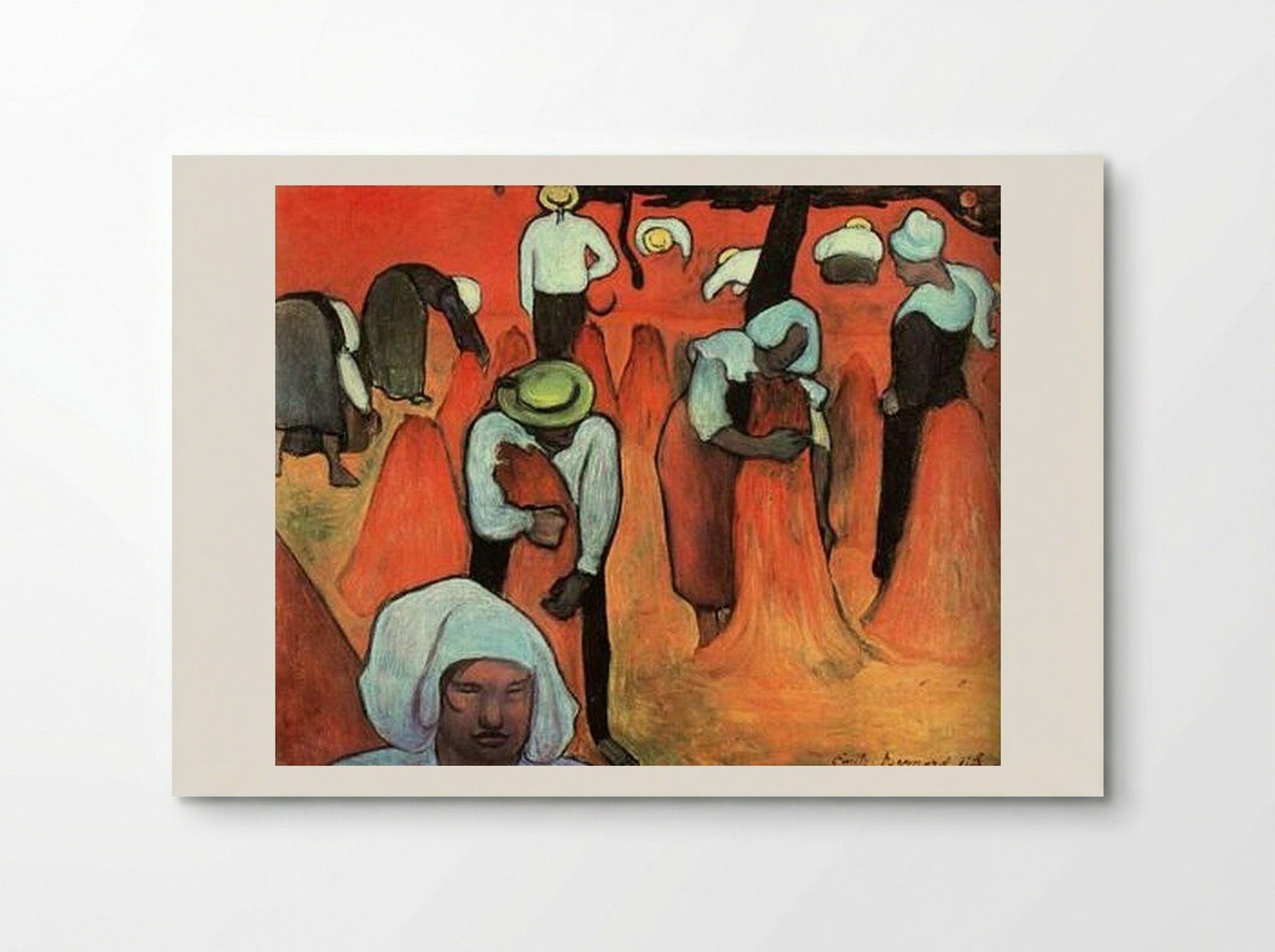
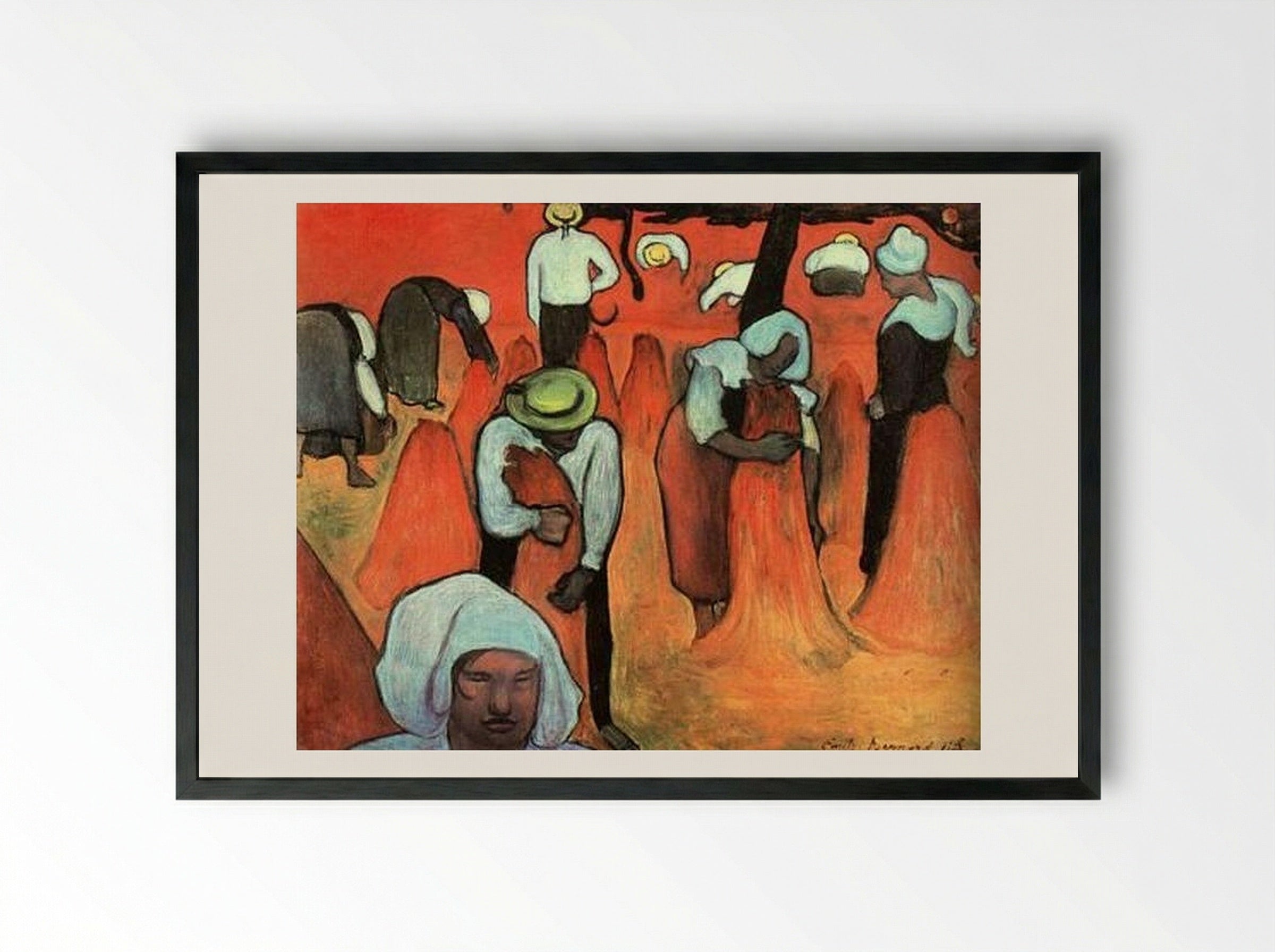
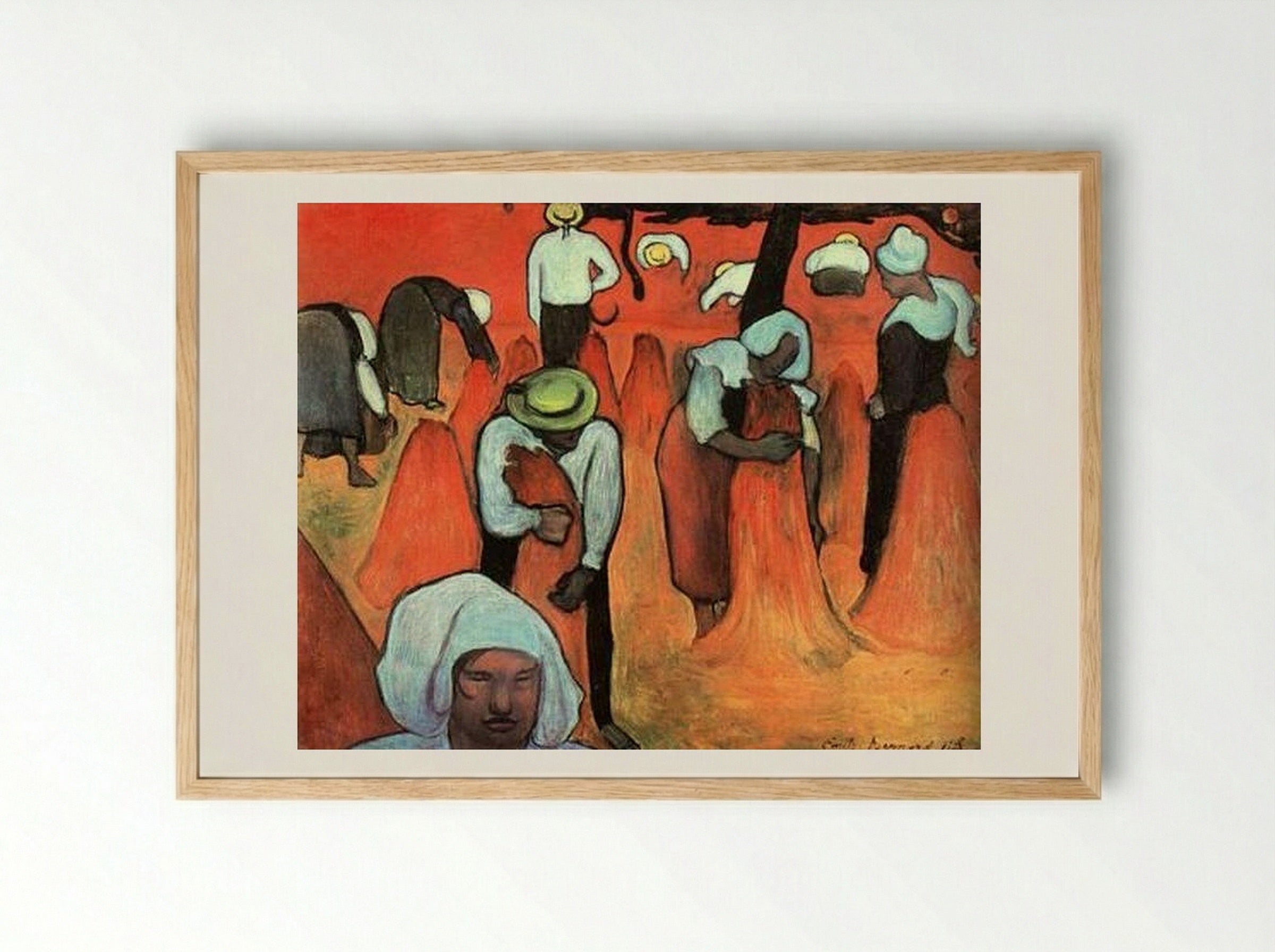
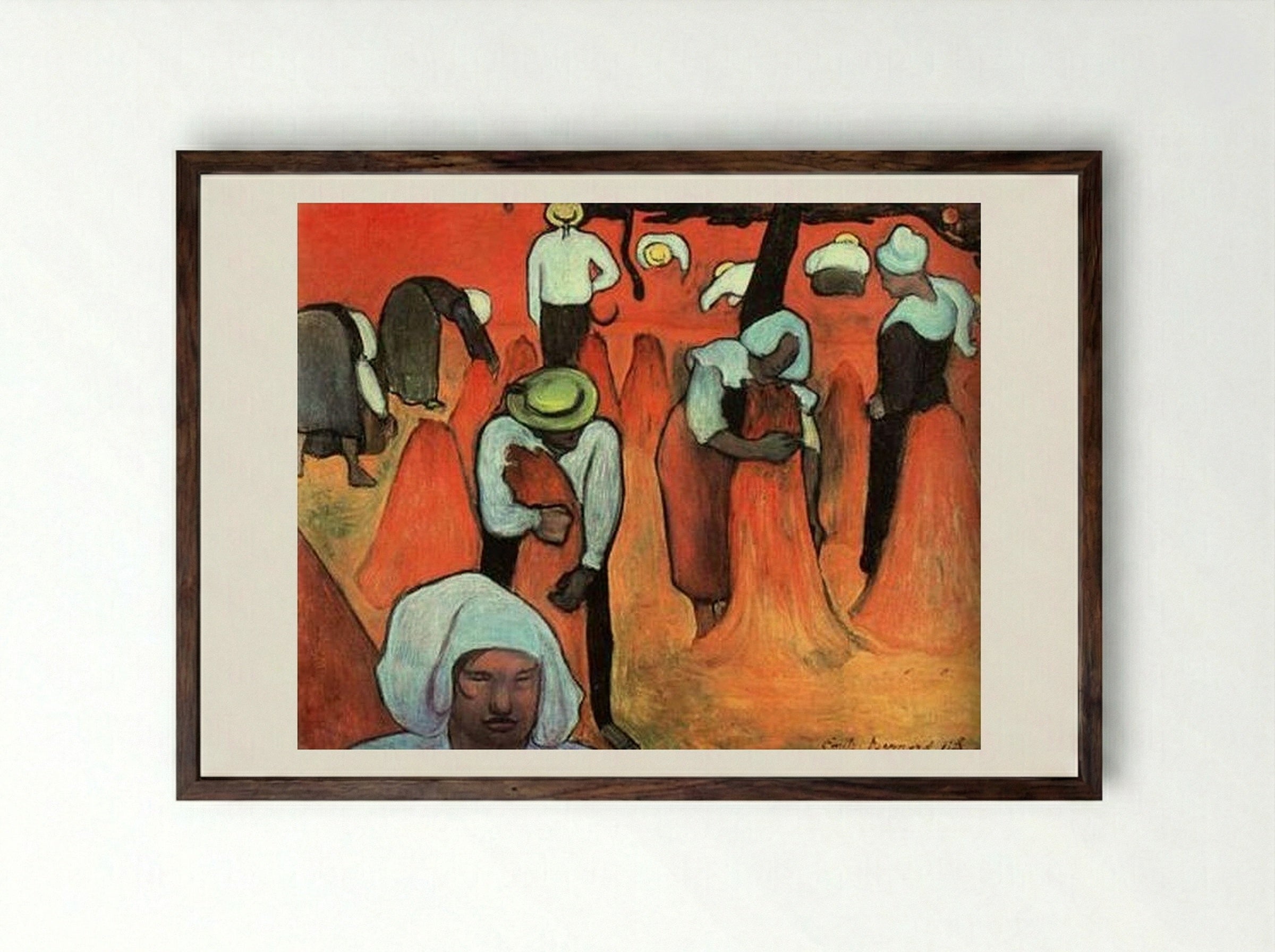
Buckwheat Harvesters at Pont-Aven - Émile Bernard
Archival giclée
Ready to hang
Secure checkout
Made to order
Description
Émile Bernard's 'Buckwheat Harvesters at Pont-Aven' (1888) is a Cloisonnist masterpiece, depicting Breton peasants in simplified forms and bold colours. This painting captures the essence of rural life through stylised figures and a warm, intense palette.
Émile Bernard's 1888 oil on canvas, Buckwheat Harvesters at Pont-Aven, exemplifies the artist's Cloisonnist style. This movement, characterised by bold blocks of colour separated by dark outlines, emerged in the late 1880s as a reaction against Impressionism's emphasis on fleeting light and optical realism. Bernard, along with Paul Gauguin and others, sought to create a more symbolic and expressive form of painting. The painting depicts a group of Breton peasants harvesting buckwheat in a field. The figures are simplified and stylised, with flattened forms and minimal detail. The colour palette is dominated by warm reds and oranges, creating a sense of heat and intensity. The composition is organised around a series of vertical and horizontal lines, giving the painting a sense of structure and order. The scene is rendered with a limited range of colours, primarily shades of red and orange, which imbue the work with a sense of warmth and intensity. The figures are outlined in dark contours, a hallmark of Cloisonnism, which flattens the picture plane and emphasises the decorative aspect of the composition. Bernard's work reflects a move away from naturalistic representation towards a more subjective and symbolic approach to art. Buckwheat Harvesters at Pont-Aven is a key example of this shift, demonstrating the artist's interest in capturing the essence of rural life through simplified forms and expressive colours.
Return policy
Because every print is made to order, we don't offer change-of-mind returns, refunds or exchanges. If your order arrives faulty, damaged or incorrect, we'll replace it free of charge — just contact us within 48 hours of delivery. EU customers have a 14-day cooling-off right. See our refunds page for full details.
Shipping
We ship worldwide, printing at the production hub nearest to your delivery address. Delivery times and costs vary by destination — you'll see the options available to you at checkout.
Manufacturing
Each print is produced to order using 12-colour giclée printing on FSC-certified archival paper. Designed in Britain and printed at your nearest production hub to reduce waste and speed up delivery.
Buckwheat Harvesters at Pont-Aven - Émile Bernard
Our Features
Designed for Lasting Impact
Specific Features
Every Solis piece is made to order with archival, gallery-quality materials built to last.
- Museum-grade giclée printing for rich, fade-resistant colour
- Archival matte fine-art paper, FSC-certified
- Choose poster, framed print, canvas or framed canvas
- Frames in black, natural wood, dark wood or white
- Framed prints arrive ready to hang
Care & Cleaning
To keep your artwork looking its best:
- Dust gently with a soft, dry cloth
- Avoid prolonged direct sunlight
- Never use liquid cleaners on the print or canvas surface
- Keep in a dry, room-temperature space
- Handle prints with clean, dry hands
Materials & Sizing
Museum-grade giclée on FSC-certified archival matte paper, with framed and canvas options.
- Paper sizes: A4, A3, A2, A1, A0 and B2 (50×70 cm)
- Canvas: XS (20×30 cm) to Large (60×90 cm)
- Frames: black, natural wood, dark wood or white
Why Choose Us ?
100% Satisfaction Guarantee
Fast Shipping
Museum-Quality Materials

Artist Biography
Émile Bernard
He was raised by his grandmother, who owned a laundry in Lille, because his younger sister was ill and required his parents' full attention. He entered the Ecole des Beaux-Arts in Paris but was expelled for insubordination. At the Academie Cormon he met Toulouse-Lautrec and Van Gogh; his friendship with Van Gogh produced some of the most important letters in art history.
Bernard and Gauguin fell out definitively in 1891 over the paternity of Symbolism and cloisonnism. Bernard believed he had been written out of the story, which he had. He spent years writing criticism and art history to set the record straight, producing first-hand accounts of the period that remain primary sources.
His later work turned conservative. He travelled to Egypt, studied the Old Masters, and repudiated the avant-garde experiments of his youth. The early paintings, made between 1886 and 1897 when he was barely out of his teens, are the ones that matter. He was brilliant too young and spent the rest of his career looking backwards. His correspondence with Van Gogh, preserved and published, is one of the most direct records of how two young painters in the 1880s thought about colour, composition and what painting was for.
You May Also Like