

Bridge - Konstantin Korovin
Archival giclée
Frames arrive ready to hang
Secure checkout
Made to order
Description
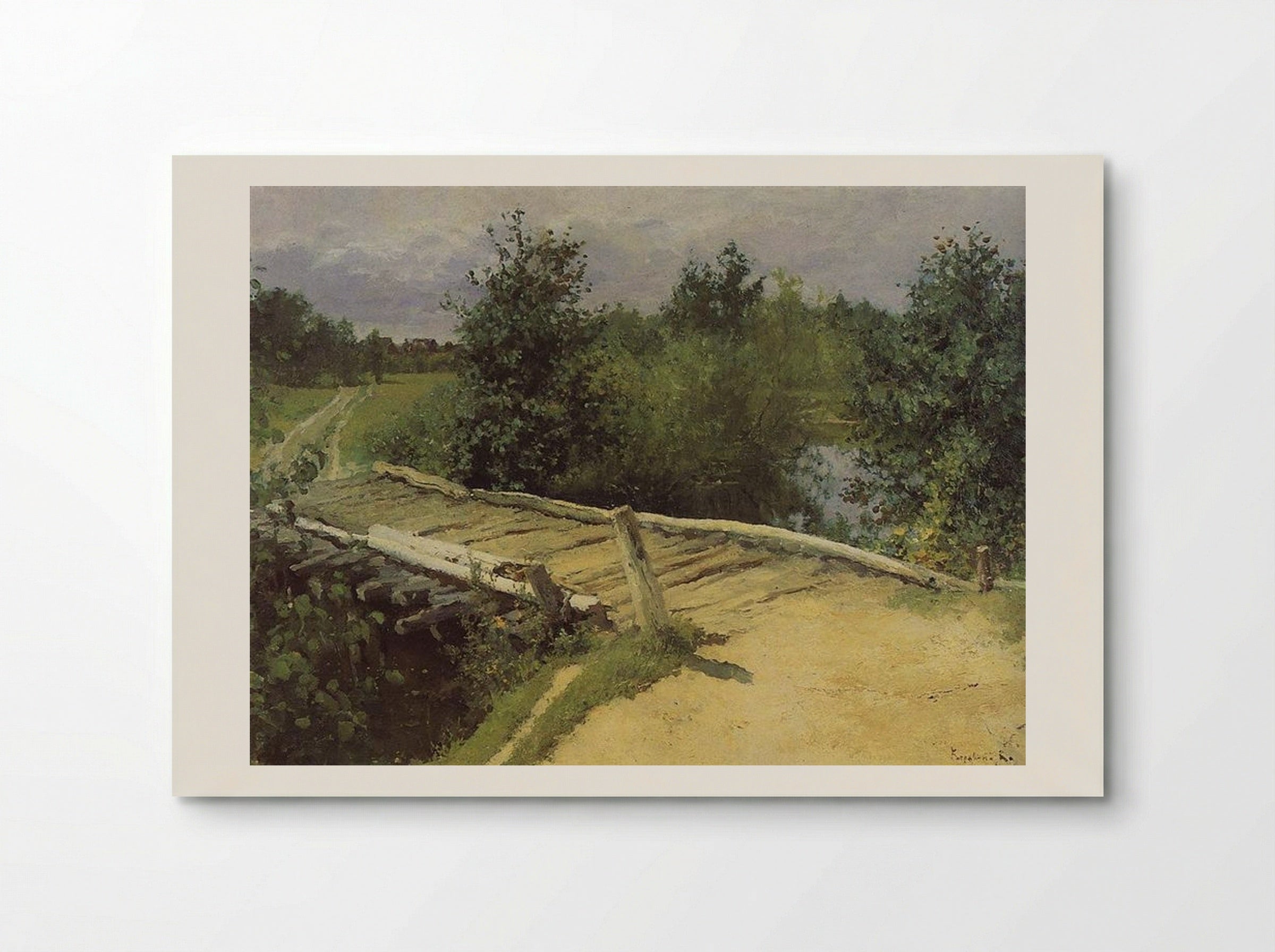
A rustic wooden bridge crosses a stream in this Impressionist landscape by Konstantin Korovin. The painting uses loose brushwork and a muted palette to capture the atmosphere of the Russian countryside.
Konstantin Korovin was a leading figure in Russian Impressionism. This work depicts a simple wooden bridge spanning a small stream or ravine. The composition places the viewer at the edge of a dirt path, looking across the timber structure toward a dense thicket of trees. Korovin uses a palette dominated by earthy ochres, muted greens, and cool greys. The sky is heavy with clouds, suggesting a humid or overcast day in the Russian countryside. The brushwork is loose and spontaneous. Korovin avoids fine detail in favour of capturing the atmospheric quality of the scene. The rough texture of the wooden planks is rendered with broad, confident strokes. To the right, a small patch of water reflects the surrounding greenery and the pale sky. The trees in the background are painted with varied shades of green and brown, creating a sense of depth without relying on strict linear perspective. Korovin studied at the Moscow School of Painting, Sculpture and Architecture under Alexei Savrasov and Vasily Polenov. His early work was influenced by the Peredvizhniki (The Wanderers), but he soon moved toward a more painterly, light-filled style after visiting Paris. This painting shows his interest in the immediate, sensory experience of nature. He focuses on the play of light on different surfaces, such as the dry earth of the path and the damp wood of the bridge. The work is a study in tonal harmony. The transition from the warm tones of the foreground path to the cool, dark shadows beneath the bridge creates a balanced image. Korovin does not seek to idealise the scene. Instead, he presents a quiet, everyday moment in a rural setting. This approach was a departure from the more narrative or moralising themes common in Russian art of the period.
Return policy
Because every print is made to order, we don't offer change-of-mind returns, refunds or exchanges. If your order arrives faulty, damaged or incorrect, we'll replace it free of charge — just contact us within 48 hours of delivery. See our refunds page for full details.
Shipping
We ship worldwide, printing at the production hub nearest to your delivery address. Delivery times and costs vary by destination — you'll see the options available to you at checkout.
Manufacturing
Each print is produced to order using 12-colour giclée printing on FSC-certified archival paper. Designed in Britain and printed at your nearest production hub to reduce waste and speed up delivery.
Care and materials
Specific Features
Every Solis piece is made to order with archival, gallery-quality materials built to last.
- Museum-grade giclée printing for rich, fade-resistant colour
- Archival matte fine-art paper, FSC-certified
- Multiple sizes and framing options available
- Frames in black, natural wood, dark wood or white
- Framed prints arrive ready to hang
Care & Cleaning
To keep your artwork looking its best:
- Dust gently with a soft, dry cloth
- Avoid prolonged direct sunlight
- Never use liquid cleaners on the print or canvas surface
- Keep in a dry, room-temperature space
- Handle prints with clean, dry hands
Materials & Sizing
Museum-grade giclée on FSC-certified archival matte paper, with framed and canvas options.
- Paper sizes: A4, A3, A2, A1, A0 and B2 (50×70 cm)
- Canvas: XS (20×30 cm) to Large (60×90 cm)
- Frames: black, natural wood, dark wood or white
Bridge - Konstantin Korovin

Artist Biography
Konstantin Korovin
He was born in Moscow in 1861 and studied under Savrasov and Polenov at the Moscow School. He was close to Mamontov's Abramtsevo circle and designed prolifically for the Bolshoi and Mariinsky theatres. His Parisian cafe scenes and Crimean landscapes use loose, luminous brushwork. After the Revolution he emigrated to Paris in 1923. He died in Paris in 1939.
Why Choose Us ?
Damage-free delivery guarantee
Fast Shipping
Museum-Quality Materials
You May Also Like