

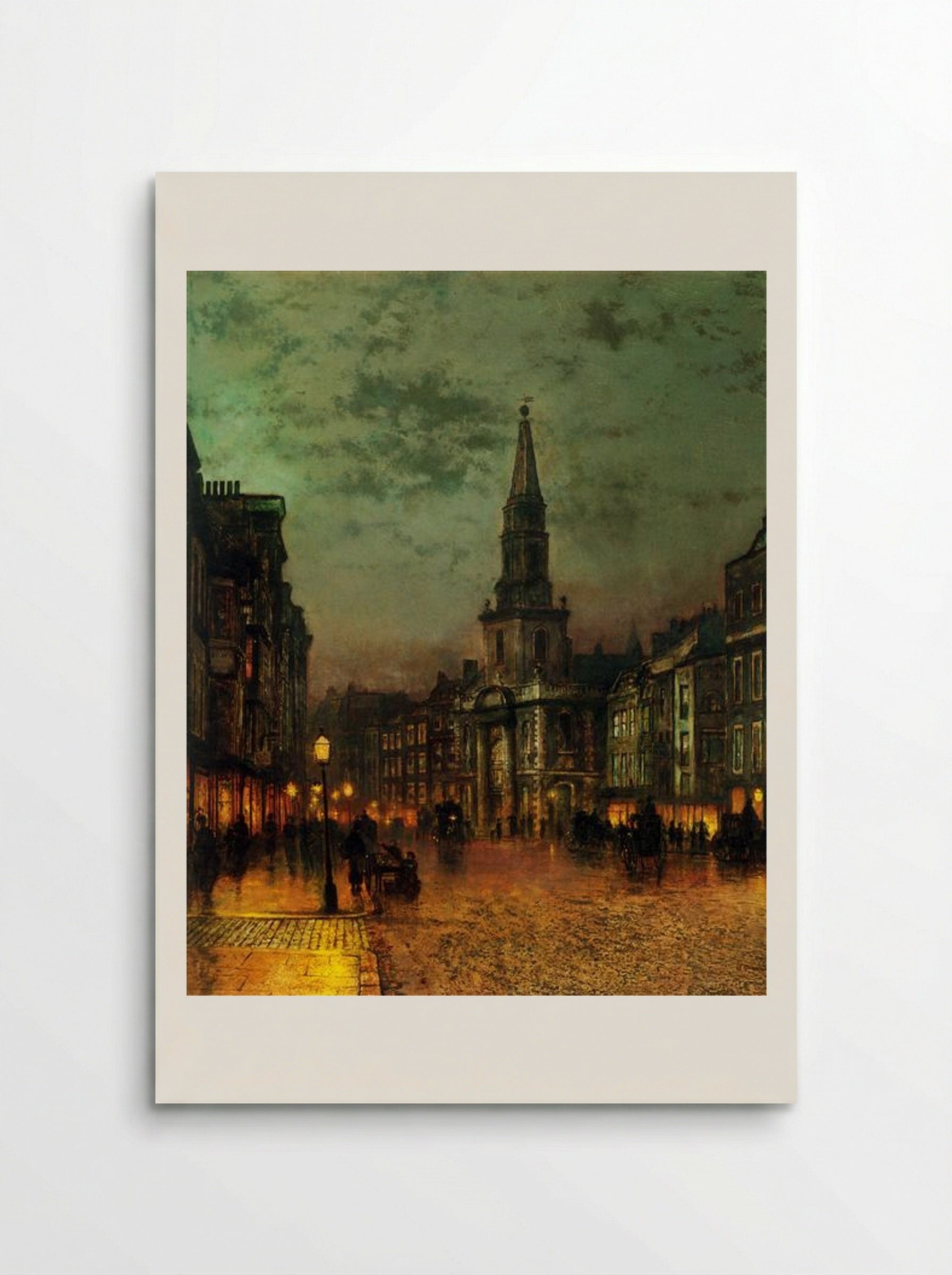
Blackman Street, London - John Atkinson Grimshaw
Archival giclée
Frames arrive ready to hang
Secure checkout
Made to order
Description
A classic nocturnal urban scene by John Atkinson Grimshaw, capturing the atmospheric light and wet cobblestones of a Victorian London street.
John Atkinson Grimshaw is recognised for his mastery of the nocturnal urban scene. In this depiction of Blackman Street, London, he captures the atmospheric conditions of the late Victorian city. The composition relies on the interplay between the dim, diffused light of the evening sky and the warm, artificial glow emanating from shop windows and street lamps. The wet cobblestones reflect these light sources, creating a sense of dampness and quietude that defines his body of work. Grimshaw often utilised a technique involving the application of thin glazes to achieve the specific luminosity of his night skies. The architecture, rendered with precision, provides a structured frame for the scene, while the silhouetted figures suggest the movement of daily life without distracting from the overall mood. His approach to painting was meticulous, often incorporating photographic references to ensure accuracy in the perspective of the buildings and the fall of light. This work demonstrates the artist's ability to transform a mundane street into a scene of quiet observation. By focusing on the transition between day and night, he invites the viewer to consider the city in a state of repose. The muted palette, dominated by deep greens, ochres, and browns, reflects the smog-filled air of the period, yet the treatment of light remains the primary focus. The church spire acts as a vertical anchor, drawing the eye upwards against the heavy, cloud-laden sky. This print captures the technical precision and the specific tonal range that made Grimshaw a unique figure in nineteenth-century British art, offering a window into the character of London streets during the late Victorian era.
Return policy
Because every print is made to order, we don't offer change-of-mind returns, refunds or exchanges. If your order arrives faulty, damaged or incorrect, we'll replace it free of charge — just contact us within 48 hours of delivery. See our refunds page for full details.
Shipping
We ship worldwide, printing at the production hub nearest to your delivery address. Delivery times and costs vary by destination — you'll see the options available to you at checkout.
Manufacturing
Each print is produced to order using 12-colour giclée printing on FSC-certified archival paper. Designed in Britain and printed at your nearest production hub to reduce waste and speed up delivery.
Care and materials
Specific Features
Every Solis piece is made to order with archival, gallery-quality materials built to last.
- Museum-grade giclée printing for rich, fade-resistant colour
- Archival matte fine-art paper, FSC-certified
- Multiple sizes and framing options available
- Frames in black, natural wood, dark wood or white
- Framed prints arrive ready to hang
Care & Cleaning
To keep your artwork looking its best:
- Dust gently with a soft, dry cloth
- Avoid prolonged direct sunlight
- Never use liquid cleaners on the print or canvas surface
- Keep in a dry, room-temperature space
- Handle prints with clean, dry hands
Materials & Sizing
Museum-grade giclée on FSC-certified archival matte paper, with framed and canvas options.
- Paper sizes: A4, A3, A2, A1, A0 and B2 (50×70 cm)
- Canvas: XS (20×30 cm) to Large (60×90 cm)
- Frames: black, natural wood, dark wood or white
Blackman Street, London - John Atkinson Grimshaw

Artist Biography
John Atkinson Grimshaw
He was born in Leeds, the son of a retired policeman. His parents disapproved of his artistic ambitions. He married his cousin and settled in Knostrop Old Hall, a manor house outside Leeds that appears in several of his paintings. He was largely self-taught, influenced by the Pre-Raphaelites' attention to natural detail and by Whistler's tonal paintings, particularly the Nocturnes.
His technique is painstaking. The moonlit skies are built up in thin glazes. The reflections on wet pavements are precise. The bare trees, silhouetted against pale skies, are painted branch by branch. The figures are small and anonymous, walking through streets that are atmospheric rather than narrative. He rarely told stories. He painted moods.
Whistler reportedly said 'I considered myself the inventor of nocturnes until I saw Grimshaw's moonlit pictures.' Whether Whistler actually said this is uncertain (Whistler said many things), but the comparison is fair. Both painted the same subject, night, with the same seriousness, though Grimshaw's approach was more literal and Whistler's more abstract.
He worked prolifically, partly from financial necessity. He had many children and the manor house was expensive to maintain. He died in 1893, at fifty-seven, and fell out of critical favour for most of the twentieth century. His paintings now sell well at auction and are among the most popular Victorian images in print.
Why Choose Us ?
Damage-free delivery guarantee
Fast Shipping
Museum-Quality Materials
You May Also Like