

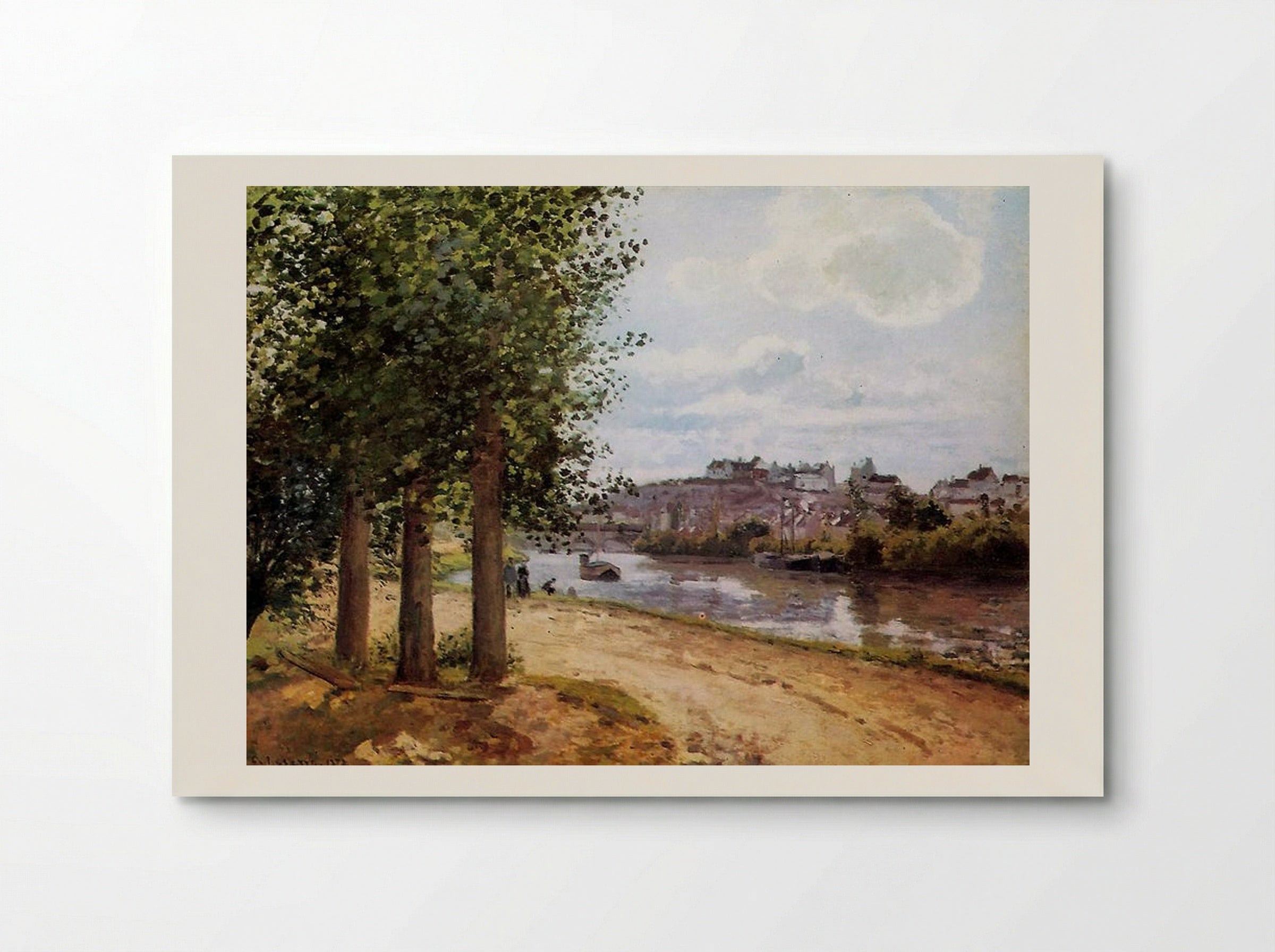
Banks of the Oise - Camille Pissarro
Archival giclée
Frames arrive ready to hang
Secure checkout
Made to order
Description
A serene 1873 Impressionist study of the Oise river by Camille Pissarro, capturing the quiet atmosphere of the French countryside near Pontoise.
Camille Pissarro painted this view of the Oise river in 1873, a period during which he resided in Pontoise. The composition captures the quiet, everyday rhythm of the French countryside, focusing on the riverbank with its tall, slender trees that frame the scene. The foreground consists of a dirt path, rendered with earthy tones and textured brushwork, leading the eye toward the water. In the middle distance, a small boat floats on the river, while the town of Pontoise rises on the hill in the background, its buildings softened by the atmospheric light. Pissarro employs a palette of greens, ochres, and soft blues to convey the specific quality of light on a summer day. The sky is filled with light, broken clouds, typical of the northern French climate. Unlike some of his contemporaries who focused on urban modernisation, Pissarro maintained a consistent interest in the rural environment. He observed the interaction between the natural world and the small-scale human activity along the river. The brushwork is deliberate, showing the artist's focus on capturing the immediate visual sensation of the location. This work reflects the Impressionist method of painting outdoors, allowing the artist to record the shifting effects of light and shadow across the water and the foliage. The painting remains a clear example of Pissarro's ability to balance structural composition with the transient qualities of the natural world, providing a calm, observational record of the Pontoise region during the late nineteenth century.
Return policy
Because every print is made to order, we don't offer change-of-mind returns, refunds or exchanges. If your order arrives faulty, damaged or incorrect, we'll replace it free of charge — just contact us within 48 hours of delivery. See our refunds page for full details.
Shipping
We ship worldwide, printing at the production hub nearest to your delivery address. Delivery times and costs vary by destination — you'll see the options available to you at checkout.
Manufacturing
Each print is produced to order using 12-colour giclée printing on FSC-certified archival paper. Designed in Britain and printed at your nearest production hub to reduce waste and speed up delivery.
Banks of the Oise - Camille Pissarro

Artist Biography
Camille Pissarro
He was born in 1830 in Charlotte Amalie, St Thomas, in the Danish West Indies. His father was a Portuguese Sephardic Jew; his mother was from the Dominican Republic. He grew up playing with children of African descent on the island, which may have seeded his later egalitarianism. In 1849 he met the Danish painter Fritz Melbye on St Thomas, who convinced him to paint full-time. He left for Paris.
He became the group's mentor, the elder statesman who taught without condescension. Cezanne, Gauguin, and later Seurat and Signac all learned from him. He introduced Cezanne to plein air painting and persuaded him to lighten his palette. He championed Gauguin when others were sceptical. When Seurat and Signac developed Pointillism, Pissarro was the first established Impressionist to adopt the technique, displaying new pointillist work alongside theirs at the 1886 exhibition. He said it was the next phase in the logical march of Impressionism. He later abandoned it, calling the system too artificial.
From about his late forties, he suffered chronic dacryocystitis, an infection of the tear duct in his left eye. Dust and wind aggravated it badly. This forced him to paint indoors, behind closed windows, and directly changed his subject matter. The rural landscapes gave way to Parisian boulevards and crowds, viewed from hotel rooms above the street. The late paintings of Rouen, Paris, and Le Havre, with their elevated perspectives and atmospheric light, were partly a medical adaptation.
He died in 1903 in Paris, aged seventy-three.
Our Features
Designed for Lasting Impact
Specific Features
Every Solis piece is made to order with archival, gallery-quality materials built to last.
- Museum-grade giclée printing for rich, fade-resistant colour
- Archival matte fine-art paper, FSC-certified
- Multiple sizes and framing options available
- Frames in black, natural wood, dark wood or white
- Framed prints arrive ready to hang
Care & Cleaning
To keep your artwork looking its best:
- Dust gently with a soft, dry cloth
- Avoid prolonged direct sunlight
- Never use liquid cleaners on the print or canvas surface
- Keep in a dry, room-temperature space
- Handle prints with clean, dry hands
Materials & Sizing
Museum-grade giclée on FSC-certified archival matte paper, with framed and canvas options.
- Paper sizes: A4, A3, A2, A1, A0 and B2 (50×70 cm)
- Canvas: XS (20×30 cm) to Large (60×90 cm)
- Frames: black, natural wood, dark wood or white
Why Choose Us ?
Damage-free delivery guarantee
Fast Shipping
Museum-Quality Materials
Artist Biography
Camille Pissarro
He was born in 1830 in Charlotte Amalie, St Thomas, in the Danish West Indies. His father was a Portuguese Sephardic Jew; his mother was from the Dominican Republic. He grew up playing with children of African descent on the island, which may have seeded his later egalitarianism. In 1849 he met the Danish painter Fritz Melbye on St Thomas, who convinced him to paint full-time. He left for Paris.
He became the group's mentor, the elder statesman who taught without condescension. Cezanne, Gauguin, and later Seurat and Signac all learned from him. He introduced Cezanne to plein air painting and persuaded him to lighten his palette. He championed Gauguin when others were sceptical. When Seurat and Signac developed Pointillism, Pissarro was the first established Impressionist to adopt the technique, displaying new pointillist work alongside theirs at the 1886 exhibition. He said it was the next phase in the logical march of Impressionism. He later abandoned it, calling the system too artificial.
From about his late forties, he suffered chronic dacryocystitis, an infection of the tear duct in his left eye. Dust and wind aggravated it badly. This forced him to paint indoors, behind closed windows, and directly changed his subject matter. The rural landscapes gave way to Parisian boulevards and crowds, viewed from hotel rooms above the street. The late paintings of Rouen, Paris, and Le Havre, with their elevated perspectives and atmospheric light, were partly a medical adaptation.
He died in 1903 in Paris, aged seventy-three.
You May Also Like