

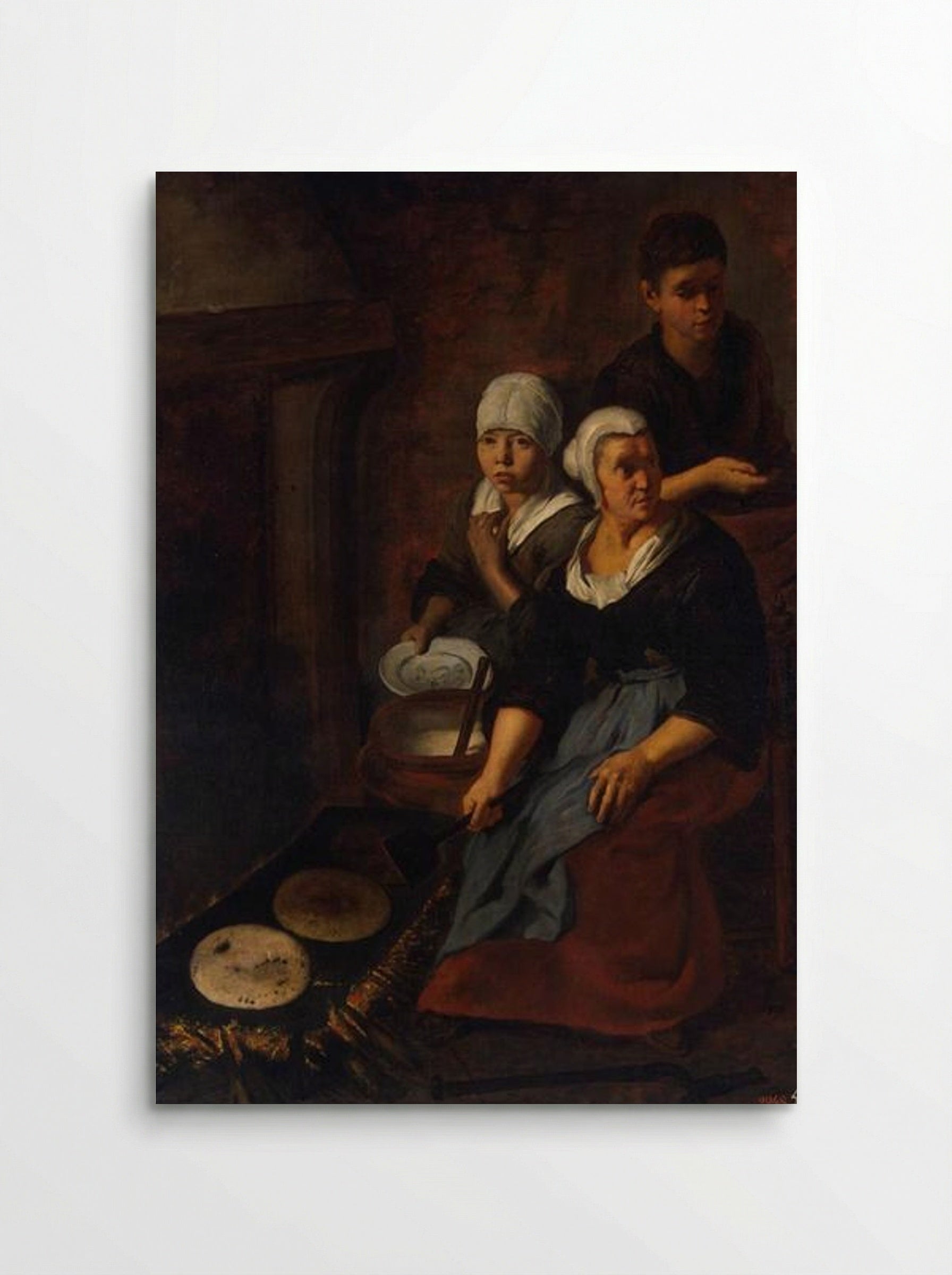
Baking of Flat Cakes - Bartolomé Esteban Murillo
Archival giclée
Frames arrive ready to hang
Secure checkout
Made to order
Description
A genre painting by Bartolomé Esteban Murillo, "Baking of Flat Cakes" depicts a domestic scene of an older woman baking flat cakes with two children looking on. The work captures a moment of everyday life in 17th-century Spain.
Bartolomé Esteban Murillo's "Baking of Flat Cakes" presents a scene of everyday life, a genre subject that gained popularity in 17th-century Europe. Murillo, a prominent figure in the Spanish Baroque period, was known for his religious paintings and his sympathetic depictions of the poor and working class. This work, painted in oil on canvas, showcases his ability to capture the humanity of his subjects with sensitivity and realism. The painting depicts a domestic interior where an older woman, possibly a mother or grandmother, is baking flat cakes on a griddle. A young girl watches attentively, holding a plate, while a boy looks on from the background. The composition is arranged to draw the viewer's eye to the central figure and the activity of baking. The colour palette is warm and earthy, with tones of brown, red, and ochre dominating the scene. Light filters into the room, illuminating the faces and highlighting the textures of the clothing and objects. Murillo's attention to detail and his ability to convey emotion make this painting a compelling example of genre painting. It offers a glimpse into the daily life of ordinary people in 17th-century Spain, capturing a moment of quiet domesticity.
Return policy
Because every print is made to order, we don't offer change-of-mind returns, refunds or exchanges. If your order arrives faulty, damaged or incorrect, we'll replace it free of charge — just contact us within 48 hours of delivery. See our refunds page for full details.
Shipping
We ship worldwide, printing at the production hub nearest to your delivery address. Delivery times and costs vary by destination — you'll see the options available to you at checkout.
Manufacturing
Each print is produced to order using 12-colour giclée printing on FSC-certified archival paper. Designed in Britain and printed at your nearest production hub to reduce waste and speed up delivery.
Baking of Flat Cakes - Bartolomé Esteban Murillo

Artist Biography
Bartolomé Esteban Murillo
He was born in Seville in late 1617, the youngest of fourteen children. His father was a barber surgeon. Both parents died before he was eleven, and he was raised by an older sister and her husband, also a barber. He studied in the workshop of Juan del Castillo, his uncle and godfather, and absorbed the realism of Zurbaran and Ribera. In 1645 he received his first major commission: eleven canvases for the convent of San Francisco in Seville. The success was decisive.
Seville became his entire world. He rarely left. In 1660 he co-founded and became first president of the city's Academy of Painting. His religious paintings, particularly his Immaculate Conceptions, were reproduced and imitated across the Catholic world for the next two centuries. He also painted contemporary street life: flower girls, beggars, street urchins, recorded with an affectionate realism that constitutes a documentary record of seventeenth-century Andalusia.
For two hundred years after his death he was considered one of the greatest painters who ever lived, ranked alongside Raphael and Titian. Then opinion turned. By the late nineteenth century his religious canvases were dismissed as sentimental and treacly, and he was nearly written out of art history altogether. The reassessment continues; the sentimentality charge has not entirely lifted.
Our Features
Designed for Lasting Impact
Specific Features
Every Solis piece is made to order with archival, gallery-quality materials built to last.
- Museum-grade giclée printing for rich, fade-resistant colour
- Archival matte fine-art paper, FSC-certified
- Multiple sizes and framing options available
- Frames in black, natural wood, dark wood or white
- Framed prints arrive ready to hang
Care & Cleaning
To keep your artwork looking its best:
- Dust gently with a soft, dry cloth
- Avoid prolonged direct sunlight
- Never use liquid cleaners on the print or canvas surface
- Keep in a dry, room-temperature space
- Handle prints with clean, dry hands
Materials & Sizing
Museum-grade giclée on FSC-certified archival matte paper, with framed and canvas options.
- Paper sizes: A4, A3, A2, A1, A0 and B2 (50×70 cm)
- Canvas: XS (20×30 cm) to Large (60×90 cm)
- Frames: black, natural wood, dark wood or white
Why Choose Us ?
Damage-free delivery guarantee
Fast Shipping
Museum-Quality Materials
Artist Biography
Bartolomé Esteban Murillo
He was born in Seville in late 1617, the youngest of fourteen children. His father was a barber surgeon. Both parents died before he was eleven, and he was raised by an older sister and her husband, also a barber. He studied in the workshop of Juan del Castillo, his uncle and godfather, and absorbed the realism of Zurbaran and Ribera. In 1645 he received his first major commission: eleven canvases for the convent of San Francisco in Seville. The success was decisive.
Seville became his entire world. He rarely left. In 1660 he co-founded and became first president of the city's Academy of Painting. His religious paintings, particularly his Immaculate Conceptions, were reproduced and imitated across the Catholic world for the next two centuries. He also painted contemporary street life: flower girls, beggars, street urchins, recorded with an affectionate realism that constitutes a documentary record of seventeenth-century Andalusia.
For two hundred years after his death he was considered one of the greatest painters who ever lived, ranked alongside Raphael and Titian. Then opinion turned. By the late nineteenth century his religious canvases were dismissed as sentimental and treacly, and he was nearly written out of art history altogether. The reassessment continues; the sentimentality charge has not entirely lifted.
You May Also Like