

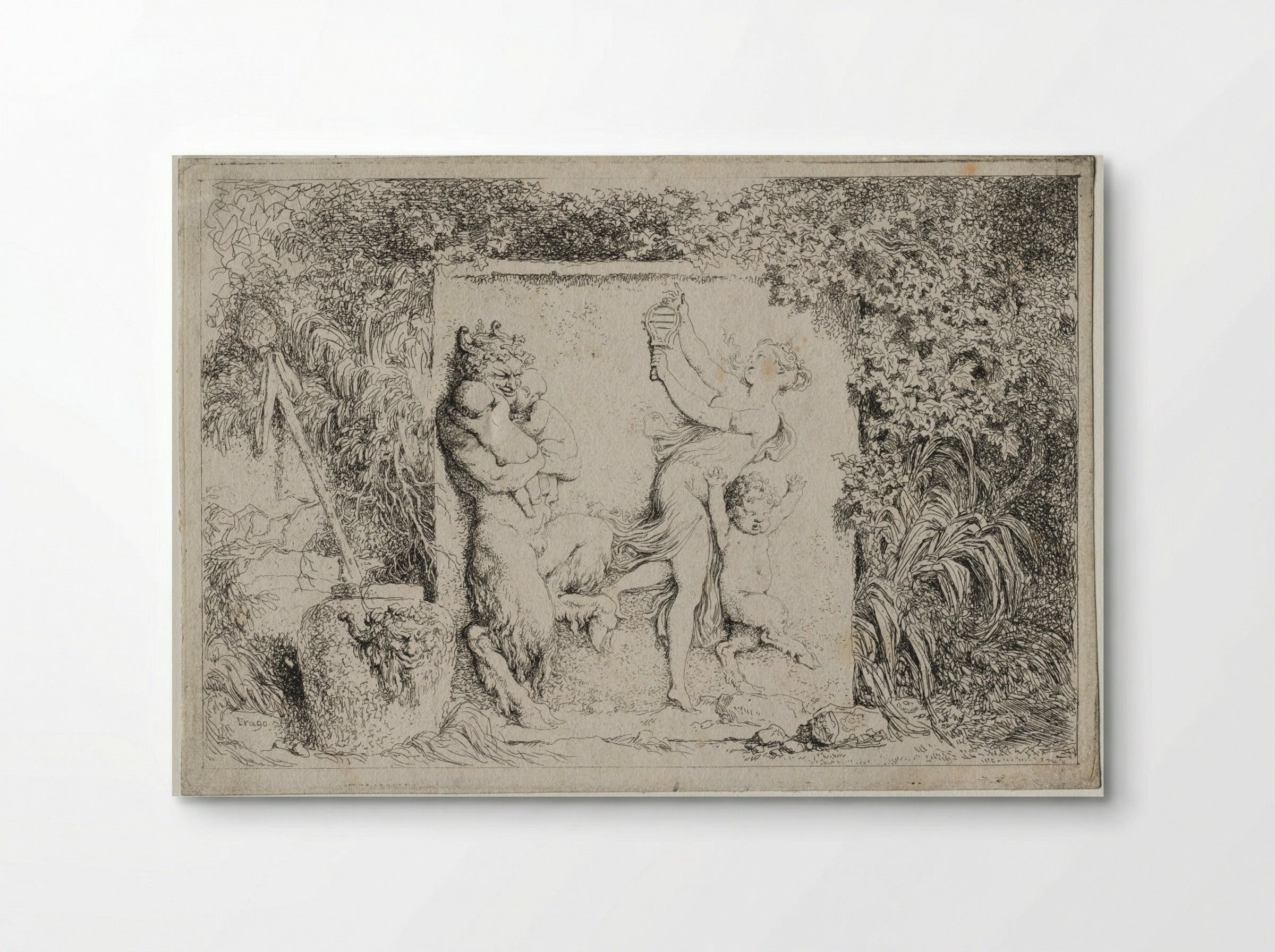
Bacchanales: The Satyr's Dance - Jean-Honoré Fragonard
Archival giclée
Frames arrive ready to hang
Secure checkout
Made to order
Description
A dynamic etching by Jean-Honoré Fragonard depicting a mythological dance of satyrs and figures within a lush, woodland setting.
This etching by Jean-Honoré Fragonard captures a scene of mythological revelry. The composition centres on a satyr, a figure from classical antiquity, who holds a child while interacting with a dancing female figure. The figures are positioned against a textured, stone-like backdrop, which is framed by dense, etched foliage that suggests a secluded woodland setting. A large, ornate vessel sits in the lower left corner, adding to the classical atmosphere of the scene. Fragonard employs a light, energetic line quality characteristic of his graphic work. The etching technique allows for a sense of spontaneity, with quick, flicking strokes defining the foliage and the musculature of the figures. The movement of the dancers is conveyed through the fluid lines of their drapery and the dynamic positioning of their limbs. The contrast between the dark, dense vegetation and the lighter, central panel creates a clear visual focus on the interaction between the satyr and his companions. This work reflects the interest in classical themes that permeated French art during the eighteenth century. Rather than a rigid or formal interpretation, Fragonard approaches the subject with a sense of playfulness and ease. The etching demonstrates his ability to translate the fluid, painterly qualities of his brushwork into the more disciplined medium of printmaking. The scene is devoid of heavy moralising, focusing instead on the rhythmic energy of the dance and the pastoral environment. It provides a glimpse into the artist's private explorations of mythological subjects, which often allowed for a greater degree of stylistic freedom than his commissioned paintings. The print remains a fine example of the technical skill and imaginative spirit that defined the Rococo period in France.
Return policy
Because every print is made to order, we don't offer change-of-mind returns, refunds or exchanges. If your order arrives faulty, damaged or incorrect, we'll replace it free of charge — just contact us within 48 hours of delivery. See our refunds page for full details.
Shipping
We ship worldwide, printing at the production hub nearest to your delivery address. Delivery times and costs vary by destination — you'll see the options available to you at checkout.
Manufacturing
Each print is produced to order using 12-colour giclée printing on FSC-certified archival paper. Designed in Britain and printed at your nearest production hub to reduce waste and speed up delivery.
Care and materials
Specific Features
Every Solis piece is made to order with archival, gallery-quality materials built to last.
- Museum-grade giclée printing for rich, fade-resistant colour
- Archival matte fine-art paper, FSC-certified
- Multiple sizes and framing options available
- Frames in black, natural wood, dark wood or white
- Framed prints arrive ready to hang
Care & Cleaning
To keep your artwork looking its best:
- Dust gently with a soft, dry cloth
- Avoid prolonged direct sunlight
- Never use liquid cleaners on the print or canvas surface
- Keep in a dry, room-temperature space
- Handle prints with clean, dry hands
Materials & Sizing
Museum-grade giclée on FSC-certified archival matte paper, with framed and canvas options.
- Paper sizes: A4, A3, A2, A1, A0 and B2 (50×70 cm)
- Canvas: XS (20×30 cm) to Large (60×90 cm)
- Frames: black, natural wood, dark wood or white
Bacchanales: The Satyr's Dance - Jean-Honoré Fragonard

Artist Biography
Jean Honore Fragonard
He was born in Grasse, in Provence, in 1732. He trained under Boucher, the leading Rococo painter, won the Prix de Rome, and spent five years in Italy studying Tiepolo and the Baroque illusionists. He painted so-called figures de fantaisie, full portraits, in about an hour each. He was enormously prolific: over 550 paintings are attributed to him.
The Revolution destroyed his client base. The aristocracy who bought his paintings were dead, exiled, or ruined. Jacques-Louis David, the leading Revolutionary painter and stylistically his opposite, intervened on his behalf. David got Fragonard appointed to an administrative arts committee, which likely saved his life. This is remarkable: David was sending former aristocrats to the guillotine while protecting their favourite painter. Fragonard also helped organise what would become the Louvre's collection.
He lost his position under Napoleon and died in 1806. The story that he died eating an ice on a hot day is probably anecdotal but frequently repeated. His reputation collapsed after death and was not revived for fifty years.
Why Choose Us ?
Damage-free delivery guarantee
Fast Shipping
Museum-Quality Materials
You May Also Like