

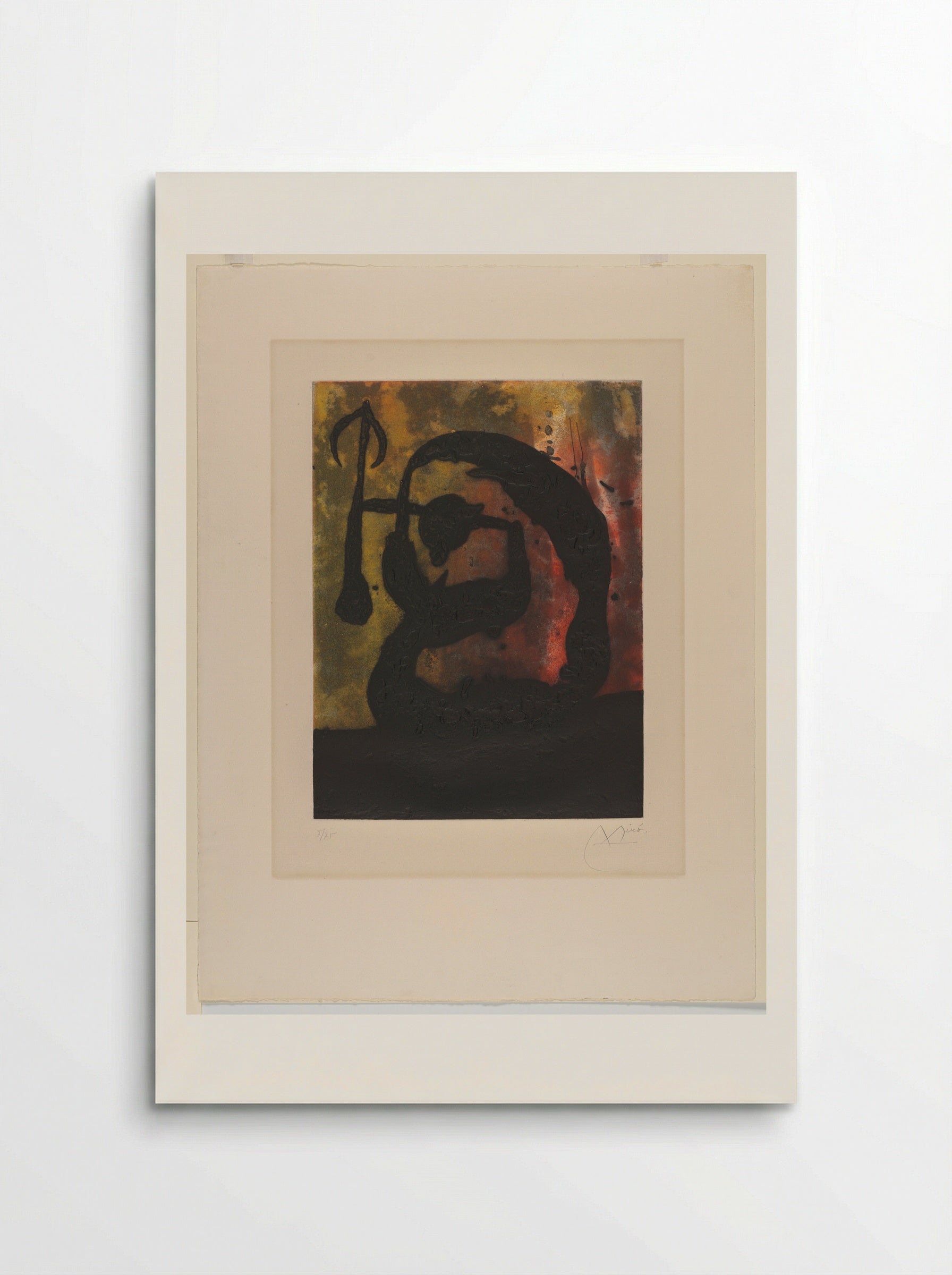
Arrowhead - Joan Miró
Archival giclée
Frames arrive ready to hang
Secure checkout
Made to order
Description
A striking abstract etching and aquatint by Joan Miró, featuring a bold, organic black form set against a textured, warm-toned background.
Joan Miró, a Catalan artist associated with the Surrealist movement, developed a unique visual language that prioritised spontaneity and the subconscious. In this work, the artist employs etching and aquatint to create a composition defined by stark contrasts. A heavy, black, organic form dominates the centre of the frame, suggesting a primitive or totemic figure. This central shape is juxtaposed against a background of mottled, atmospheric colour, where shades of ochre, burnt orange, and deep red bleed into one another. The print demonstrates Miró's interest in the physical properties of the medium. The ink application appears thick and tactile, particularly within the central silhouette, which possesses a matte, almost sculptural quality. The background, by contrast, exhibits the granular texture characteristic of aquatint, providing a sense of depth that prevents the image from appearing entirely flat. The titular arrowhead is rendered as a simplified, linear element, floating near the upper left of the main form. This inclusion introduces a sense of directionality and tension to the otherwise ambiguous arrangement of shapes. Miró often sought to strip away the superfluous, focusing instead on elemental signs and symbols. This print reflects his mature period, during which his work became increasingly focused on the interplay between solid mass and negative space. The composition avoids narrative clarity, inviting the viewer to engage with the work on a purely visual and sensory level. The signature at the bottom right confirms the artist's hand, while the edition numbering indicates its status as a limited production. This piece represents the artist's ability to balance controlled technical execution with a sense of raw, unmediated expression, characteristic of his later graphic output.
Return policy
Because every print is made to order, we don't offer change-of-mind returns, refunds or exchanges. If your order arrives faulty, damaged or incorrect, we'll replace it free of charge — just contact us within 48 hours of delivery. See our refunds page for full details.
Shipping
We ship worldwide, printing at the production hub nearest to your delivery address. Delivery times and costs vary by destination — you'll see the options available to you at checkout.
Manufacturing
Each print is produced to order using 12-colour giclée printing on FSC-certified archival paper. Designed in Britain and printed at your nearest production hub to reduce waste and speed up delivery.
Care and materials
Specific Features
Every Solis piece is made to order with archival, gallery-quality materials built to last.
- Museum-grade giclée printing for rich, fade-resistant colour
- Archival matte fine-art paper, FSC-certified
- Multiple sizes and framing options available
- Frames in black, natural wood, dark wood or white
- Framed prints arrive ready to hang
Care & Cleaning
To keep your artwork looking its best:
- Dust gently with a soft, dry cloth
- Avoid prolonged direct sunlight
- Never use liquid cleaners on the print or canvas surface
- Keep in a dry, room-temperature space
- Handle prints with clean, dry hands
Materials & Sizing
Museum-grade giclée on FSC-certified archival matte paper, with framed and canvas options.
- Paper sizes: A4, A3, A2, A1, A0 and B2 (50×70 cm)
- Canvas: XS (20×30 cm) to Large (60×90 cm)
- Frames: black, natural wood, dark wood or white
Arrowhead - Joan Miró

Artist Biography
Joan Miro
He grew up in Barcelona, the son of a goldsmith and watchmaker. He studied at the Escola de Belles Arts and at Francesc Gali's art school, where Gali made students draw objects by touch, blindfolded, to develop their sense of form. Miro went to Paris in 1920 and fell in with the Surrealists. Andre Breton called him 'the most Surrealist of us all', which was a compliment. Miro's paintings from this period look like dreams transcribed by someone who has never seen a dream depicted before: biomorphic shapes, stars, eyes, birds, and moons floating on flat fields of colour.
The Constellations series, twenty-three small gouaches painted during the Second World War, are his masterwork. He started them in Normandy as the German army advanced, continued in Palma de Mallorca after fleeing, and finished them in Barcelona. Each one is dense with interlocking forms connected by fine black lines, like a musical score or a star chart.
His late work includes monumental ceramics, tapestries, and public sculptures. The Barcelona airport has a floor mosaic. The Joan Miro Foundation on Montjuic, designed by his friend Josep Lluis Sert, opened in 1975. He burned canvases, stabbed them, walked on them. He was eighty-five and still trying to murder painting.
Why Choose Us ?
Damage-free delivery guarantee
Fast Shipping
Museum-Quality Materials
You May Also Like