

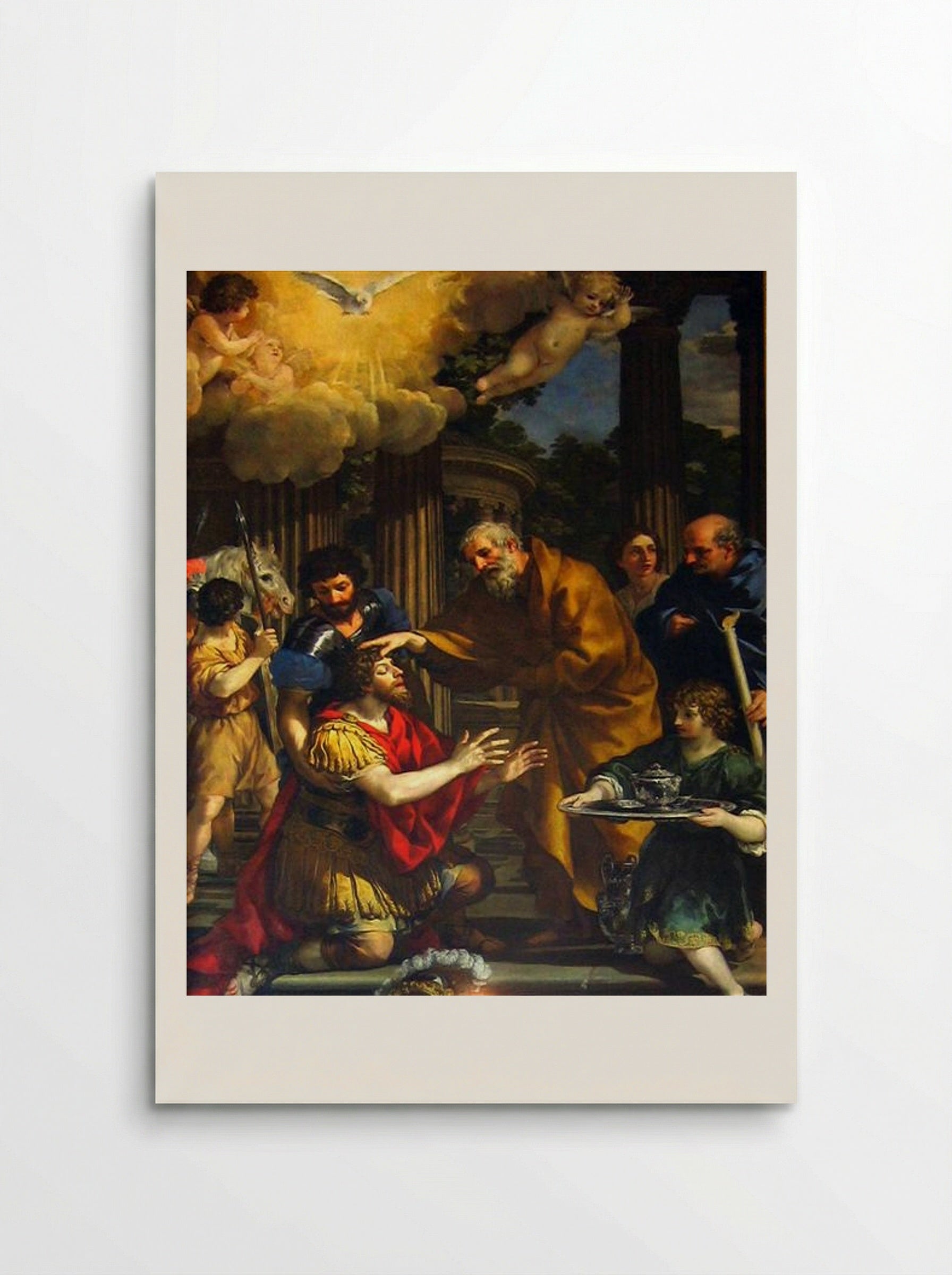
Ananias restoring the sight of Saint Paul - Pietro da Cortona
Archival giclée
Frames arrive ready to hang
Secure checkout
Made to order
Description
This oil on canvas by Pietro da Cortona captures the moment Ananias restores sight to Saint Paul. The Baroque painting features a dynamic composition, rich colours, and dramatic lighting.
Pietro da Cortona's oil on canvas depicts the biblical scene of Ananias restoring sight to Saint Paul. The composition is filled with figures, arranged in a dynamic and theatrical manner typical of the Baroque period. Paul, kneeling and draped in a red cloak, is the centre of attention as Ananias lays his hands upon him. The figures surrounding them, including soldiers, onlookers, and angels above, contribute to the dramatic intensity of the moment. The artist's use of colour and light enhances the emotional impact of the scene. Warm tones dominate the palette, with reds, golds, and browns creating a sense of richness and depth. Light streams down from above, illuminating the central figures and casting shadows that add to the overall drama. The architectural setting, with its classical columns and arches, provides a grand backdrop for the event. Pietro da Cortona (1596-1669) was a leading figure of the Roman Baroque. He was known for his grand decorative schemes and his ability to create dynamic and emotionally charged compositions. His work often combined classical elements with a Baroque sensibility, resulting in a style that was both elegant and dramatic. This painting exemplifies his mastery of composition, colour, and light, and his ability to bring biblical stories to life.
Return policy
Because every print is made to order, we don't offer change-of-mind returns, refunds or exchanges. If your order arrives faulty, damaged or incorrect, we'll replace it free of charge — just contact us within 48 hours of delivery. See our refunds page for full details.
Shipping
We ship worldwide, printing at the production hub nearest to your delivery address. Delivery times and costs vary by destination — you'll see the options available to you at checkout.
Manufacturing
Each print is produced to order using 12-colour giclée printing on FSC-certified archival paper. Designed in Britain and printed at your nearest production hub to reduce waste and speed up delivery.
Ananias restoring the sight of Saint Paul - Pietro da Cortona

Artist Biography
Pietro Da Cortona
He was born Pietro Berrettini in Cortona, Tuscany, around 1596 and trained in Rome under Andrea Commodi and Baccio Ciarpi. He served as head of the Accademia di San Luca from 1634 to 1638. His architectural works include the facades of Santa Maria della Pace and Santa Maria in Via Lata, making him one of the rare artists of the period to excel equally as painter, architect and interior decorator.
His frescoes in the Palazzo Pitti in Florence (1637 to 1647) were his other major decorative cycle. He died in Rome in 1669, at seventy-two.
His influence on Baroque ceiling painting was immediate and lasting: every illusionistic fresco produced in Rome for the next century took the Barberini ceiling as its starting point, whether following Cortona's method or reacting against it. Few single paintings have shaped an entire tradition so decisively.
Our Features
Designed for Lasting Impact
Specific Features
Every Solis piece is made to order with archival, gallery-quality materials built to last.
- Museum-grade giclée printing for rich, fade-resistant colour
- Archival matte fine-art paper, FSC-certified
- Multiple sizes and framing options available
- Frames in black, natural wood, dark wood or white
- Framed prints arrive ready to hang
Care & Cleaning
To keep your artwork looking its best:
- Dust gently with a soft, dry cloth
- Avoid prolonged direct sunlight
- Never use liquid cleaners on the print or canvas surface
- Keep in a dry, room-temperature space
- Handle prints with clean, dry hands
Materials & Sizing
Museum-grade giclée on FSC-certified archival matte paper, with framed and canvas options.
- Paper sizes: A4, A3, A2, A1, A0 and B2 (50×70 cm)
- Canvas: XS (20×30 cm) to Large (60×90 cm)
- Frames: black, natural wood, dark wood or white
Why Choose Us ?
Damage-free delivery guarantee
Fast Shipping
Museum-Quality Materials
Artist Biography
Pietro da Cortona
He was born Pietro Berrettini in Cortona, Tuscany, around 1596 and trained in Rome under Andrea Commodi and Baccio Ciarpi. He served as head of the Accademia di San Luca from 1634 to 1638. His architectural works include the facades of Santa Maria della Pace and Santa Maria in Via Lata, making him one of the rare artists of the period to excel equally as painter, architect and interior decorator.
His frescoes in the Palazzo Pitti in Florence (1637 to 1647) were his other major decorative cycle. He died in Rome in 1669, at seventy-two.
His influence on Baroque ceiling painting was immediate and lasting: every illusionistic fresco produced in Rome for the next century took the Barberini ceiling as its starting point, whether following Cortona's method or reacting against it. Few single paintings have shaped an entire tradition so decisively.
You May Also Like