

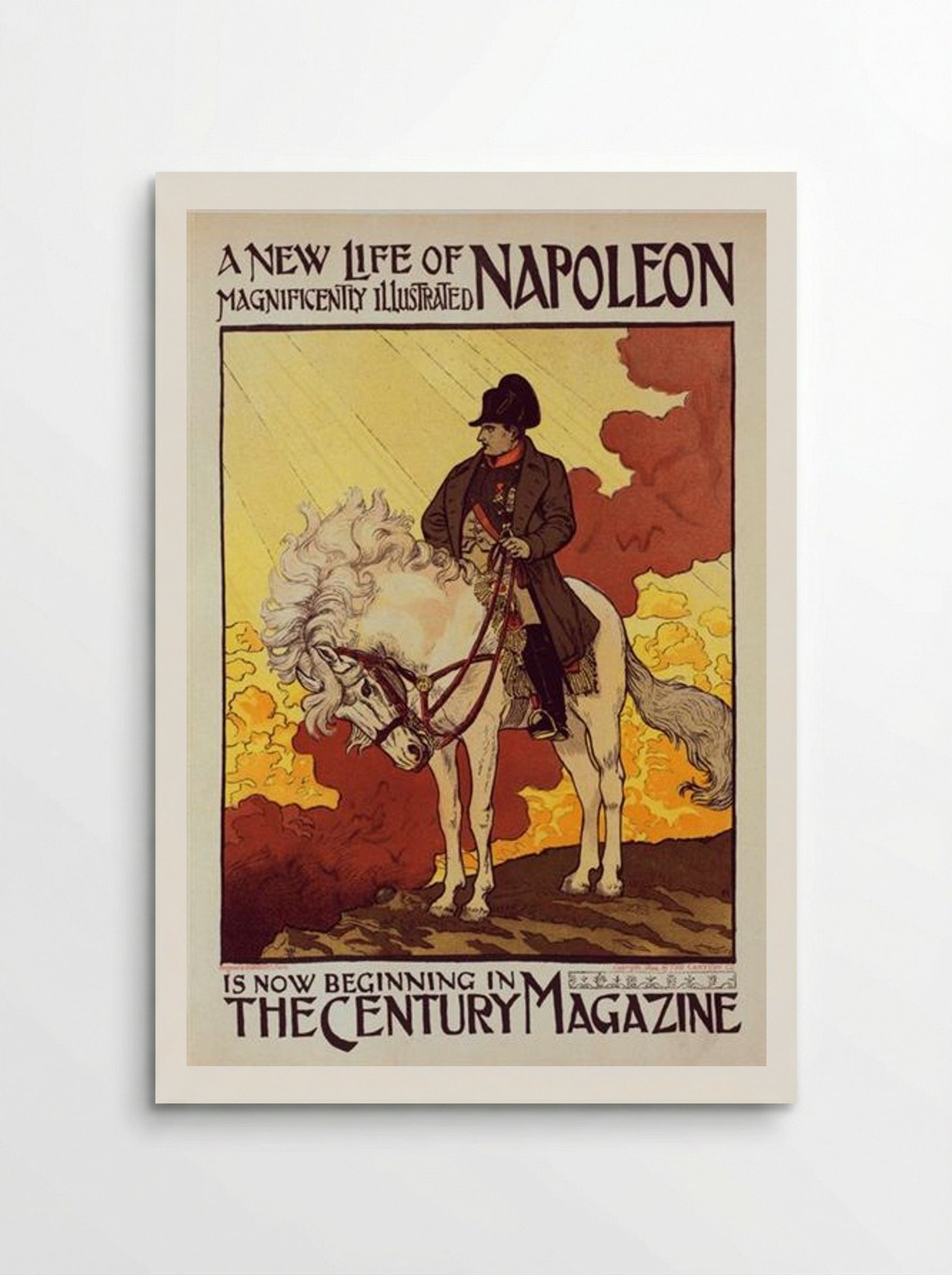
Affiche pour The Century Magazine, Napoléon - Eugène Grasset
Archival giclée
Ready to hang
Secure checkout
Made to order
Description
A 1894 Art Nouveau lithograph by Eugène Grasset, designed as a promotional poster for The Century Magazine featuring Napoleon Bonaparte.
This lithographic poster by Eugène Grasset, created in 1894, promotes a biographical series on Napoleon Bonaparte for The Century Magazine. Grasset, a figure in the development of the Art Nouveau style, employs a clear, graphic approach that reflects his background in architectural design and decorative arts. The composition features Napoleon mounted on a white horse, set against a backdrop of stylised, billowing clouds and a radiant sky. The work demonstrates the influence of Japanese woodblock prints, particularly in the use of bold outlines and flattened perspective. The colour palette is restricted to a few tones, allowing the forms to remain legible from a distance, which was a requirement for effective street advertising during the late nineteenth century. The lettering is integrated into the design, a hallmark of Grasset's approach to graphic communication. Grasset was instrumental in the transition from Victorian-era illustration to the more fluid, organic forms of the Art Nouveau movement. His work often combined medieval motifs with modern printing techniques. In this piece, the figure of Napoleon is rendered with a sense of stoic authority, while the surrounding environment is simplified into decorative shapes. The contrast between the dark silhouette of the rider and the warm, golden hues of the background creates a balanced visual hierarchy. This print offers a glimpse into the commercial art practices of the 1890s, where fine art techniques were applied to mass-produced media to capture public attention.
Return policy
Because every print is made to order, we don't offer change-of-mind returns, refunds or exchanges. If your order arrives faulty, damaged or incorrect, we'll replace it free of charge — just contact us within 48 hours of delivery. EU customers have a 14-day cooling-off right. See our refunds page for full details.
Shipping
We ship worldwide, printing at the production hub nearest to your delivery address. Delivery times and costs vary by destination — you'll see the options available to you at checkout.
Manufacturing
Each print is produced to order using 12-colour giclée printing on FSC-certified archival paper. Designed in Britain and printed at your nearest production hub to reduce waste and speed up delivery.
Affiche pour The Century Magazine, Napoléon - Eugène Grasset
Our Features
Designed for Lasting Impact
Specific Features
Every Solis piece is made to order with archival, gallery-quality materials built to last.
- Museum-grade giclée printing for rich, fade-resistant colour
- Archival matte fine-art paper, FSC-certified
- Choose poster, framed print, canvas or framed canvas
- Frames in black, natural wood, dark wood or white
- Framed prints arrive ready to hang
Care & Cleaning
To keep your artwork looking its best:
- Dust gently with a soft, dry cloth
- Avoid prolonged direct sunlight
- Never use liquid cleaners on the print or canvas surface
- Keep in a dry, room-temperature space
- Handle prints with clean, dry hands
Materials & Sizing
Museum-grade giclée on FSC-certified archival matte paper, with framed and canvas options.
- Paper sizes: A4, A3, A2, A1, A0 and B2 (50×70 cm)
- Canvas: XS (20×30 cm) to Large (60×90 cm)
- Frames: black, natural wood, dark wood or white
Why Choose Us ?
100% Satisfaction Guarantee
Fast Shipping
Museum-Quality Materials

Artist Biography
Eugène Grasset
Grasset was born in Lausanne in 1845, the son of a cabinetmaker and sculptor who taught him to use a chisel before he could draw. He studied drawing under Francois Bocion, then architecture in Zurich. A trip to Egypt after completing his education left a permanent mark on his visual vocabulary. He moved to Paris in 1871 and began designing furniture, wallpapers, fabrics, tapestries, ceramics and jewellery before turning to graphic design in 1877.
Poster art became his primary medium. His style drew on Viollet-le-Duc's theories of decorative structure, Japanese woodblock prints and Egyptian ornament, combined into flowing compositions that helped define Art Nouveau before the term existed. The G. Peignot et Fils typefoundry introduced the "Grasset" typeface at the 1900 Universal Exhibition, an italic design he created for use on his posters. He also collaborated with the jeweller Henri Vever on pieces that merged Art Nouveau organic forms with mythological subjects.
He taught design at a succession of Paris institutions from 1890 until 1913, including the Ecole Guerin, the Ecole Estienne and the Academie de la Grande Chaumiere. His influence on the generation of designers who followed him was extensive but largely unacknowledged outside France. He died in 1917, at seventy-two.
You May Also Like