

Fine Art Poster
From £28
A giclée print on 200gsm matte fine art paper, using a twelve-colour process for accurate, fade-resistant colour. Supplied unframed, delivered flat or rolled.



Archival giclée
Frames arrive ready to hang
Secure checkout
Made to order
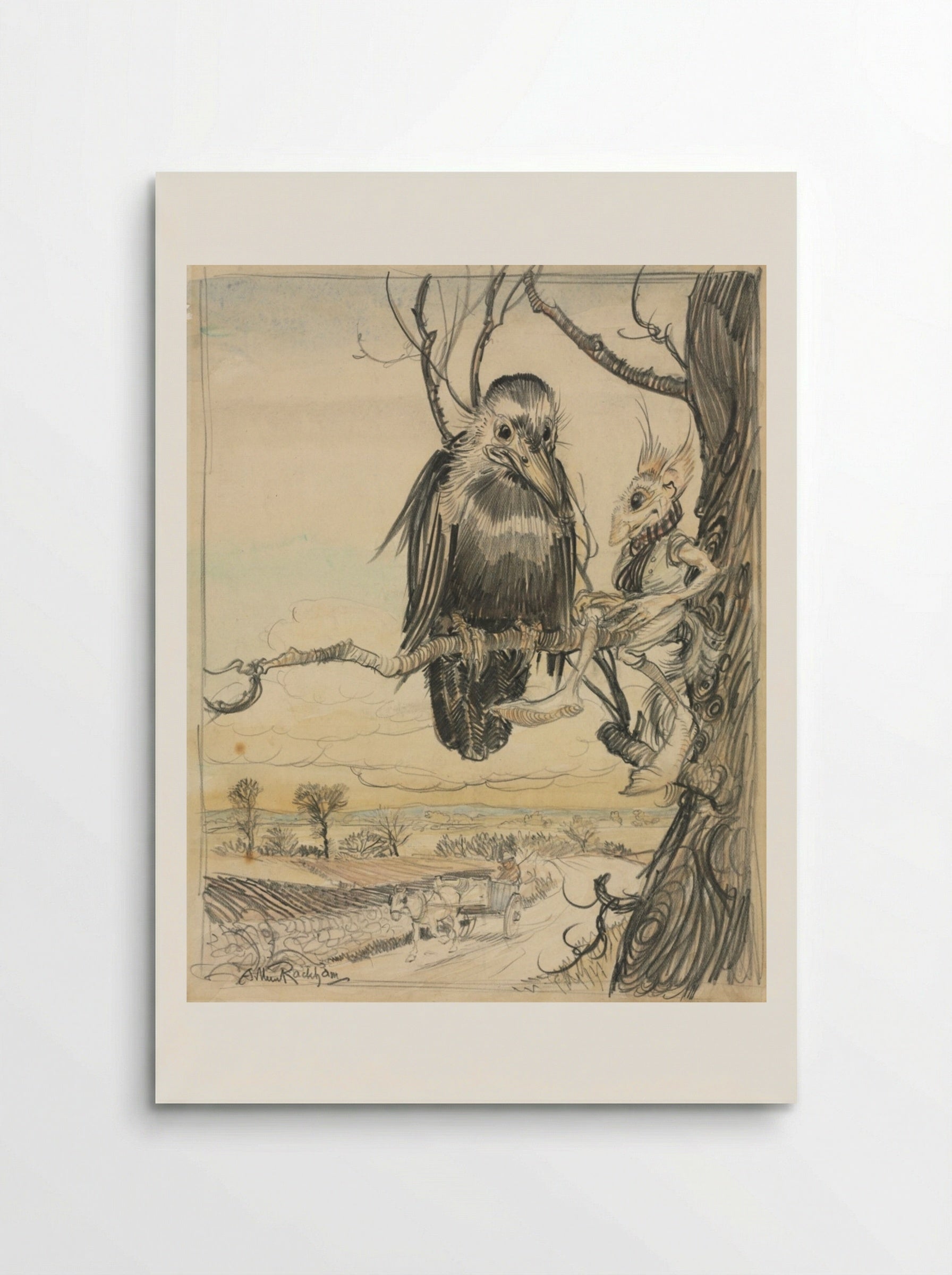
A classic fantasy illustration by Arthur Rackham, featuring a crow and a squirrel perched in a tree, rendered in his signature ink and watercolour style.
Arthur Rackham remains one of the most recognisable figures of the British Golden Age of Illustration. His work is defined by a distinct technical approach, combining fine pen and ink lines with a restrained, muted watercolour palette. In this piece, Rackham displays his characteristic ability to anthropomorphise natural subjects. The crow and the squirrel are rendered with expressive, almost human-like features, perched upon a gnarled tree branch that dominates the foreground. Rackham often employed a specific compositional strategy, placing his primary subjects in the immediate foreground while allowing a distant, sketch-like view of the countryside to recede into the background. Here, a small horse-drawn cart travels along a quiet road, providing a sense of scale and atmosphere that contrasts with the larger, more detailed figures in the tree. The line work is precise and rhythmic, showing the artist's background in commercial illustration and his mastery of the ink medium. The subtle application of colour, primarily in the warm tones of the sky and the earthy hues of the tree trunk, ensures that the focus remains on the interaction between the two creatures. This work reflects the period's fascination with folklore and the natural world, themes that Rackham explored throughout his career. His style is marked by a balance between observation and imagination, creating scenes that feel grounded in reality yet possess a clear narrative quality. The paper texture and the visible pencil under-drawings offer a glimpse into his working process, revealing the careful construction behind his finished illustrations. This print captures the quiet, observational nature of his art, making it a representative example of his contribution to early twentieth-century British illustration.
Because every print is made to order, we don't offer change-of-mind returns, refunds or exchanges. If your order arrives faulty, damaged or incorrect, we'll replace it free of charge — just contact us within 48 hours of delivery. See our refunds page for full details.
We ship worldwide, printing at the production hub nearest to your delivery address. Delivery times and costs vary by destination — you'll see the options available to you at checkout.
Each print is produced to order using 12-colour giclée printing on FSC-certified archival paper. Designed in Britain and printed at your nearest production hub to reduce waste and speed up delivery.

Artist Biography
Our Features
Designed for Lasting Impact
Every Solis piece is made to order with archival, gallery-quality materials built to last.
To keep your artwork looking its best:
Museum-grade giclée on FSC-certified archival matte paper, with framed and canvas options.
Made to order
Every piece is printed to order. These are the five finishes, and what makes each one different.
From £28
A giclée print on 200gsm matte fine art paper, using a twelve-colour process for accurate, fade-resistant colour. Supplied unframed, delivered flat or rolled.

From £45
The same fine art print in a solid wood frame with UV-protective acrylic glaze and rigid backing. Five frame colours. Arrives ready to hang.

From £85
A deeper solid wood frame: 33mm deep with a 20mm face and Perspex glaze. The print sits unmounted for a clean gallery presentation. Black, white or natural.

From £30
Hand-stretched canvas with neat gallery-wrapped edges, giving the artwork surface texture and depth. Arrives ready to hang.

From £135
Stretched canvas set in a floating wood frame, our most substantial finish. Arrives ready to hang.
Why Choose Us ?
Damage-free delivery guarantee
Fast Shipping
Museum-Quality Materials
Artist Biography
Arthur Rackham
You May Also Like
We use cookies to measure our marketing and see which prints people love.We use cookies to measure our marketing.
By continuing to browse, you agree · Privacy Policy