

Fine Art Poster
From £28
A giclée print on 200gsm matte fine art paper, using a twelve-colour process for accurate, fade-resistant colour. Supplied unframed, delivered flat or rolled.



Archival giclée
Frames arrive ready to hang
Secure checkout
Made to order
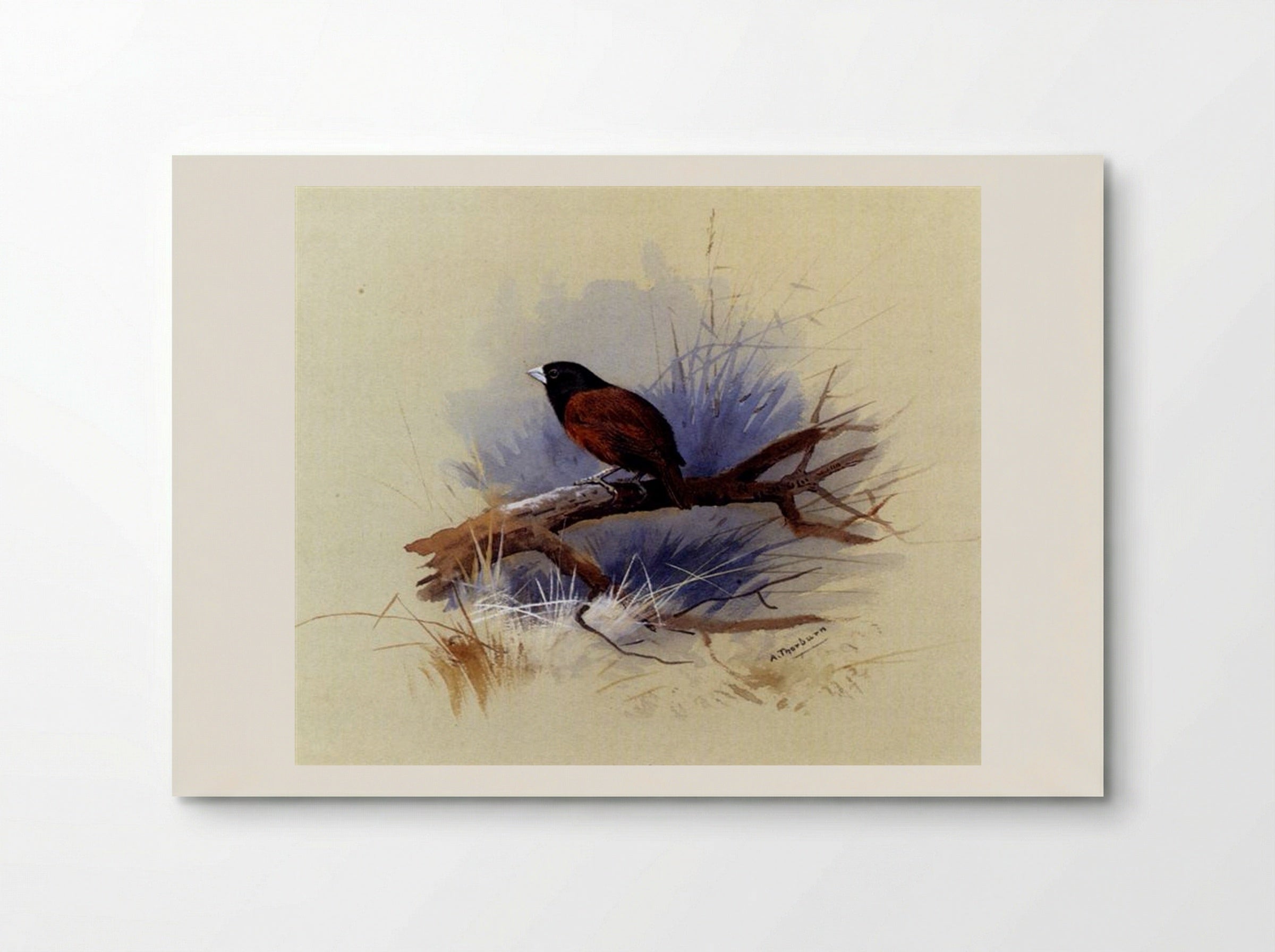
A precise watercolour study of a Nepalese black-headed nun by the acclaimed British ornithological illustrator Archibald Thorburn.
Archibald Thorburn, a Scottish artist known for his precise depictions of British wildlife, captures the Nepalese black-headed nun (Lonchura malacca) in this watercolour study. The bird, a member of the estrildid finch family, is rendered with the anatomical accuracy that defined Thorburn's career as a premier illustrator of birds. His technique relies on a controlled application of pigment, allowing the paper to provide the necessary highlights while building form through subtle washes. The composition is sparse, focusing entirely on the subject perched upon a weathered branch. Thorburn uses a muted palette to ground the bird within its environment, employing soft blue-grey washes in the background to suggest a misty or distant habitat. This approach draws the eye directly to the contrast between the bird's dark, hooded head and its warm, chestnut-brown plumage. The branch itself is depicted with quick, confident brushwork, showing the texture of bark and the slight decay of the wood. Thorburn was a frequent contributor to scientific publications and ornithological volumes during the late nineteenth and early twentieth centuries. His work often appeared in books where clarity and identification were paramount. Unlike many of his contemporaries who favoured dramatic action, Thorburn preferred to observe his subjects in moments of stillness. This print reflects his ability to balance scientific observation with a quiet, aesthetic sensibility. The work remains a fine example of the tradition of natural history illustration, where the artist acts as both a recorder of species and a skilled painter of light and form.
Because every print is made to order, we don't offer change-of-mind returns, refunds or exchanges. If your order arrives faulty, damaged or incorrect, we'll replace it free of charge — just contact us within 48 hours of delivery. See our refunds page for full details.
We ship worldwide, printing at the production hub nearest to your delivery address. Delivery times and costs vary by destination — you'll see the options available to you at checkout.
Each print is produced to order using 12-colour giclée printing on FSC-certified archival paper. Designed in Britain and printed at your nearest production hub to reduce waste and speed up delivery.

Artist Biography
Our Features
Designed for Lasting Impact
Every Solis piece is made to order with archival, gallery-quality materials built to last.
To keep your artwork looking its best:
Museum-grade giclée on FSC-certified archival matte paper, with framed and canvas options.
Made to order
Every piece is printed to order. These are the five finishes, and what makes each one different.
From £28
A giclée print on 200gsm matte fine art paper, using a twelve-colour process for accurate, fade-resistant colour. Supplied unframed, delivered flat or rolled.

From £45
The same fine art print in a solid wood frame with UV-protective acrylic glaze and rigid backing. Five frame colours. Arrives ready to hang.

From £85
A deeper solid wood frame: 33mm deep with a 20mm face and Perspex glaze. The print sits unmounted for a clean gallery presentation. Black, white or natural.

From £30
Hand-stretched canvas with neat gallery-wrapped edges, giving the artwork surface texture and depth. Arrives ready to hang.

From £135
Stretched canvas set in a floating wood frame, our most substantial finish. Arrives ready to hang.
Why Choose Us ?
Damage-free delivery guarantee
Fast Shipping
Museum-Quality Materials
Artist Biography
Archibald Thorburn
You May Also Like
We use cookies to measure our marketing and see which prints people love.We use cookies to measure our marketing.
By continuing to browse, you agree · Privacy Policy