

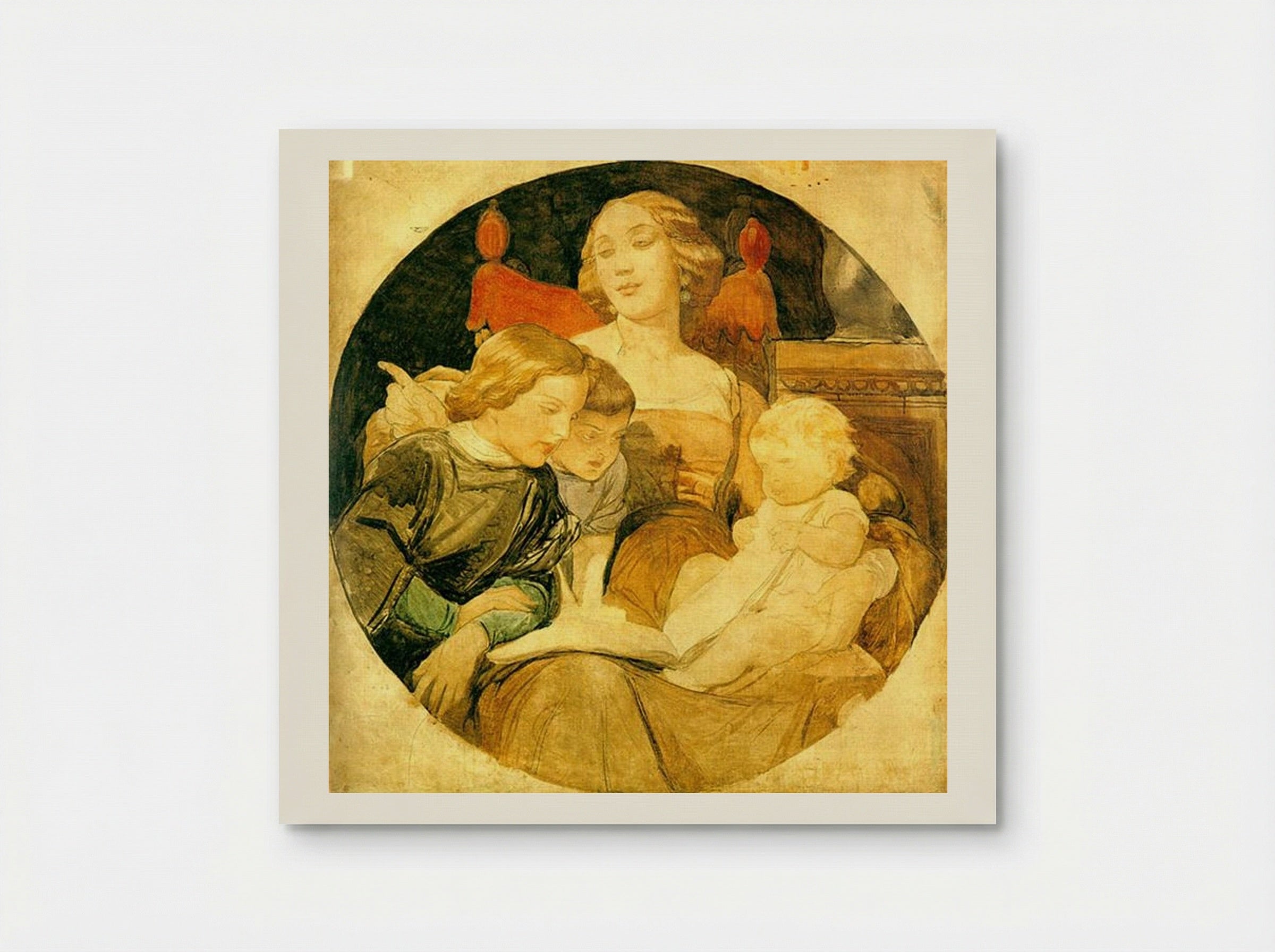
A Family Scene - Paul Delaroche
Archival giclée
Frames arrive ready to hang
Secure checkout
Made to order
Description
A tender, circular composition by Paul Delaroche depicting a mother and her children sharing a book, rendered in warm, golden tones.
This work by Paul Delaroche presents a domestic grouping within a circular composition. The artist, known for his historical paintings and precise draughtsmanship, shifts his focus here to a quiet, intimate moment. A mother sits with her children, their attention directed towards an open book held in their collective grasp. The figures are arranged in a pyramidal structure, a common device in nineteenth-century European painting to create stability and focus. Delaroche employs a warm, golden-toned palette that unifies the figures with their surroundings. The lighting is soft, suggesting an indoor setting where the primary source of illumination falls gently upon the faces and the pages of the book. The mother's expression is one of calm observation, while the children display varying degrees of engagement with the text. The brushwork remains controlled, reflecting the artist's training within the French Academic tradition, where clarity of form and balanced composition were prioritised over expressive, loose application of paint. The circular format, or tondo, encourages the viewer to focus on the central interaction between the figures. By removing extraneous background details, Delaroche directs the eye to the shared activity of reading. The clothing is rendered with subtle attention to texture, though the artist avoids excessive detail to maintain the focus on the emotional connection between the family members. This piece offers a glimpse into the domestic ideals of the period, capturing a moment of quiet education and maternal care. The work remains a representative example of the artist's ability to imbue his subjects with a sense of gravity and human warmth, even when working outside of his usual historical or religious themes.
Return policy
Because every print is made to order, we don't offer change-of-mind returns, refunds or exchanges. If your order arrives faulty, damaged or incorrect, we'll replace it free of charge — just contact us within 48 hours of delivery. See our refunds page for full details.
Shipping
We ship worldwide, printing at the production hub nearest to your delivery address. Delivery times and costs vary by destination — you'll see the options available to you at checkout.
Manufacturing
Each print is produced to order using 12-colour giclée printing on FSC-certified archival paper. Designed in Britain and printed at your nearest production hub to reduce waste and speed up delivery.
Care and materials
Specific Features
Every Solis piece is made to order with archival, gallery-quality materials built to last.
- Museum-grade giclée printing for rich, fade-resistant colour
- Archival matte fine-art paper, FSC-certified
- Multiple sizes and framing options available
- Frames in black, natural wood, dark wood or white
- Framed prints arrive ready to hang
Care & Cleaning
To keep your artwork looking its best:
- Dust gently with a soft, dry cloth
- Avoid prolonged direct sunlight
- Never use liquid cleaners on the print or canvas surface
- Keep in a dry, room-temperature space
- Handle prints with clean, dry hands
Materials & Sizing
Museum-grade giclée on FSC-certified archival matte paper, with framed and canvas options.
- Paper sizes: A4, A3, A2, A1, A0 and B2 (50×70 cm)
- Canvas: XS (20×30 cm) to Large (60×90 cm)
- Frames: black, natural wood, dark wood or white
A Family Scene - Paul Delaroche

Artist Biography
Paul Delaroche
He was born in 1797 in Paris and specialised in English and French history scenes because they sold well. In his own lifetime, his commercial success often exceeded both Ingres and Delacroix. Upon first seeing the daguerreotype in 1839, he reportedly declared: from today, painting is dead.
He married Louise Vernet, daughter of the painter Horace Vernet, in 1835. She was the absorbing passion of his life. She died in 1845, aged thirty-one. He sketched her on her deathbed; the drawing survives at the Walters Art Museum in Baltimore. He never recovered from the loss. His later work turned exclusively to religious subjects. He died in 1856.
Why Choose Us ?
Damage-free delivery guarantee
Fast Shipping
Museum-Quality Materials
You May Also Like