

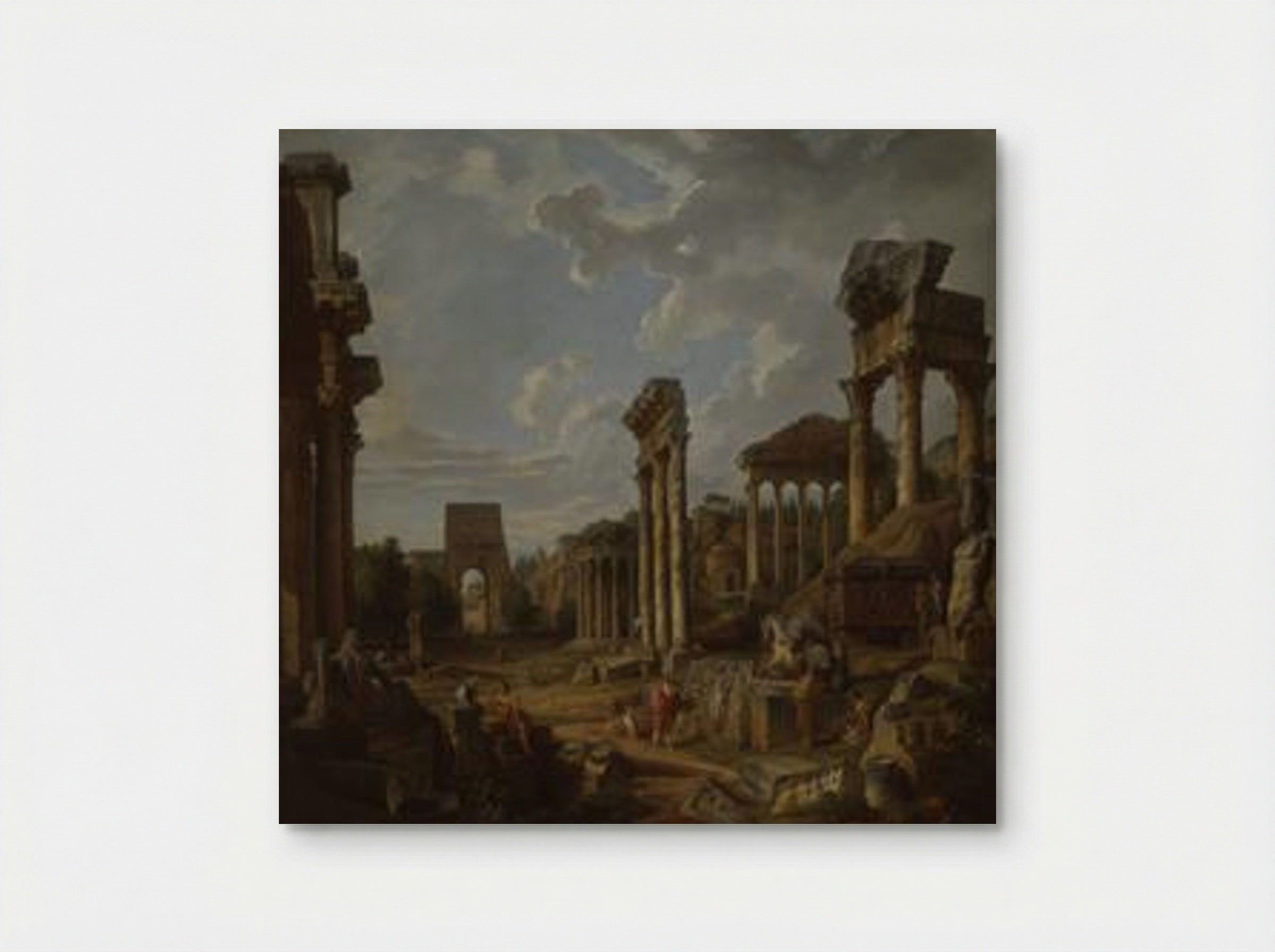
A Capriccio of the Roman Forum - Giovanni Paolo Panini
Archival giclée
Frames arrive ready to hang
Secure checkout
Made to order
Description
This capriccio by Giovanni Paolo Panini depicts a fanciful arrangement of Roman Forum ruins. The painting features classical structures and small figures, rendered in muted earth tones under a soft, atmospheric light.
Giovanni Paolo Panini, an Italian painter and architect, is best known for his views of Rome, especially its ancient ruins. He often painted 'capricci', which are architectural fantasies that rearrange real elements into imaginary settings. Panini trained with figure painters in Rome before establishing himself as an independent artist. He gained recognition for his decorative work in Roman palaces and his easel paintings of Roman scenes. He taught at the Académie de France in Rome and was admitted to the Accademia di San Luca. 'A Capriccio of the Roman Forum' presents a fanciful arrangement of the Forum's ruins. The painting depicts a broad panorama of classical structures, including arches, columns, and fragmented buildings, under a sky with soft, billowing clouds. Small figures populate the scene, adding a sense of scale and human presence amid the grandeur of the ruins. The colour palette is dominated by earth tones, with muted browns, greys, and creams, accented by touches of red and blue in the figures' clothing. The light is diffused, creating a soft, atmospheric effect that unifies the composition.
Return policy
Because every print is made to order, we don't offer change-of-mind returns, refunds or exchanges. If your order arrives faulty, damaged or incorrect, we'll replace it free of charge — just contact us within 48 hours of delivery. See our refunds page for full details.
Shipping
We ship worldwide, printing at the production hub nearest to your delivery address. Delivery times and costs vary by destination — you'll see the options available to you at checkout.
Manufacturing
Each print is produced to order using 12-colour giclée printing on FSC-certified archival paper. Designed in Britain and printed at your nearest production hub to reduce waste and speed up delivery.
A Capriccio of the Roman Forum - Giovanni Paolo Panini

Artist Biography
Giovanni Paolo Panini
He was born in Piacenza in 1691 and trained under Giuseppe Natali, the stage designer Francesco Galli-Bibiena, and Andrea Galluzzi. He settled in Rome in 1711 and entered the studio of Benedetto Luti. His early career was in palace decoration: the Villa Patrizi (1719), the Palazzo de Carolis (1720) and the Seminario Romano (1721). But veduta painting, views of real and imagined Rome, became his principal occupation.
His vedute split into two modes. Some were topographically faithful; others were capricci, fanciful rearrangements of monuments that compressed centuries of Roman architecture into a single composition. Both types were bought by European collectors, royalty and Grand Tourists who wanted a portable version of the city to take home. The Spanish monarchs were particularly avid patrons; several Panini paintings remain in the Prado.
He taught perspective and optics at the French Academy in Rome, where his students included Hubert Robert and the stage designer Giovanni Niccolo Servandoni. His methods were later formalised into the "Panini projection", a mathematical technique for rendering panoramic views. He was elected director of the Accademia di San Luca in 1754. He died in Rome in 1765.
Our Features
Designed for Lasting Impact
Specific Features
Every Solis piece is made to order with archival, gallery-quality materials built to last.
- Museum-grade giclée printing for rich, fade-resistant colour
- Archival matte fine-art paper, FSC-certified
- Multiple sizes and framing options available
- Frames in black, natural wood, dark wood or white
- Framed prints arrive ready to hang
Care & Cleaning
To keep your artwork looking its best:
- Dust gently with a soft, dry cloth
- Avoid prolonged direct sunlight
- Never use liquid cleaners on the print or canvas surface
- Keep in a dry, room-temperature space
- Handle prints with clean, dry hands
Materials & Sizing
Museum-grade giclée on FSC-certified archival matte paper, with framed and canvas options.
- Paper sizes: A4, A3, A2, A1, A0 and B2 (50×70 cm)
- Canvas: XS (20×30 cm) to Large (60×90 cm)
- Frames: black, natural wood, dark wood or white
Why Choose Us ?
Damage-free delivery guarantee
Fast Shipping
Museum-Quality Materials
Artist Biography
Giovanni Paolo Panini
He was born in Piacenza in 1691 and trained under Giuseppe Natali, the stage designer Francesco Galli-Bibiena, and Andrea Galluzzi. He settled in Rome in 1711 and entered the studio of Benedetto Luti. His early career was in palace decoration: the Villa Patrizi (1719), the Palazzo de Carolis (1720) and the Seminario Romano (1721). But veduta painting, views of real and imagined Rome, became his principal occupation.
His vedute split into two modes. Some were topographically faithful; others were capricci, fanciful rearrangements of monuments that compressed centuries of Roman architecture into a single composition. Both types were bought by European collectors, royalty and Grand Tourists who wanted a portable version of the city to take home. The Spanish monarchs were particularly avid patrons; several Panini paintings remain in the Prado.
He taught perspective and optics at the French Academy in Rome, where his students included Hubert Robert and the stage designer Giovanni Niccolo Servandoni. His methods were later formalised into the "Panini projection", a mathematical technique for rendering panoramic views. He was elected director of the Accademia di San Luca in 1754. He died in Rome in 1765.
You May Also Like