

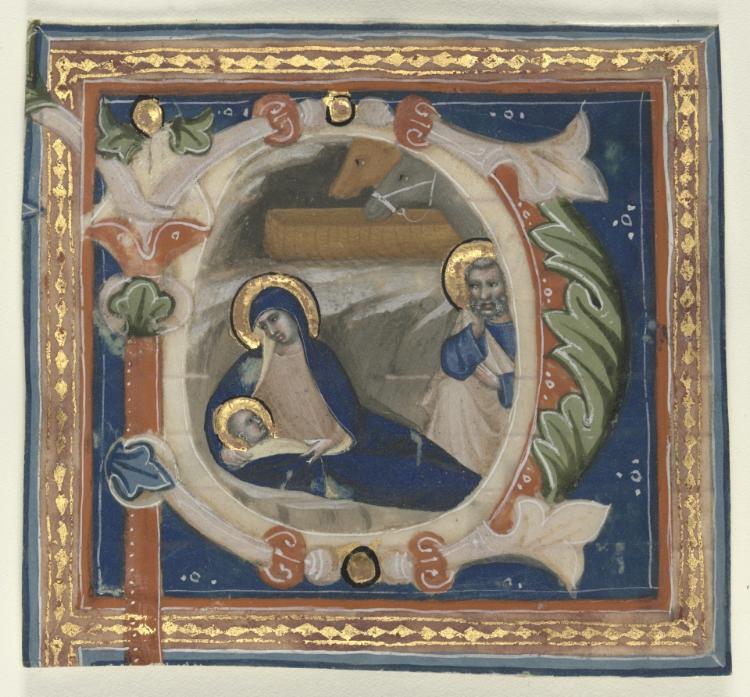


Lippo Vanni
Lippo Vanni began his career as a miniaturist, specialising in the decoration of choir books and liturgical manuscripts. His transition from these small-scale works to large frescoes for the Sienese government is unusual for the period. In 1344, the Republic of Siena commissioned him to decorate the records of the Biccherna, which was the city's financial office. This role required a high degree of precision and technical skill.

Biography
The artist followed the Sienese tradition, which preferred linear grace and gold backgrounds. His work shows the influence of Simone Martini and the Lorenzetti brothers. Vanni often placed figures within architectural frames, such as the initial letters found in his missal fragments. These fragments demonstrate his ability to depict religious scenes, like the Ascension or the celebration of the Mass, within the confines of a single letter. He used a palette of blues and golds to create a sense of sacred space.
Modern collectors value these works for their graphic quality and historical detail. The fragments of missals provide a window into fourteenth-century religious life and book production. Because these pieces were originally part of larger volumes, they possess a portable and intimate quality. They suit contemporary interiors that favour historical objects with clear lines and distinct colours. The focus on single figures or specific scenes allows for a focused aesthetic in a home gallery.
Notable Works
Tap to view larger.
Next stop
Sienese school →
Explore the artists and ideas of Sienese school.
Related Artists


Frequently Asked Questions
When was Lippo Vanni born?
Lippo Vanni was born in 1315 and died in 1375.What art movement was Lippo Vanni part of?
Lippo Vanni was associated with Sienese school.What is Lippo Vanni known for?
Lippo Vanni is known for lippo Vanni was a fourteenth-century Sienese painter and manuscript illuminator known for his precise religious miniatures and large-scale public frescoes.