




Josef Müller
Josef Müller is often associated with the cold precision of Swiss Design, but his work shares a mathematical logic with ancient sacred arts. He sought a universal visual language through the grid, much like the iconometric systems used in the Karma Gardri school of Tibetan painting. These traditional methods used precise geometric ratios to depict figures, ensuring every line adhered to a strict spiritual and mathematical order. His interest lay in the underlying structure of the image rather than decorative flair.
Biography
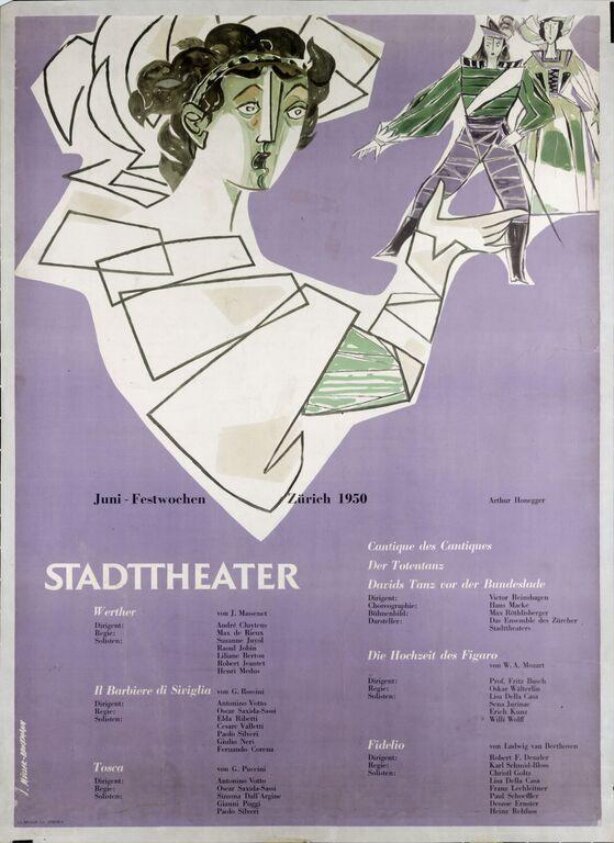
The approach of Josef Müller discarded subjective ornament in favour of a structured hierarchy. He used the grid to organise information, believing that objective rules created the most effective communication. His work often features sans-serif typography and primary colours, arranged on a coordinate system that dictates the placement of every element. This methodology mirrors the Tibetan practice of using a central axis and specific measurements to maintain balance in complex compositions. He avoided personal expression to focus on functional clarity.
Modern collectors value Josef Müller for his clarity and the timeless nature of his geometric logic. His prints offer a sense of calm and order that fits well in contemporary interiors. By removing the artist's ego from the work, he created pieces that remain relevant across different eras. The connection between his modernism and ancient iconographic grids demonstrates a long-standing human desire for mathematical harmony. These works are ideal for those who appreciate minimalism and structural beauty.
Notable Works
Tap to view larger.
Next stop
Browse the movements →
Every movement in the collection, from the Renaissance to Pop art.
Frequently Asked Questions
What is Josef Müller known for?
Josef Müller is known for josef Müller used mathematical grid systems to create objective, clear graphic designs that mirror the geometric precision of ancient sacred iconometry.