



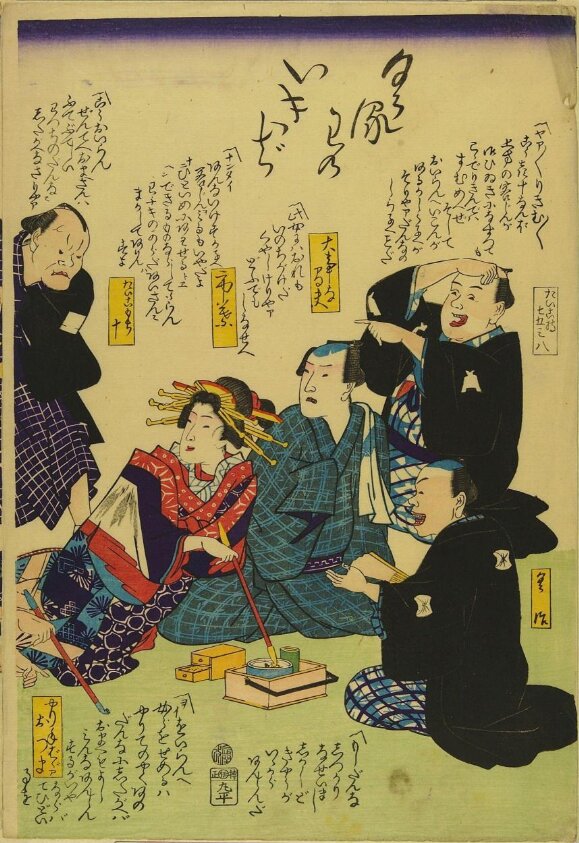


Hiroshige III
Hiroshige III secured his professional name through a complicated family arrangement. He was the second student to marry the daughter of Hiroshige I after the first successor, Hiroshige II, divorced her and moved to Yokohama. This artist took the title in 1867, just as Japan entered the Meiji era. His career coincided with the rapid modernisation of Tokyo, which he documented with a journalistic eye.
Biography
His work differs from his teacher by focusing on the physical signs of Western influence. He frequently depicted steam locomotives and brick buildings. These elements appeared alongside traditional subjects like "Moon at Shinagawa". He adopted new synthetic pigments, particularly a bright red dye, to capture the changing city. His compositions maintain the technical skill of the Utagawa school while applying it to a world of transition. He was particularly interested in how the architecture of Tokyo shifted from wood to stone.
Modern collectors find these prints appealing because they document the history of Japan. They record the specific moment when traditional woodblock techniques met industrial subjects. The use of bold colour and clear lines suits contemporary spaces. These prints provide a record of total social transformation.
Notable Works
Tap to view larger.
Next stop
Browse the movements →
Every movement in the collection, from the Renaissance to Pop art.
Related Artists


Frequently Asked Questions
When was Hiroshige III born?
Hiroshige III was born in 1842 and died in 1894.What is Hiroshige III known for?
Hiroshige III is known for utagawa Hiroshige III was a Meiji-era woodblock artist who documented the arrival of Western technology and architecture in Japan through the traditional Utagawa school style.