

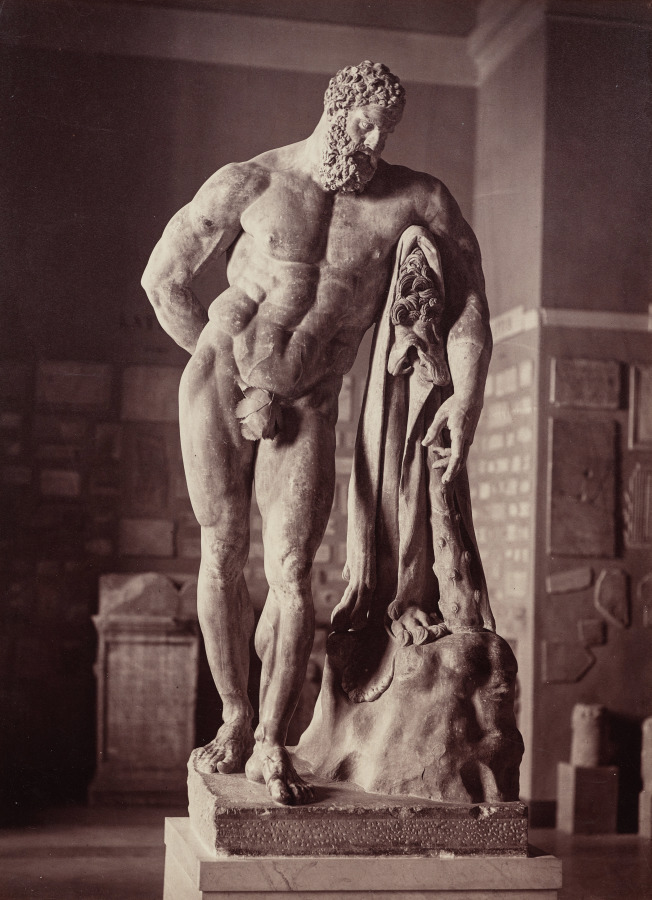

Giorgio Sommer
Giorgio Sommer arrived in Italy from Frankfurt in 1856, eventually establishing a prolific photographic studio in Naples. While many of his contemporaries focused solely on ruins, Sommer was fascinated by the mechanics of the city. He famously documented the eruption of Mount Vesuvius in 1872, risking his equipment to capture the physical reality of the disaster. His studio became a commercial powerhouse, producing thousands of images that defined the European perception of the Mediterranean.

Biography
His approach combined technical precision with a keen eye for social observation. Sommer photographed the Greek theatre of Syracuse and the statues of the Villa Nazionale. He also recorded the people who occupied these spaces. His catalogue includes street scenes of pasta makers drying their wares on wooden racks and public writers assisting young women at outdoor tables. These images provide a factual record of nineteenth-century Neapolitan life, from the tarantella dancers to the horse-drawn trams of the Santa Lucia district.
Modern collectors value Sommer for his ability to balance classical composition with raw, everyday details. His prints offer a window into a world where ancient history and modern industry coexisted. The sepia tones and sharp details of his work bring a sense of historical weight to a room without feeling dated. Whether capturing a funeral procession of monks or the busy commerce of Via Roma, his photography remains a clear and direct observation of a vanished era.
Notable Works
Tap to view larger.
Next stop
Browse the movements →
Every movement in the collection, from the Renaissance to Pop art.
Giorgio Sommer prints
Hand-finished archival prints from Giorgio Sommer's body of work.
 Fresco in Pompeii, Depicting Wild Animals - Giorgio Sommer
From £28.00
Fresco in Pompeii, Depicting Wild Animals - Giorgio Sommer
From £28.00
 Venditrice d'amorini - Giorgio Sommer
From £28.00
Venditrice d'amorini - Giorgio Sommer
From £28.00
 Diana and Actaeon (After Pompeian Fresco) - Giorgio Sommer
From £28.00
Diana and Actaeon (After Pompeian Fresco) - Giorgio Sommer
From £28.00
 Plaster Cast of a Victim of the Eruption of Vesuvius - Giorgio Sommer
From £28.00
Plaster Cast of a Victim of the Eruption of Vesuvius - Giorgio Sommer
From £28.00
 Interieur van het amfitheater in Pompeï - Giorgio Sommer
From £28.00
Interieur van het amfitheater in Pompeï - Giorgio Sommer
From £28.00
 Casa di Diomede, Pompei - Giorgio Sommer
From £28.00
Casa di Diomede, Pompei - Giorgio Sommer
From £28.00
Related Artists


Take Giorgio Sommer home.
See all Giorgio Sommer prints →Frequently Asked Questions
When was Giorgio Sommer born?
Giorgio Sommer was born in 1834 and died in 1914.What is Giorgio Sommer known for?
Giorgio Sommer is known for giorgio Sommer was a Prussian-born photographer who documented nineteenth-century Italy, capturing everything from the ruins of Pompeii to the daily lives of Neapolitan pasta makers.