

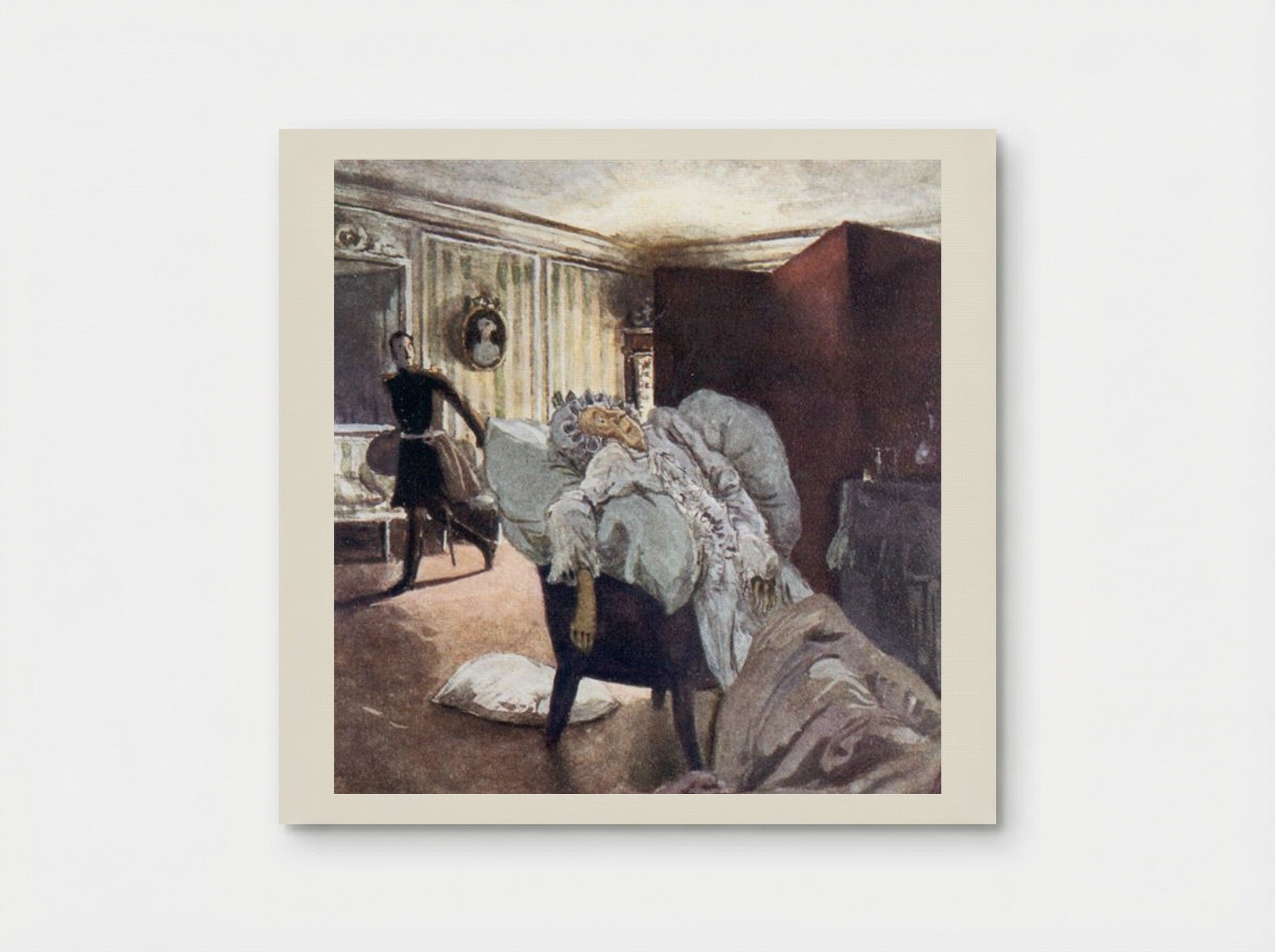
Tod der Gräfin - Alexandre Benois
Archival Pigmentdruck
Rahmen werden montagefertig geliefert
Sichere Kaufabwicklung
Auf Bestellung gefertigt
Beschreibung
Ein Aquarell und Gouache von Alexandre Benois mit dem Titel „Tod der Gräfin“, das einen Mann in Militäruniform zeigt, der über einer verstorbenen Frau auf einem Stuhl steht.
Alexandre Benois (1870–1960) war ein russischer Künstler, Kunstkritiker, Historiker und Bühnenbildner, der eine bedeutende Rolle in den Ballets Russes spielte. Er war Gründungsmitglied der Bewegung Mir iskusstwa (Welt der Kunst), die Ästhetizismus fördern und Kunst in alle Aspekte des Lebens integrieren wollte. Benois wurde von der französischen Rokokokunst und der italienischen Renaissance beeinflusst. Er ist bekannt für seine Historienbilder, Buchillustrationen und Theaterentwürfe. „Tod der Gräfin“ zeigt eine Szene mit einem Mann in Militäruniform, der über einer verstorbenen Frau auf einem Stuhl steht. Die Szene ist ein Innenraum mit gestreiften Tapeten und spärlicher Einrichtung. Die Farbpalette ist gedämpft, dominiert von Grau-, Braun- und Cremetönen. Die Komposition ist etwas theatralisch, wobei die Figuren so angeordnet sind, dass sie ein Gefühl von Drama und Endgültigkeit vermitteln. Das Werk ist in Aquarell und Gouache ausgeführt, was ihm ein weiches, strukturiertes Aussehen verleiht.
Rückgaberecht
Da jeder Druck auf Bestellung gefertigt wird, bieten wir keine Rücksendungen, Rückerstattungen oder Umtausche aufgrund von Meinungsänderungen an. Sollte Ihre Bestellung fehlerhaft, beschädigt oder falsch ankommen, ersetzen wir sie kostenlos – kontaktieren Sie uns einfach innerhalb von 48 Stunden nach Lieferung. Vollständige Details finden Sie auf unserer Rückerstattungsseite.
Versand
Wir versenden weltweit und drucken im Produktionszentrum in der Nähe Ihrer Lieferadresse. Lieferzeiten und -kosten variieren je nach Zielort – die Ihnen zur Verfügung stehenden Optionen werden Ihnen an der Kasse angezeigt.
Fertigung
Jeder Druck wird auf Bestellung im 12-Farben-Giclée-Druckverfahren auf FSC-zertifiziertem Archivpapier hergestellt. Entworfen in Großbritannien und gedruckt in Ihrem nächstgelegenen Produktionszentrum, um Abfall zu reduzieren und die Lieferung zu beschleunigen.
Care and materials
Specific Features
Every Solis piece is made to order with archival, gallery-quality materials built to last.
- Museum-grade giclée printing for rich, fade-resistant colour
- Archival matte fine-art paper, FSC-certified
- Multiple sizes and framing options available
- Frames in black, natural wood, dark wood or white
- Framed prints arrive ready to hang
Care & Cleaning
To keep your artwork looking its best:
- Dust gently with a soft, dry cloth
- Avoid prolonged direct sunlight
- Never use liquid cleaners on the print or canvas surface
- Keep in a dry, room-temperature space
- Handle prints with clean, dry hands
Materials & Sizing
Museum-grade giclée on FSC-certified archival matte paper, with framed and canvas options.
- Paper sizes: A4, A3, A2, A1, A0 and B2 (50×70 cm)
- Canvas: XS (20×30 cm) to Large (60×90 cm)
- Frames: black, natural wood, dark wood or white
Tod der Gräfin - Alexandre Benois
Artist Biography
Alexandre Benois
Born in 1870 in St Petersburg into a family of architects and artists, Benois was largely self-taught after a brief, dissatisfying spell as an unregistered student at the Academy of Arts. He studied law at university and educated himself through trips to Italy, Spain, and France. By the 1890s he was Russia's pre-eminent art critic, and in 1898 he co-founded the journal Mir iskusstva (World of Art) with Sergei Diaghilev, backed by Princess Tenisheva and the industrialist Savva Mamontov. The journal opposed the didactic social realism of the Peredvizhniki and insisted that Russian art engage seriously with European modernism.
As a painter, Benois worked primarily in watercolour and gouache until 1905. His Russian history series of 1907-10, commissioned by publisher Iosif Knoebel, depicted Petrine and Catherinian court life with careful archival precision; his three editions of illustrations for Pushkin's Bronze Horseman (1903, 1905, 1916-22) remain defining images of the poem. Theatre absorbed him most fully. He wrote the libretto for Stravinsky's Petrouchka (1911), designed the first Ballets Russes Paris season, and headed the Moscow Arts Theatre's art production section from 1913 to 1915.
From 1918 to 1926 he directed the Picture Gallery at the Hermitage, a formidable institutional role through years of revolutionary upheaval. He left Russia permanently in 1926, settling in Paris the following year, and spent his final decades producing more than sixty theatre and opera productions across La Scala, the Paris Opéra, and major houses in London and New York. He died in Paris in February 1960.
Warum uns wählen?
Garantie für beschädigungsfreie Lieferung
Schneller Versand
Museumsreife Materialien
Das könnte Ihnen auch gefallen