

Sammlung
Antonello Da Messina
Entdecken Sie kuratierte Kunstdrucke, ausgewählt für individuelle Wohnräume und durchdachte Interieurs.
Vorgeschlagene Filter
-
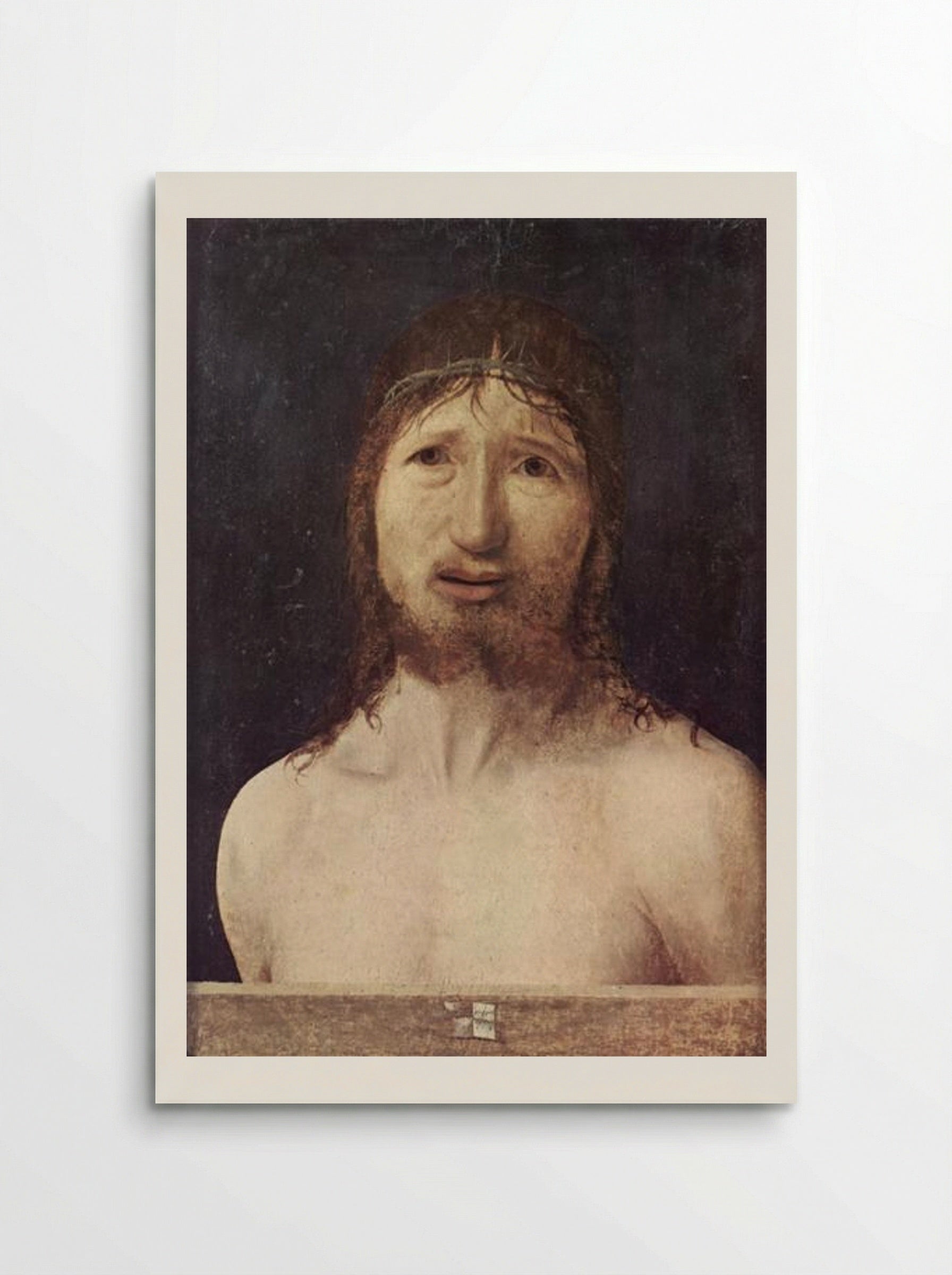 Ecce Homo - Antonello da Messina
Print
Regulärer Preis Ab £28.00 GBPAngebotspreis Ab £28.00 GBP Regulärer Preis

Artist Biography
Antonello Da Messina
When Giorgio Vasari told the story of how Antonello da Messina travelled to Flanders and was personally taught oil painting by Jan van Eyck, it made for an irresistible tale. The flaw was that Van Eyck died when Antonello was still a boy. The actual source was Naples, where the young Sicilian painter worked around 1450. King Alfonso I's collection there included works by Van Eyck and Rogier van der Weyden, and the Neapolitan master Colantonio had already absorbed Flemish methods. From this environment Antonello mastered the key technique: by layering multiple transparent glazes of oil-rich paint, a painter could achieve depths of colour that tempera alone could never produce.
His early St Jerome in His Study (c.1456, 46 x 36 cm, National Gallery, London) shows the synthesis already complete: Flemish precision in the still-life objects and tiled floors, combined with a system of perspective more rigorous than the Netherlandish masters ever attempted. It is a small picture that feels entirely worked out.
The decisive episode came in 1475-76, when he visited Venice and painted the San Cassiano Altarpiece for the church of San Cassiano. The altarpiece was dismembered in the 17th century; only fragments survive in Vienna's Kunsthistorisches Museum. His contact with Giovanni Bellini during this visit generated one of the great productive arguments in art history: scholars still dispute who influenced whom. Either way, Venetian painting was different afterwards.
He returned to Messina and died there in 1479. His late Virgin Annunciate (c.1475, 34.5 x 44.5 cm, Galleria Nazionale, Palermo), showing the Madonna without the angel Gabriel, demonstrates how far he had travelled from his sources: the geometric stillness and internal luminosity are entirely his own.
His early St Jerome in His Study (c.1456, 46 x 36 cm, National Gallery, London) shows the synthesis already complete: Flemish precision in the still-life objects and tiled floors, combined with a system of perspective more rigorous than the Netherlandish masters ever attempted. It is a small picture that feels entirely worked out.
The decisive episode came in 1475-76, when he visited Venice and painted the San Cassiano Altarpiece for the church of San Cassiano. The altarpiece was dismembered in the 17th century; only fragments survive in Vienna's Kunsthistorisches Museum. His contact with Giovanni Bellini during this visit generated one of the great productive arguments in art history: scholars still dispute who influenced whom. Either way, Venetian painting was different afterwards.
He returned to Messina and died there in 1479. His late Virgin Annunciate (c.1475, 34.5 x 44.5 cm, Galleria Nazionale, Palermo), showing the Madonna without the angel Gabriel, demonstrates how far he had travelled from his sources: the geometric stillness and internal luminosity are entirely his own.


Warum uns wählen?