

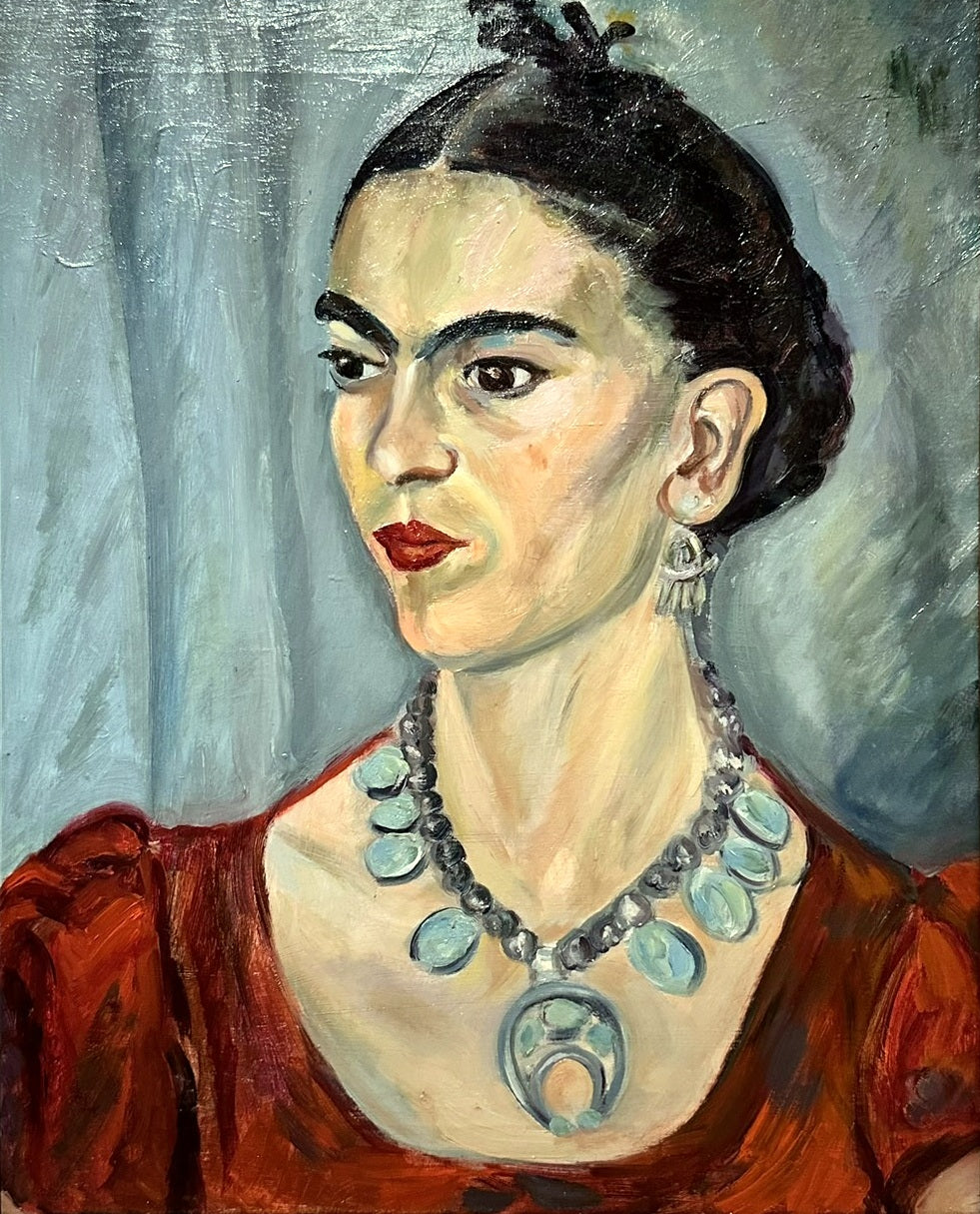
Frida Kahlo produced about 143 paintings in a working life of twenty-eight years. Fifty-five of them were self-portraits. The proportion is unusual for a painter who could draw anything. Kahlo painted herself repeatedly because she had a working model permanently available (herself), because she was almost continuously injured and could not always travel to other sitters, and because the figure she most wanted to investigate was the one she could not stop being.
The story of Kahlo has been compressed in popular culture into a few large events: the streetcar accident at eighteen, the marriage to Diego Rivera, the affairs, the surgeries, the unibrow. The compression is accurate to the headlines and misleading about the work. What Kahlo actually did, day by day for twenty-eight years, was sit in front of a small mirror and paint herself.
The Accident
On 17 September 1925, Kahlo was eighteen and a student at the Escuela Nacional Preparatoria in Mexico City. She was travelling home on a wooden bus that collided with an electric streetcar at the corner of Cuauhtemoctzin and Calzada de Tlalpan. The streetcar drove the bus forward; the bus collapsed; an iron handrail entered her body through her left hip and exited through her vagina. Her spine was fractured in three places. Her right leg was broken in eleven places. Her right foot was crushed. Her collarbone was broken. Two of her ribs were broken. Her pelvis was broken in three places.
She survived. The medical care she received in 1925 Mexico City was unable to fully repair any of these injuries. She underwent more than thirty surgeries across her remaining twenty-eight years, was repeatedly placed in plaster body casts and metal corsets, and lived with continuous physical pain. The accident is the single fact from which the rest of her biography unfolds.
The Studio That Was a Bed
She began painting during the long convalescence. Her mother had a special easel made that allowed her to work lying down. A mirror was set into the canopy of the bed so that she could see her own face while immobile. The first self-portrait was made in 1926, in the year following the accident.
Kahlo painted in oil. Her early canvases are small, often less than fifty centimetres on a side. The smallness was practical: she was working from a bed and could not handle large supports. The smallness also fits the kind of attention she was paying. A small painting forces the viewer close enough to read every detail. Kahlo's self-portraits ask to be read at the distance she painted them, which was the distance from her own face to her own mirror.
The Marriage
Kahlo met Diego Rivera in 1928. He was twenty-one years older, already a famous muralist, and married twice before. They were married in August 1929. Rivera weighed roughly twice what Kahlo did; Kahlo's mother described the wedding photographs as "the marriage of an elephant and a dove."
The marriage produced two extended separations and one divorce-and-remarriage. Rivera had affairs with Kahlo's sister Cristina in 1934 and with multiple other women across the marriage. Kahlo had affairs in response, including with the photographer Nickolas Muray and (briefly) with Leon Trotsky in 1937 when the Trotskys were sheltering at the Casa Azul in Coyoacán.
The marriage worked in spite of all this. Rivera was the most respected painter in Mexico during the period; Kahlo's reputation was secondary to his, both publicly and (somewhat) in her own self-presentation. They lived next door to each other in twin houses connected by a bridge after their 1940 remarriage. He died in 1957, three years after she did.
The Subject She Made Her Own
Kahlo's self-portraits are not a sequence of likenesses. They are a sequence of arguments. Each painting takes the same face (heavy brow, full mouth, severe parted hair, often with elaborate hairstyles or floral arrangements) and uses it as the centre of a composition that argues for something specific: a political position, a medical fact, a marital crisis, a relationship to her ancestry.
The 1939 painting The Two Fridas shows her in two costumes (one Tehuana, one European), seated side by side, holding hands, with their exposed hearts joined by a single artery. The painting was made during the months Rivera was suing for divorce. The double-figure is Kahlo arguing publicly that she contained both identities (Mexican peasant heritage on her mother's side, European bourgeois on her father's) and that the loss of Rivera would not collapse either.
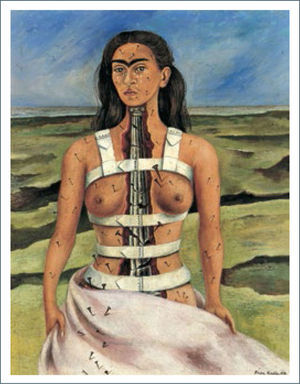
The 1944 painting The Broken Column shows her in a metal medical corset, her body split open vertically to reveal a crumbling Ionic column where her spine should be. The painting was made after a spinal surgery that had fused several of her vertebrae. The argument is direct: this is what is wrong with me.
What the Self-Portraits Are For
The conventional reading of Kahlo's self-portraits is that they are confessional, that they document her life directly, and that her work is therefore a form of autobiography. This reading is not wrong, but it is incomplete.
The self-portraits are also, more importantly, a discipline. They are a daily exercise in looking at the same subject and finding something new in it. The same face, painted fifty-five times, becomes a kind of laboratory. Kahlo varies the costume, the background, the colour palette, the symbolism. The face itself is the constant. The variables are everything else.
The painter who emerges from this discipline is more rigorous than the confessional reading suggests. Kahlo was not unloading her trauma onto canvas. She was building, painting by painting, a way of using the self-portrait as a structural form. The form was Mexican Catholic devotional painting (the small ex-voto pictures hung in churches across Mexico), the materials were European oil-on-canvas, and the subject was a woman who had been almost destroyed at eighteen and was working out, methodically, what could be salvaged.
The End
Kahlo's right leg was amputated at the knee in August 1953. Gangrene had developed from the original 1925 injuries. She lived less than a year afterwards. The last self-portrait, painted in 1953 or 1954, shows her in a brace and corset, on the front porch of the Casa Azul, with a small dog at her feet.
She died on 13 July 1954, aged forty-seven. The official cause of death was pulmonary embolism. Her diary, found after her death, ended with the line, "I hope the leaving is joyful and I hope never to return."
The 143 paintings, including the 55 self-portraits, were spread across several Mexican museums, private collections, and (a small number) international institutions. The Casa Azul became a museum dedicated to her in 1958. The reputation that had been secondary to Rivera's during her lifetime became, by the 1980s, larger than his. She is now the most famous Mexican artist of the twentieth century and one of the most reproduced female painters in any tradition.
What survives is not the biography. The biography has been retold often enough to dull. What survives is the discipline. Fifty-five times, in front of the same mirror, painting the same face with absolute attention.


