

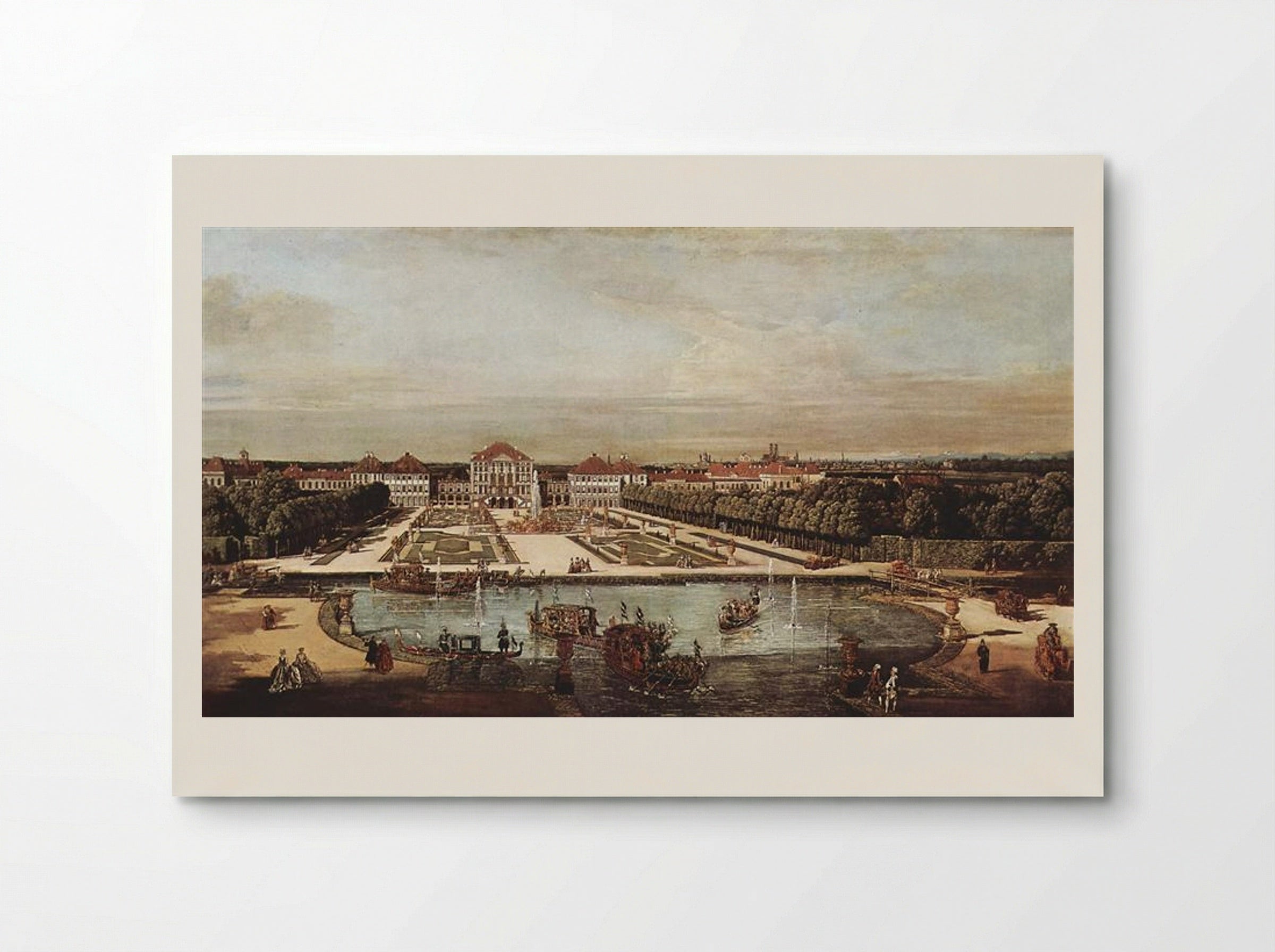
Schloss Nymphenburg - Bernardo Bellotto
Archival Pigmentdruck
Rahmen werden montagefertig geliefert
Sichere Kaufabwicklung
Auf Bestellung gefertigt
Beschreibung
Ein Panorama-Ölgemälde auf Leinwand von Schloss Nymphenburg von Bernardo Bellotto, bekannt für seine detaillierten Veduten europäischer Städte. Das Gemälde zeigt den Barockpalast in München mit akribischer architektonischer Detailtreue und einer gedämpften Farbpalette.
Bernardo Bellotto (1722-1780) war ein italienischer Stadtlandschaftsmaler, auch bekannt als Canaletto der Jüngere, da er der Neffe und Schüler Canalettos war. Er ist bekannt für seine detaillierten Veduten, oder Stadtansichten, europäischer Städte wie Dresden, Wien und Warschau. Sein Stil zeichnet sich durch präzise architektonische Darstellung und atmosphärische Effekte aus, oft mit einer kühlen, silbrigen Tonalität. Bellottos Gemälde liefern wertvolle historische Dokumentationen der städtischen Umgebungen seiner Zeit. Dieses Gemälde zeigt eine Panoramaansicht von Schloss Nymphenburg, einem Barockpalast in München, Deutschland. Die Komposition ist in drei horizontale Abschnitte unterteilt: den Himmel, den Palast und die Gärten sowie den Vordergrundteich. Der Himmel ist mit weichem, diffusem Licht dargestellt, das ein Gefühl von atmosphärischer Perspektive erzeugt. Der Palast und die Gärten sind mit akribischer Detailtreue abgebildet, die die architektonische Pracht des Palastes und die geometrische Anordnung der Gärten zeigt. Im Vordergrund ist ein Teich mit dekorativen Booten und Figuren in zeitgenössischer Kleidung bevölkert, was der Szene ein Gefühl von Maßstab und menschlicher Präsenz verleiht. Die Farbpalette wird von gedämpften Grau-, Grün- und Brauntönen dominiert, mit Akzenten von Rot und Gold in den architektonischen Details und Figuren.
Rückgaberecht
Da jeder Druck auf Bestellung gefertigt wird, bieten wir keine Rücksendungen, Rückerstattungen oder Umtausche aufgrund von Meinungsänderungen an. Sollte Ihre Bestellung fehlerhaft, beschädigt oder falsch ankommen, ersetzen wir sie kostenlos – kontaktieren Sie uns einfach innerhalb von 48 Stunden nach Lieferung. Vollständige Details finden Sie auf unserer Rückerstattungsseite.
Versand
Wir versenden weltweit und drucken im Produktionszentrum in der Nähe Ihrer Lieferadresse. Lieferzeiten und -kosten variieren je nach Zielort – die Ihnen zur Verfügung stehenden Optionen werden Ihnen an der Kasse angezeigt.
Fertigung
Jeder Druck wird auf Bestellung im 12-Farben-Giclée-Druckverfahren auf FSC-zertifiziertem Archivpapier hergestellt. Entworfen in Großbritannien und gedruckt in Ihrem nächstgelegenen Produktionszentrum, um Abfall zu reduzieren und die Lieferung zu beschleunigen.
Schloss Nymphenburg - Bernardo Bellotto

Artist Biography
Bernardo Bellotto
Born in Venice in 1721, Bellotto was the nephew of Giovanni Antonio Canal on his mother's side and trained in his uncle's studio from early adolescence. By his mid-teens he was a registered member of the Venetian painters' guild. His early work so closely followed Canaletto's manner that he occasionally signed canvases "Canaletto" himself, a habit that has tangled attribution ever since. He left Venice in 1746 for a long Italian tour before heading north; in 1747, aged twenty-six, he accepted an invitation to Dresden from Frederick-Augustus II, Elector of Saxony, who paid him twenty thalers a year as court painter.
The Dresden commissions produced some of his finest work: The Moat of the Zwinger (1749-53, 133 x 235 cm, Gemaldegalerie) and a series of Neumarkt views including the Frauenkirche, in which extreme diagonal compositions amplify the spatial depth of the city's Baroque squares. Empress Maria Theresa summoned him to Vienna in 1758, where he painted View from the Belvedere (1759-60, Kunsthistorisches Museum); in 1767 he moved to Warsaw, entering the service of Stanislaw II of Poland and beginning the topographical documentation that would outlast the city itself.
His palette runs consistently cooler and crisper than Canaletto's; he paid more attention to cloud formations, deep shadows, and foliage, and packed his views with more figure groups. Where Canaletto often revisited the same standpoints, Bellotto almost always sought new vantage points. Scholars read his documentary precision as a function of his market: not Venice's tourist trade but the royal courts of Europe, patrons who wanted their capitals recorded with near-surveyor exactitude.
Unsere Funktionen
Entwickelt für nachhaltige Wirkung
Besondere Eigenschaften
Jedes Solis-Stück wird auf Bestellung mit archivtauglichen Materialien in Galeriequalität gefertigt, die für eine lange Lebensdauer ausgelegt sind.
- Giclée-Druck in Museumsqualität für satte, lichtbeständige Farben
- Mattes Fine-Art-Papier in Archivqualität, FSC-zertifiziert
- Mehrere Größen und Rahmenoptionen verfügbar
- Rahmen in Schwarz, Naturholz, dunklem Holz oder Weiß
- Gerahmte Drucke werden fertig zum Aufhängen geliefert
Pflege & Reinigung
Damit Ihr Kunstwerk optimal aussieht:
- Vorsichtig mit einem weichen, trockenen Tuch abstauben
- Längere direkte Sonneneinstrahlung vermeiden
- Niemals flüssige Reiniger auf Druck- oder Leinwandoberflächen verwenden
- An einem trockenen Ort bei Raumtemperatur aufbewahren
- Drucke mit sauberen, trockenen Händen anfassen
Material & Größe
Museums-Giclée-Druck auf FSC-zertifiziertem, archivbeständigem, mattem Papier, wahlweise mit Rahmen oder als Leinwand.
- Papierformate: A4, A3, A2, A1, A0 und B2 (50×70 cm)
- Leinwand: XS (20×30 cm) bis Large (60×90 cm)
- Rahmen: Schwarz, Naturholz, dunkles Holz oder Weiß
Warum uns wählen?
Garantie für beschädigungsfreie Lieferung
Schneller Versand
Museumsreife Materialien
Biografie des Künstlers
Bernardo Bellotto
Born in Venice in 1721, Bellotto was the nephew of Giovanni Antonio Canal on his mother's side and trained in his uncle's studio from early adolescence. By his mid-teens he was a registered member of the Venetian painters' guild. His early work so closely followed Canaletto's manner that he occasionally signed canvases "Canaletto" himself, a habit that has tangled attribution ever since. He left Venice in 1746 for a long Italian tour before heading north; in 1747, aged twenty-six, he accepted an invitation to Dresden from Frederick-Augustus II, Elector of Saxony, who paid him twenty thalers a year as court painter.
The Dresden commissions produced some of his finest work: The Moat of the Zwinger (1749-53, 133 x 235 cm, Gemaldegalerie) and a series of Neumarkt views including the Frauenkirche, in which extreme diagonal compositions amplify the spatial depth of the city's Baroque squares. Empress Maria Theresa summoned him to Vienna in 1758, where he painted View from the Belvedere (1759-60, Kunsthistorisches Museum); in 1767 he moved to Warsaw, entering the service of Stanislaw II of Poland and beginning the topographical documentation that would outlast the city itself.
His palette runs consistently cooler and crisper than Canaletto's; he paid more attention to cloud formations, deep shadows, and foliage, and packed his views with more figure groups. Where Canaletto often revisited the same standpoints, Bellotto almost always sought new vantage points. Scholars read his documentary precision as a function of his market: not Venice's tourist trade but the royal courts of Europe, patrons who wanted their capitals recorded with near-surveyor exactitude.
Das könnte Ihnen auch gefallen