

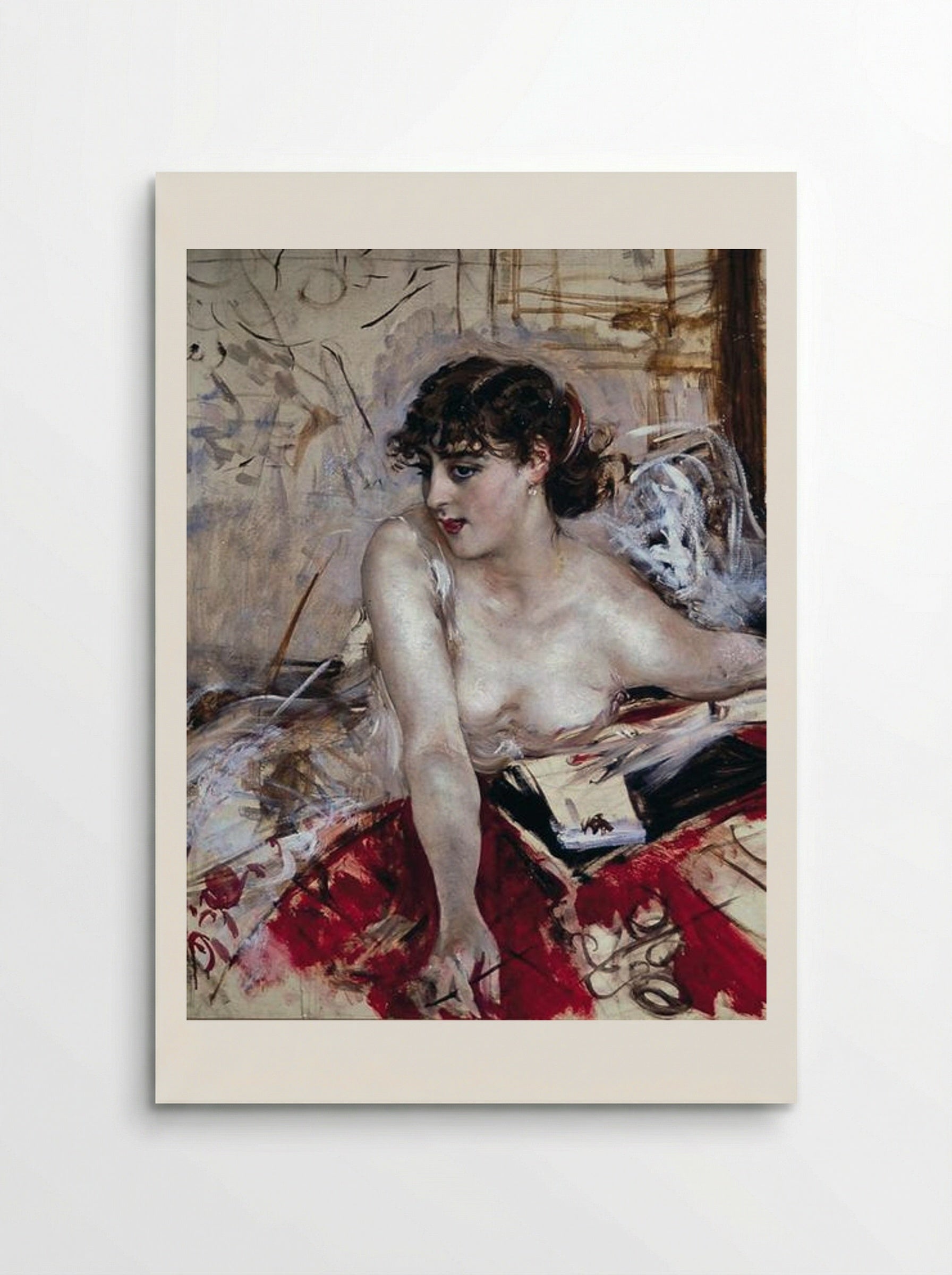
Morgenbrief - Giovanni Boldini
Archival Pigmentdruck
Rahmen werden montagefertig geliefert
Sichere Kaufabwicklung
Auf Bestellung gefertigt
Beschreibung
Giovanni Boldinis „Morgenbrief“ fängt einen Moment intimer Kontemplation ein. Die sanfte Farbpalette und die lockeren Pinselstriche erzeugen ein Gefühl von Wärme und Spontaneität.
Giovanni Boldini, ein italienischer Genre- und Porträtmaler, der den Großteil seiner Karriere in Paris lebte und arbeitete, malte „Morgenbrief“. Boldini wurde während der Belle Époque als Meister der mondänen Porträts bekannt. Sein Stil zeichnet sich durch energische Pinselführung und ein Gefühl von Unmittelbarkeit aus, das den Geist der Epoche einfängt. Auf diesem Gemälde lehnt eine Frau auf einem Bett und scheint in einem Moment der Kontemplation gefangen zu sein. Die Komposition ist intim und konzentriert sich auf den Oberkörper und das Gesicht der Frau. Ihr Blick ist vom Betrachter abgewandt, was das Gefühl der Privatsphäre verstärkt. Die Farbpalette ist weich, mit gedämpften Tönen, die ein Gefühl von Wärme und Intimität erzeugen. Die lockeren Pinselstriche und die unvollendete Qualität des Hintergrunds tragen zum allgemeinen Gefühl von Spontaneität und Informalität des Gemäldes bei. Die roten Akzente in der Bettwäsche ziehen den Blick auf sich und verleihen der Szene einen Hauch von Dramatik.
Rückgaberecht
Da jeder Druck auf Bestellung gefertigt wird, bieten wir keine Rücksendungen, Rückerstattungen oder Umtausche aufgrund von Meinungsänderungen an. Sollte Ihre Bestellung fehlerhaft, beschädigt oder falsch ankommen, ersetzen wir sie kostenlos – kontaktieren Sie uns einfach innerhalb von 48 Stunden nach Lieferung. Vollständige Details finden Sie auf unserer Rückerstattungsseite.
Versand
Wir versenden weltweit und drucken im Produktionszentrum in der Nähe Ihrer Lieferadresse. Lieferzeiten und -kosten variieren je nach Zielort – die Ihnen zur Verfügung stehenden Optionen werden Ihnen an der Kasse angezeigt.
Fertigung
Jeder Druck wird auf Bestellung im 12-Farben-Giclée-Druckverfahren auf FSC-zertifiziertem Archivpapier hergestellt. Entworfen in Großbritannien und gedruckt in Ihrem nächstgelegenen Produktionszentrum, um Abfall zu reduzieren und die Lieferung zu beschleunigen.
Care and materials
Specific Features
Every Solis piece is made to order with archival, gallery-quality materials built to last.
- Museum-grade giclée printing for rich, fade-resistant colour
- Archival matte fine-art paper, FSC-certified
- Multiple sizes and framing options available
- Frames in black, natural wood, dark wood or white
- Framed prints arrive ready to hang
Care & Cleaning
To keep your artwork looking its best:
- Dust gently with a soft, dry cloth
- Avoid prolonged direct sunlight
- Never use liquid cleaners on the print or canvas surface
- Keep in a dry, room-temperature space
- Handle prints with clean, dry hands
Materials & Sizing
Museum-grade giclée on FSC-certified archival matte paper, with framed and canvas options.
- Paper sizes: A4, A3, A2, A1, A0 and B2 (50×70 cm)
- Canvas: XS (20×30 cm) to Large (60×90 cm)
- Frames: black, natural wood, dark wood or white
Morgenbrief - Giovanni Boldini

Artist Biography
Giovanni Boldini
He was born in Ferrara in 1842, the son of a painter. He was filling sketchbooks by the age of five, before he could write. At eighteen he already had a reputation as a portraitist. In 1862 he went to Florence and fell in with the Macchiaioli, the Italian precursors to Impressionism whose broken brushwork and plein-air practice influenced his early style. He reached Paris in 1871 and stayed.
Time magazine later called him the "Master of Swish" for his fluid, elongated brushstrokes. His portraits captured sitters in soft focus, stretching their features to accentuate elegance and creating a sense of motion that made his subjects look both sophisticated and restless. The technique owed something to Parmigianino's Mannerist elongations and anticipated Futurism's interest in movement. He was friends with Degas, Manet, Sisley, Caillebotte and Corot, and in 1889 travelled to Spain with Degas to study Velazquez and Goya.
He worked in oil, pastel, watercolour and drawing, and was prolific across all media. He died in Paris in 1931, at eighty-eight, having outlived Belle Epoque society and the world that had kept him busy.
Warum uns wählen?
Garantie für beschädigungsfreie Lieferung
Schneller Versand
Museumsreife Materialien
Das könnte Ihnen auch gefallen