

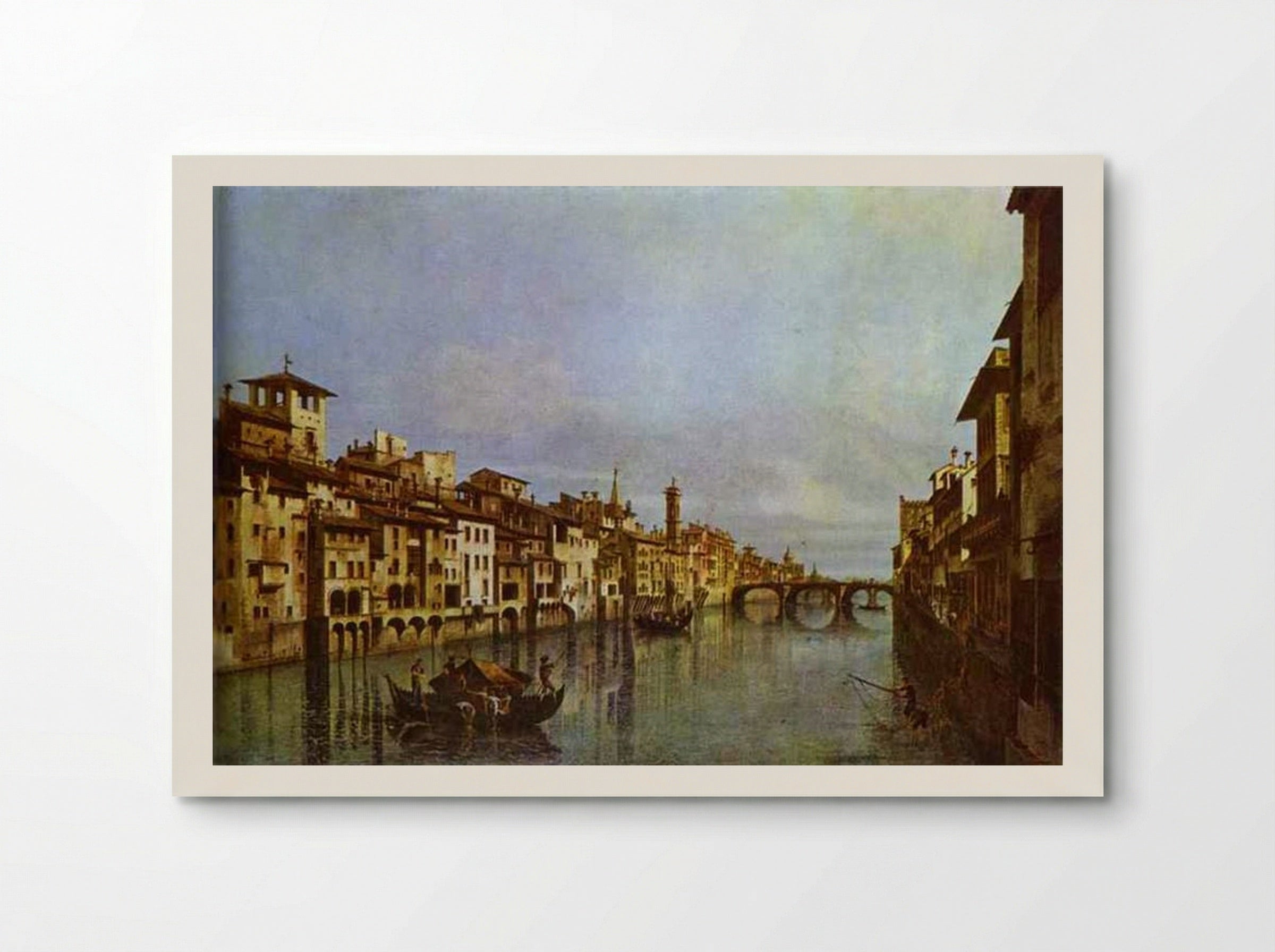
Arno in Florenz – Bernardo Bellotto
Archival Pigmentdruck
Rahmen werden montagefertig geliefert
Sichere Kaufabwicklung
Auf Bestellung gefertigt
Beschreibung
Eine detaillierte Stadtansicht von Bernardo Bellotto, die den Fluss Arno in Florenz darstellt. Das Gemälde zeigt das Können des Künstlers in architektonischer Darstellung und atmosphärischen Effekten.
Bernardo Bellotto (1722-1780) war ein italienischer Vedutenmaler und Schüler seines Onkels Canaletto. Er ist bekannt für seine detaillierten Stadtansichten, insbesondere von Dresden, Wien und Warschau. Sein Stil zeichnet sich durch präzise architektonische Darstellung und atmosphärische Effekte aus. Bellottos Gemälde bieten eine wertvolle historische Dokumentation der von ihm dargestellten urbanen Umgebungen. Er arbeitete für königliche und aristokratische Gönner in ganz Europa. Sein Neffe war Francesco Guardi. Dieses Gemälde zeigt eine Ansicht des Flusses Arno in Florenz. Die Komposition ist in drei horizontale Abschnitte unterteilt: den Himmel, die Gebäude und den Fluss. Der Himmel ist ein helles Blau-Grau mit sanften Wolken. Die Gebäude sind detailliert wiedergegeben und zeigen die Architektur der Stadt. Der Fluss spiegelt die Gebäude und den Himmel wider und erzeugt so ein Gefühl von Tiefe. Mehrere Boote befinden sich auf dem Fluss und verleihen dem Bild ein Gefühl von Maßstab. Die Farbpalette ist gedämpft, mit Braun-, Gelb- und Blautönen. Das Gemälde ist ein hervorragendes Beispiel für Bellottos Können als Vedutenmaler.
Rückgaberecht
Da jeder Druck auf Bestellung gefertigt wird, bieten wir keine Rücksendungen, Rückerstattungen oder Umtausche aufgrund von Meinungsänderungen an. Sollte Ihre Bestellung fehlerhaft, beschädigt oder falsch ankommen, ersetzen wir sie kostenlos – kontaktieren Sie uns einfach innerhalb von 48 Stunden nach Lieferung. Vollständige Details finden Sie auf unserer Rückerstattungsseite.
Versand
Wir versenden weltweit und drucken im Produktionszentrum in der Nähe Ihrer Lieferadresse. Lieferzeiten und -kosten variieren je nach Zielort – die Ihnen zur Verfügung stehenden Optionen werden Ihnen an der Kasse angezeigt.
Fertigung
Jeder Druck wird auf Bestellung im 12-Farben-Giclée-Druckverfahren auf FSC-zertifiziertem Archivpapier hergestellt. Entworfen in Großbritannien und gedruckt in Ihrem nächstgelegenen Produktionszentrum, um Abfall zu reduzieren und die Lieferung zu beschleunigen.
Care and materials
Specific Features
Every Solis piece is made to order with archival, gallery-quality materials built to last.
- Museum-grade giclée printing for rich, fade-resistant colour
- Archival matte fine-art paper, FSC-certified
- Multiple sizes and framing options available
- Frames in black, natural wood, dark wood or white
- Framed prints arrive ready to hang
Care & Cleaning
To keep your artwork looking its best:
- Dust gently with a soft, dry cloth
- Avoid prolonged direct sunlight
- Never use liquid cleaners on the print or canvas surface
- Keep in a dry, room-temperature space
- Handle prints with clean, dry hands
Materials & Sizing
Museum-grade giclée on FSC-certified archival matte paper, with framed and canvas options.
- Paper sizes: A4, A3, A2, A1, A0 and B2 (50×70 cm)
- Canvas: XS (20×30 cm) to Large (60×90 cm)
- Frames: black, natural wood, dark wood or white
Arno in Florenz – Bernardo Bellotto

Artist Biography
Bernardo Bellotto
Born in Venice in 1721, Bellotto was the nephew of Giovanni Antonio Canal on his mother's side and trained in his uncle's studio from early adolescence. By his mid-teens he was a registered member of the Venetian painters' guild. His early work so closely followed Canaletto's manner that he occasionally signed canvases "Canaletto" himself, a habit that has tangled attribution ever since. He left Venice in 1746 for a long Italian tour before heading north; in 1747, aged twenty-six, he accepted an invitation to Dresden from Frederick-Augustus II, Elector of Saxony, who paid him twenty thalers a year as court painter.
The Dresden commissions produced some of his finest work: The Moat of the Zwinger (1749-53, 133 x 235 cm, Gemaldegalerie) and a series of Neumarkt views including the Frauenkirche, in which extreme diagonal compositions amplify the spatial depth of the city's Baroque squares. Empress Maria Theresa summoned him to Vienna in 1758, where he painted View from the Belvedere (1759-60, Kunsthistorisches Museum); in 1767 he moved to Warsaw, entering the service of Stanislaw II of Poland and beginning the topographical documentation that would outlast the city itself.
His palette runs consistently cooler and crisper than Canaletto's; he paid more attention to cloud formations, deep shadows, and foliage, and packed his views with more figure groups. Where Canaletto often revisited the same standpoints, Bellotto almost always sought new vantage points. Scholars read his documentary precision as a function of his market: not Venice's tourist trade but the royal courts of Europe, patrons who wanted their capitals recorded with near-surveyor exactitude.
Warum uns wählen?
Garantie für beschädigungsfreie Lieferung
Schneller Versand
Museumsreife Materialien
Das könnte Ihnen auch gefallen