

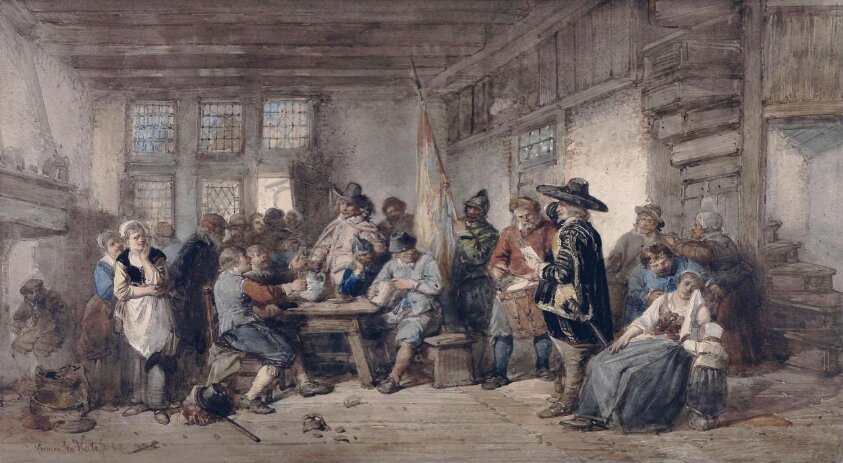


Mari ten Kate
Mari ten Kate is remembered for his depictions of childhood: he was also a dedicated observer of Dutch national crises. In 1855, he travelled to the sites of devastating floods to record the destruction firsthand. His sketches from this period provided a visual record of events like the Dijkdoorbraak van de Maas bij Poederoijen. These works moved beyond simple landscape painting to document the resilience of rural communities during environmental catastrophes.

Biography
His technique relied on a balance between human figures and their surroundings. In Twee kinderen bij een graf and Na de Doop, Ten Kate focuses on the emotional state of his subjects through posture and placement. He avoided the stiff formality of earlier Dutch portraiture. Instead, he favoured naturalistic settings where light defines the mood of the scene. This approach made his work popular among the 19th-century middle class who sought art that reflected daily life.
Modern collectors appreciate Ten Kate for the quiet narrative quality of his compositions. His prints offer a window into 19th-century Dutch social history without the heavy-handed moralising common in Victorian art. Works like Boerderij gered possess a timeless quality that suits contemporary homes. The combination of historical accuracy and soft atmosphere allows these pieces to function as both conversation starters and calming visual elements in a room.
Notable Works
Tap to view larger.
Next stop
Browse the movements →
Every movement in the collection, from the Renaissance to Pop art.
Mari ten Kate prints
Hand-finished archival prints from Mari ten Kate's body of work.

Related Artists


.jpg)


Take Mari ten Kate home.
See all Mari ten Kate prints →Frequently Asked Questions
When was Mari ten Kate born?
Mari ten Kate was born in 1831 and died in 1910.What is Mari ten Kate known for?
Mari ten Kate is known for mari ten Kate was a 19th-century Dutch artist known for his sensitive genre scenes and his journalistic depictions of the Great Floods of 1855.