


In the fifth month of 1804, officers of the Tokugawa shogunate arrested Kitagawa Utamaro, the most sought-after designer of women's portraits in Edo. His crime was a set of woodblock prints showing the sixteenth-century warlord Toyotomi Hideyoshi at a cherry-blossom party with his wife and concubines, each one named beside her likeness, drawn from the popular chronicle Ehon Taikōki. Naming the Taikō, or any recent military ruler, in a commercial print was against the law. Utamaro was jailed for several days, then manacled at his own house for about fifty days, and his publishers were fined. He was in his early fifties, at the height of his reputation as the pre-eminent painter of bijin (pictures of beautiful women) in Japan. He died two years later, in 1806, and historians of ukiyo-e still debate how much those fifty days in chains had to do with it.
The print that broke the law
The prints that ended Utamaro's freedom, however briefly, were not shunga or courtesan studies, the material usually blamed for his censorship troubles. They showed Toyotomi Hideyoshi (1537 to 1598), the warlord who unified Japan before the Tokugawa family took power, entertaining his wife and concubines at a spring outing to view cherry blossoms. The gathering, held at Daigo-ji temple in Kyoto in 1598 not long before Hideyoshi's death, was already familiar from popular history. Utamaro's source was the Ehon Taikōki, an illustrated chronicle of Hideyoshi's rise published between 1797 and 1802 and staged repeatedly as kabuki and jōruri between 1799 and 1804.
Depicting named, identifiable military rulers, Hideyoshi above all, was forbidden under shogunate law. Hideyoshi's son and heir had been destroyed by the first Tokugawa shogun in 1615; a picture of the old warlord surrounded by named women, sold in the idiom of a Yoshiwara courtesan print, was not a comfortable subject for his successors to see in circulation. Utamaro was not alone in misjudging the risk. Kitagawa Tsukimaro, Utagawa Toyokuni, Katsukawa Shuntei, Katsukawa Shun'ei and the writer Jippensha Ikku were caught in the same case, along with their publishers. Utamaro, the best known of the group, was jailed for several days and then sentenced to about fifty days in manacles at his own house. The publishers paid heavy fines.
Toyoaki becomes Utamaro
Utamaro's origins are not well documented. He was born around 1753, and even his birthplace, variously given as Edo, Kyoto, Osaka and Kawagoe, is not settled. He trained under Toriyama Sekien, a Kanō-schooled painter turned ukiyo-e artist who taught him for years before his own death in 1788. Utamaro published minor book illustrations and actor prints from about 1775 under the name Kitagawa Toyoaki. At a banquet in 1782 he announced a new art name, Utamaro, the one he used for the rest of his career.
By 1783 he had moved into the household of Tsutaya Jūzaburō, the Yoshiwara publisher who had built his business on guidebooks to the licensed quarter and was about to become the most important print publisher in Edo. Utamaro lived and worked under Tsutaya's roof for several years, alongside other talents the publisher had gathered, Kitao Masanobu among them. His earliest bijin prints followed the elegant, elongated figures that Torii Kiyonaga had made fashionable through the 1780s. Only in the early 1790s did Utamaro find a manner unmistakably his own, and it was Tsutaya who published it.
The invention of the ōkubi-e
What changed, around 1791, was distance. Instead of the full-length figure that Kiyonaga and his contemporaries favoured, Utamaro began cropping in: head and shoulders, or the figure from the waist up, set against a plain or mica-dusted ground with no interior and no furniture to place the woman anywhere in particular. Historians of the print call the format ōkubi-e (large-head pictures). Neither the close crop nor the coloured ground was new by itself, but Utamaro was the first to use them as a sustained programme rather than an occasional device.
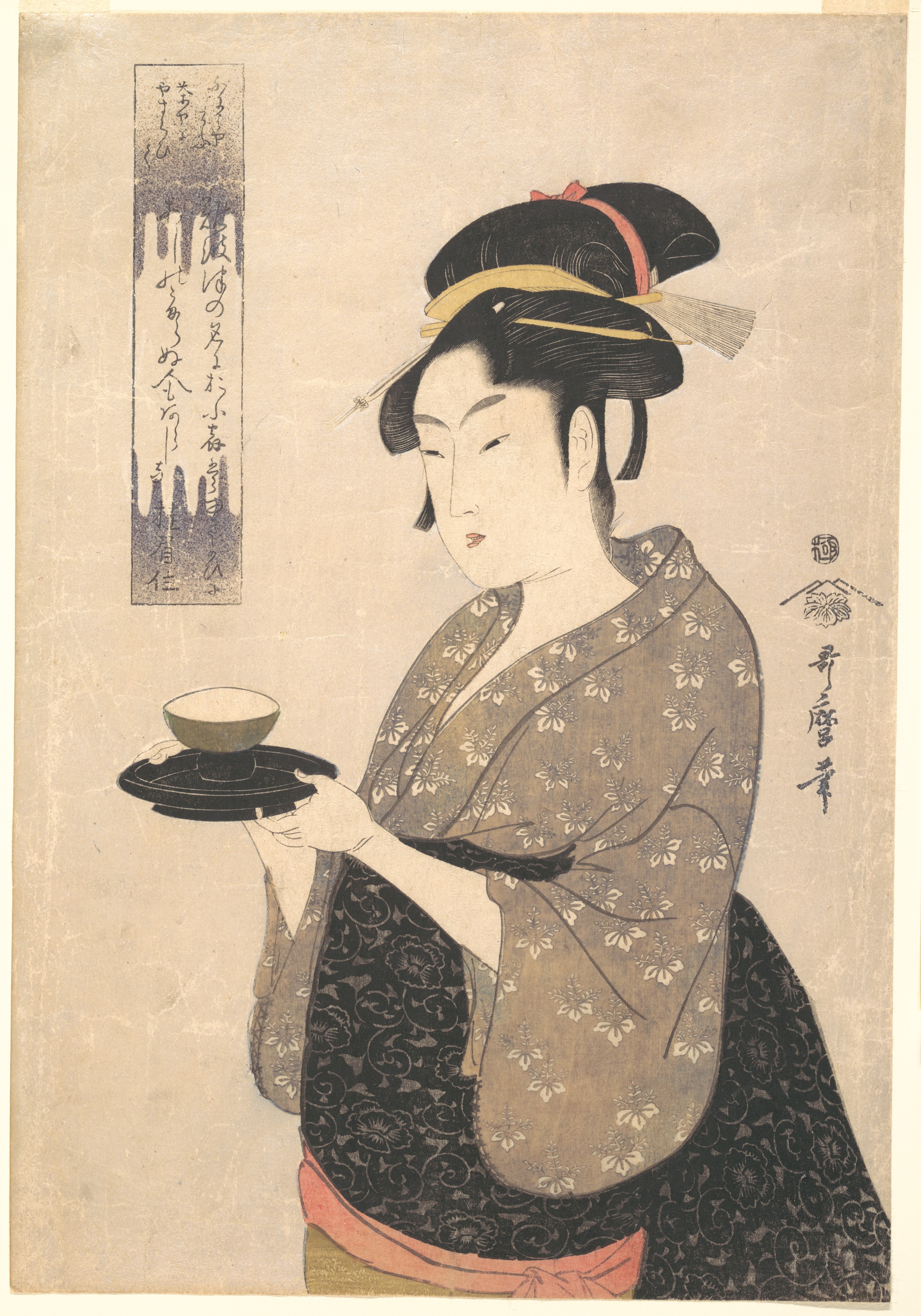
The effect turned a decorative genre into something closer to characterisation. A face filling the sheet has to carry the print on its own. Utamaro gave his women narrowed or heavy-lidded eyes, private half-smiles, a downward tilt of the head that reads as thought rather than display. Three Beauties of the Present Day, published by Tsutaya around 1792 to 1793, arranges three real Edo women, the geisha Tomimoto Toyohina and the teahouse workers Naniwaya Kita and Takashima Hisa, in a tight triangular cluster of overlapping profiles. Naming ordinary women in prints was against the law, so each is identified instead by a family crest worked into her clothing or her fan. The mica ground behind them catches the light rather than describing a place.
Mica, sumptuary law and Tsutaya's shop
The shimmering backgrounds were made with kira, powdered mica, brushed onto paper so that the pigment caught the light like a dull metal. It was an expensive effect, several separate printings for one sheet, and it needed a publisher willing to pay for it. Tsutaya was that publisher. He had built his fortune on Yoshiwara guidebooks before moving into prints and illustrated books, and he understood the market for a luxury object sold as ephemera. Their partnership, from 1783 until Tsutaya's death in 1797, produced some of the finest printing of the period.
It also operated under constant political risk. Between 1787 and 1793 the shogunate's chief councillor, Matsudaira Sadanobu, pushed through the Kansei Reforms, a programme of sumptuary regulation that reached into the publishing trade: restrictions on subject matter, on naming ordinary women, and eventually, in 1795, a ban on mica grounds themselves. Publishers who defied the rules risked fines or worse. Tsutaya had already lost half his assets in 1791, after the writer Santō Kyōden, whom he published, was sentenced to fifty days in manacles for three sharebon that broke the sumptuary code. Utamaro's mica-ground bijin were a luxury made inside a shrinking legal space, years before his own arrest showed how much further that space could close.
Individual faces, not ideal types
Utamaro's reputation rests on more than technique. Kiyonaga and his followers had painted an ideal, a type of beauty repeated from print to print. Utamaro increasingly painted particular women. Teahouse workers such as Naniwaya Okita and Takashima Ohisa appear again and again across his output, recognisable from sheet to sheet by more than a crest. He was interested in a woman's character and mood as much as her surface prettiness, in a sideways glance or a hand pressed against a cheek.
The law made plain identification difficult. Naming ordinary women in a commercial print was forbidden, so Utamaro and his publishers found ways round it: a crest, a shop name folded into the design, and from around 1795 a run of prints that hid a beauty's name inside a visual puzzle. His range went beyond the Yoshiwara and its teahouses. He drew women diving for awabi shellfish, mothers with children and old women alongside the courtesans and geisha who made his name. Series such as Ten Types of Women's Physiognomy, published in the same years as Three Beauties, isolated one face and one mood at a time: absorption, in a young woman blowing into a glass noisemaker; vanity, in another checking her teeth in a mirror.
The last two years
Tsutaya Jūzaburō died in 1797. Utamaro kept working, prolifically: across his career he is credited with more than two thousand print designs, over a hundred series of bijin alone, illustrations for close to a hundred books and around thirty paintings, issued through nearly sixty different publishers. Even so, several historians of ukiyo-e judge that his most inventive decade closed with Tsutaya's shop. By the early 1800s the large-head format he had invented was everywhere, copied by rivals and by his own students, Tsukimaro and Kiyomine among them, and his own late series increasingly repeat earlier ideas rather than extend them.
The Ehon Taikōki case, in 1804, landed on a fifty-one-year-old artist already past his best years. He served his sentence, fifty days manacled at home after a short jailing, and went back to print design, but not for long. He died in Edo on the twentieth day of the ninth month of 1806, aged fifty-three. Whether the manacles caused his decline in any medical sense is not something the record can settle. What the record shows is the timing: arrest in 1804, a diminished final period, death in 1806.
Utamaro reaches Paris
Japanese prints began reaching Europe in quantity after trade reopened in 1854, first as packing paper around export porcelain, then as a market in their own right. Utamaro's sheets were among the most sought after. Claude Monet owned more than thirty of them. Edgar Degas, Mary Cassatt, Henri de Toulouse-Lautrec and James McNeill Whistler all collected or studied his bijin. What drew them was the crop: a face or a gesture filling the sheet, with no perspective box or interior to place it in. The Paris shop La Porte Chinoise, a gathering point from the 1860s for painters curious about Japanese imports, did more to shape Impressionist and Post-Impressionist composition than its modest premises suggested.
None of this was available to Utamaro. He worked for Edo publishers and Edo buyers, inside Edo law, and the same shogunate that could manacle him for fifty days over a print of a dead warlord had no mechanism for objecting to what happened when his sheets reached Montmartre. By the time Monet was buying them, the ōkubi-e format Utamaro had invented to sell portraits of teahouse waitresses was reshaping paintings the shogunate would never see and could never have licensed.


