


In 1842 the shogunate's senior councillor, Mizuno Tadakuni, banned the publication of woodblock prints showing kabuki actors, courtesans and geisha. It was one clause in a wider programme of moral austerity known as the Tenpō Reforms, and on paper it ended a whole category of print overnight. Utagawa Kuniyoshi, already Edo's most inventive designer of warriors and monsters, simply moved the actors somewhere the law could not reach. He drew them as cats grooming themselves in a leading man's exact stage pose, as goldfish with a familiar crest stamped on the fin, as toys and paper fans carrying a face any kabuki-goer would know at a glance.
He pushed the joke further once, and it nearly cost him. The Earth Spider Conjures Up Demons at the Mansion of Minamoto Yorimitsu, a triptych from the following year, shows a warrior asleep and ill while demons close in around him; Edo read it at once as a portrait of a sick government surrounded by the people it had ruined. The magistrates called Kuniyoshi and his publisher in to account for it. Both talked their way out of a formal charge, though the printing blocks were confiscated.
A silk dyer's son learns from Toyokuni
Kuniyoshi was born in Edo in the last days of 1797 by the Japanese calendar, which places his birthday on 1 January 1798 in the Western one. His father dyed silk for a living. As a boy he is said to have shown the print master Utagawa Toyokuni a drawing of Shōki, the demon-queller of Chinese legend, and impressed him enough to be taken on as a pupil around 1811. Training in Toyokuni's studio meant the standard Utagawa curriculum: actor portraits and pictures of beautiful women, the two genres that sold. Kuniyoshi took the art name by which he is known and set up on his own around 1814, and the years that followed were lean. By one account he was reduced for a time to repairing and reselling discarded tatami mats to get by. Commissions came slowly. It took thirteen more years, and one particular series, to change that.
The Suikoden makes his name
In 1827 the publisher Kagaya Kichiemon issued the first instalments of One Hundred and Eight Heroes of the Popular Suikoden (Tsūzoku Suikoden Gōketsu Hyakuhachinin no Hitori), Kuniyoshi's single-sheet portraits of the outlaw-heroes of the Chinese Water Margin tale in its Japanese retelling. Each print gave one hero the full-page, close-up treatment: a fixed stare, a weapon, and skin covered in dragons, tigers, peonies and demons rendered as elaborate tattoos. Kyūmonryū Shishin, "Nine Dragons" Shi Jin, bares a back covered in coiling dragon tattoos in one of the set's best-known sheets. The design was new to print and, by most accounts, new to Edo fashion too: tattoo motifs Kuniyoshi invented for paper are credited with helping start a vogue for full-body irezumi among firemen and labourers who wanted the same designs on their own skin. The series ran for years and made Kuniyoshi the leading designer of warrior prints in Japan, a position he held for the rest of his career even as he moved into views of famous places, ghost stories and comic sheets of frogs and other animals mimicking kabuki roles.
The Tenpō Reforms reach the print shops
Shogun Tokugawa Ienari died in 1841. His successor's government handed real power to Mizuno Tadakuni, a rōjū (senior councillor), who used the change to launch a broad programme of retrenchment named for the Tenpō era, covering sumptuary limits on dress and festivals as well as tighter restrictions on the size and cost of woodblock prints. The print trade's specific blow landed in 1842, when the production of prints depicting kabuki actors, courtesans and geisha was prohibited outright. For Edo's publishers this was not a minor loss. Actor portraits and pictures of beautiful women were the two best-selling genres in the trade, the genres Kuniyoshi himself had trained in years before. Mizuno fell from office in 1843, driven out over a separate and deeply unpopular land-reallocation edict, but the print ban he had imposed did not lift with him. Enforcement continued for several more years and only eased around 1846, when actors began to reappear in prints, at first still folded into scenery and crowd scenes rather than named outright on a theatre bill.
Cats, goldfish and a wardrobe of disguises
Kuniyoshi's workaround was to keep drawing actors and simply stop calling them that. Around 1842 he produced A Hundred Cats' Physiognomies (Neko no Hyaku Mensō), showing performers from a famous scene in the play Chūshingura as cats: the pose, a crest worked into a paw or a collar, the tilt of a whiskered face were enough for a regular theatregoer to name every actor being sent up. A companion print did the same trick with goldfish, each fish carrying an actor's mon, or family crest, on its fin so the joke could be read at a glance. Others turn up disguised as toys, kitchen implements and folding fans. None of this broke the letter of the ban. A cat is a cat; a goldfish is a goldfish; the magistrates had prohibited pictures of actors, not pictures of animals that happened to strike an actor's pose. Kuniyoshi's publishers understood the distinction and kept printing.
A demon-haunted shogun asleep
Not every print from these years was so easily defended. The Earth Spider Conjures Up Demons at the Mansion of Minamoto Yorimitsu, published in 1843, shows the Heian-era warrior Yorimitsu lying ill and asleep while a monstrous spider spins its web above him. His retainers sit in the foreground playing a board game, oblivious, as grotesque yōkai crowd in from every side. Read as a straightforward illustration of an old warrior legend, the print was unremarkable. Read as commentary on the current government, with the sleeping, sickly Yorimitsu standing in for a shogunate that had lost its grip and the demons for the officials and citizens the reforms had damaged, it was something else again. Edo read it the second way almost immediately. The authorities noticed too: Kuniyoshi and his publisher were brought in for questioning, and the blocks used to print it were seized. Neither man was formally punished. Whether Kuniyoshi intended the reading that made the print famous is still debated; what is certain is that he and his publisher denied it under questioning, and got away with the denial.
A house that ran on cats
The cats were more than camouflage. By several accounts Kuniyoshi kept a dozen or more of them in his studio at any one time, working with a kitten tucked into the sleeve of his kimono while he painted. When one died he had it buried with a Buddhist funeral and gave it a posthumous name recorded on a small altar he kept at home, alongside what visitors described as a register of his cats' deaths. Cats appear in his work from well before the Tenpō ban and long after it lifted; the appetite for parody just gave a personal habit a commercial outlet for a few years.
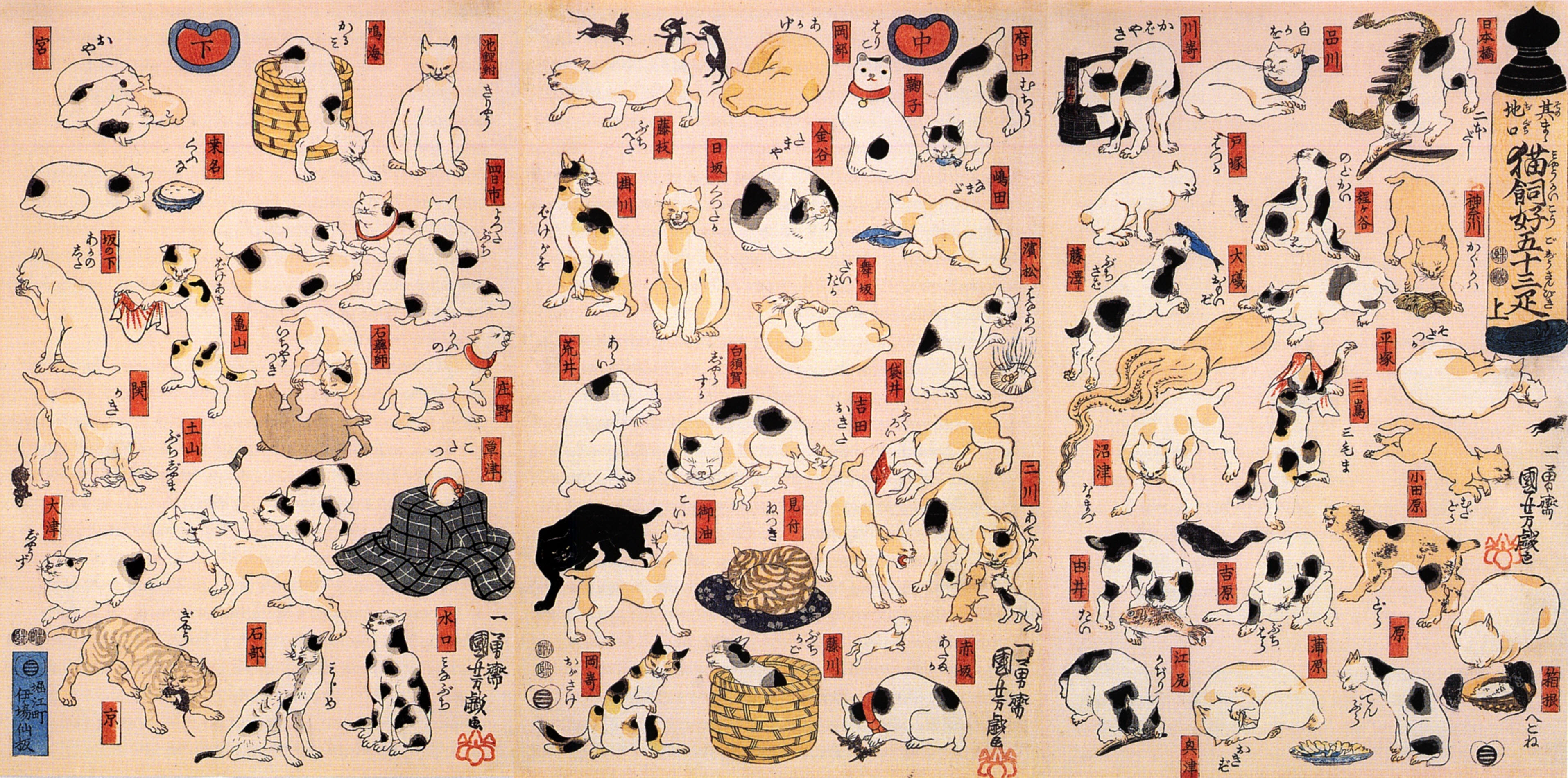
Cats Suggested as the Fifty-three Stations of the Tōkaidō, a triptych from around 1847 to 1850, has nothing to do with disguising actors. It takes Hiroshige's Tōkaidō series, itself an account of the fifty-three post-stations on the road between Edo and Kyoto, and replaces every view with a pun: fifty-five cats in total, one for each station plus the two endpoints, each pose or prop a play on the sound of a place name. Understanding the jokes now takes a glossary. Buying the joke in 1850 apparently took nothing more than being able to read a cat's expression, which for Kuniyoshi's audience was evidently a skill already well practised.
The students who carried the line on
Kuniyoshi ran one of the largest studios of his generation and, by his own students' account, a cheerful one. Yoshitoshi, later called the last master of the woodblock print, joined as a teenager and became his most important pupil. Yoshitora, Yoshiiku, Yoshikazu, Yoshitsuya and Yoshifuji all trained under him and carried Utagawa-school warrior and actor prints into the second half of the century. So did Kyōsai, who arrived at the studio around 1837 at the age of six and stayed until he was nine. Decades later, in a book of reminiscences published in 1887, Kyōsai drew the scene from memory: Kuniyoshi mid-lesson, brush in hand, two of his older students caught mid-scuffle in the corner of the room. He did not draw the cats. By every other account, there would have been several in the picture if he had.


