


Odysseus devised a wooden horse to enter Troy after the Greeks failed to capture the city by force. Greek warriors hid inside while the army sailed away, and the Trojans brought the horse within their walls before celebrating their supposed victory.
Odysseus Builds the Trojan Horse
Odysseus proposed a new stratagem after the Greeks had failed to take Troy by force. He told the Greeks to build an enormous hollow horse of wood and conceal their best warriors inside it. Epeios, an architect and skilled worker in wood, built the horse from timber felled on Mount Ida. It was hollow within and had an opening at its side. Odysseus persuaded the chieftains to enter, although the men understood the danger. Neoptolemus, the son of Achilles, was the only one described as free from terror.
The remaining Greeks were to burn their tents, board their ships, and appear to sail away. They would hide beyond Tenedos, or behind the nearest island, where the Trojans could not see them. A Greek whom the Trojans did not know was left near the deserted camp. The plan depended on the Trojans finding the horse after the army had withdrawn and believing that the war was over. They discovered the wooden horse and brought it through the city gates. One account says that they took it as a divine gift. The Trojans then spent the day celebrating.
When night came, the hidden warriors emerged from the horse. They reached the sentries and opened the gates for the Greek army, which had quietly returned from its hiding place. The Greeks entered Troy and sacked the city. After the fall of Troy, Odysseus and his men boarded their ships and sailed towards Ithaca. A storm sent by Poseidon at Athena's request drove them off course, beginning their long wanderings.
Poseidon Curses Odysseus
Odysseus and his companions blinded Polyphemus with a sharpened club after heating its point in the fire. They had prepared the weapon inside the Cyclops’s cave. When Polyphemus cried out to the neighbouring Cyclopes, they came and asked who was hurting him. He answered, “Nobody.” Believing that no one was attacking him, they went away.
When the flocks left the cave for pasture, Polyphemus opened the entrance and felt the sheep as they passed. Odysseus tied three rams together, hid beneath the largest, and left with the flock. He then freed his companions from beneath the animals and drove the sheep to the ships. As the ship moved away, he called back to Polyphemus and revealed his name. He said that if any man asked who had blinded him, the Cyclops should answer that it was Odysseus, son of Laërtes, whose home was in Ithaca.
Polyphemus remembered that a prophet named Telemos, son of Eurymos, had foretold that Odysseus would blind him. Odysseus’s companions urged him to stop provoking the Cyclops. They had already seen Polyphemus throw a rock into the sea, bringing the ship back towards the land, and feared that another stone would destroy them. Odysseus ignored their warning and continued to shout at Polyphemus.
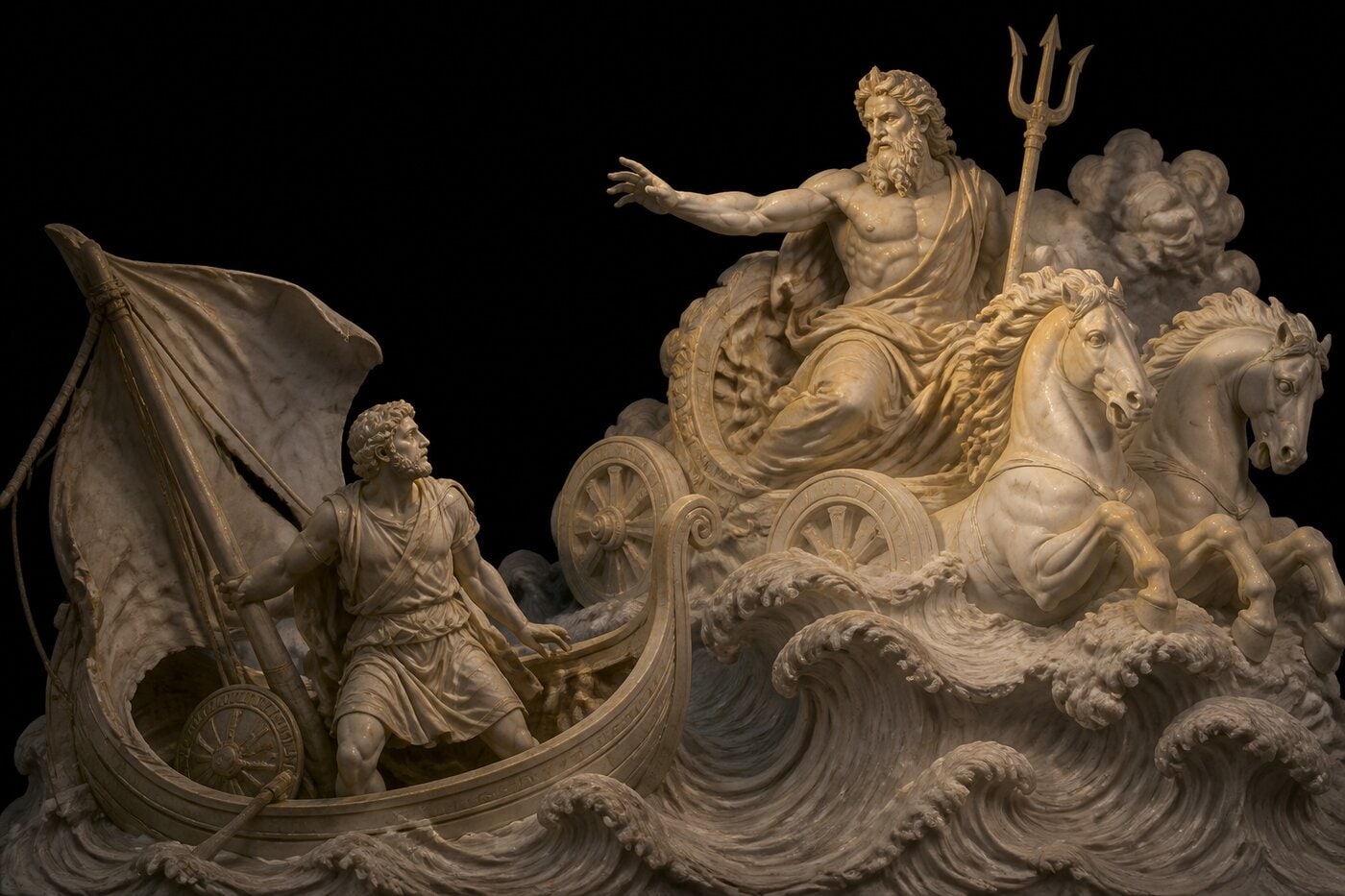
Polyphemus raised his hands to the heavens and prayed to Poseidon, claiming that the god was his father. He asked that Odysseus never reach Ithaca. If Odysseus was destined to return, Polyphemus asked that he arrive late, after suffering many troubles, losing all his companions, travelling on another man’s ship, and finding grief in his house. Poseidon heard the prayer. Polyphemus then lifted a much larger rock, swung it round, and hurled it with all his strength. It fell near the ship’s steering-oar. The sea surged when the stone struck the water, and its wake drove the ship onward.
Aeolus Gives Odysseus the Winds
At Aeolus's island, Odysseus and his companions were received as guests. Zeus had appointed Aeolus to control the winds, allowing him to calm them or send them forth. When Odysseus prepared to leave, Aeolus placed the winds that could hinder or endanger the voyage inside a leather bag. He fastened it with a silver string and arranged for favourable winds to carry the ships towards their homeland.
The voyage went well. For nine days, Odysseus kept watch and held the steering rope, refusing to give it to another man. As they drew close to Ithaca, he could see smoke rising from the town. Exhausted from constant effort, he fell asleep. His companions looked at the sealed bag and decided that it must contain gold, silver, or other treasures that Aeolus had given their commander. They believed Odysseus had received a richer reward than they had, although they had shared the same journey.
Their suspicion overcame their judgement. They untied the bag, and the imprisoned winds burst out. The ships were swept away from their course and carried back across the sea towards Aeolus's island. Odysseus then returned to Aeolus and asked for help and a favourable wind. Aeolus refused him. He said that he could not aid a man whom the gods were opposing, and that he could not save someone against their will. The ships therefore left the island again without his assistance.


