

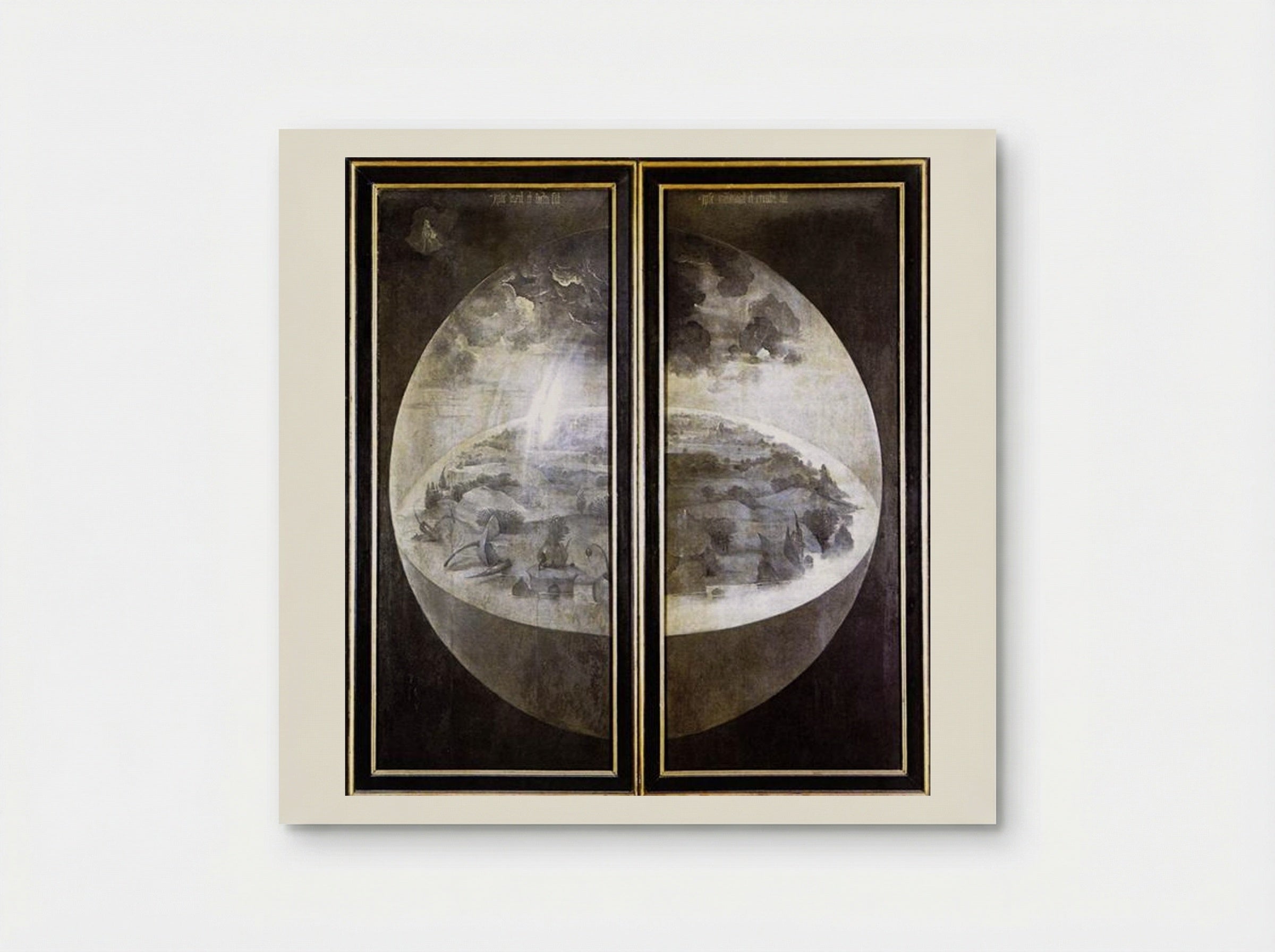
Lustarnas trädgård (yttre luckor) - Hieronymus Bosch
Arkivbeständigt giclée-tryck
Ramar levereras klara att hängas upp
Säker utcheckning
Tillverkad på beställning
Beskrivning
Boschs mästerverks yttre luckor, återgivna i monokrom grisaille för att skildra skapelsens tredje dag.
Denna bild föreställer de yttre luckorna på den berömda triptyken Lustgården, av Hieronymus Bosch. Till skillnad från de färgstarka och kaotiska inre panelerna är utsidan utförd i grisaille, en teknik som använder nyanser av grått för att efterlikna utseendet av stenskulptur. Detta färgval skapar en stark kontrast, som förbereder betraktaren för övergången från den vardagliga världen till de komplexa moraliska narrativen som finns inneslutna i de stängda panelerna. Kompositionen presenterar en transparent sfär, ofta tolkad som världen under skapelsens tredje dag. Inom jordklotet kan man observera en primordial jord, med klippformationer, sparsam vegetation och vatten. En liten figur av Gud sitter i det övre vänstra hörnet och observerar den pågående skapelsen. Användningen av en cirkulär form inom en rektangulär ram betonar världens isolering, upphängd i ett mörkt, tomrumsliknande utrymme. Målningsapplikationen är precis, med fokus på de subtila graderingarna av ljus och skugga för att definiera sfärens krökning och den framväxande terrängens texturer. Bosch använder denna monokroma ansats för att föreslå en värld före införandet av mänsklig synd och den efterföljande korruptionen av naturen. Bristen på färg tjänar till att fokusera betraktaren på scenens strukturella element, vilket speglar periodens teologiska betänkligheter angående universums ursprung. De latinska inskriptionerna överst på panelerna, hämtade från Psalm 33, förankrar ytterligare verket i dess religiösa kontext, där det står att Gud talade och världen blev till. Denna yttre vy fungerar som ett skyddande skal, som döljer de moraliska varningarna och allegorierna i interiören tills verket öppnas för kontemplation.
Returpolicy
Eftersom varje tryck görs på beställning erbjuder vi inte returer, återbetalningar eller byten på grund av ändrade åsikter. Om din beställning kommer fram felaktig, skadad eller fel, ersätter vi den kostnadsfritt – kontakta oss bara inom 48 timmar efter leverans. Se vår återbetalningssida för fullständig information.
Frakt
Vi skickar till hela världen och trycker vid den produktionsanläggning som är närmast din leveransadress. Leveranstider och kostnader varierar beroende på destination – du ser tillgängliga alternativ i kassan.
Tillverkning
Varje tryck produceras på beställning med 12-färgs gicléetryck på FSC-certifierat arkivpapper. Designade i Storbritannien och tryckta vid närmaste produktionsanläggning för att minska avfall och snabba upp leveransen.
Lustarnas trädgård (yttre luckor) - Hieronymus Bosch

Artist Biography
Hieronymus Bosch
When he was about thirteen, a fire destroyed 4,000 houses in the town. He almost certainly watched it. Scholars point to this event when explaining why flames appear so insistently in his later work, licking across panels of the damned and the disobedient, painted with a specificity that suggests memory rather than imagination.
He came from painters. His grandfather Jan van Aken had been one; four of Jan's five sons were painters too, though none of their work survives. Bosch married Aleyt Goyaerts van den Meervenne, a woman who was older than him and considerably wealthier. Her money meant he did not depend on commissions. He could paint what interested him, and what interested him was the full catalogue of human foolishness.
Only about 25 paintings are confidently attributed to him today. He signed just seven of them and dated none. The Garden of Earthly Delights, his best-known work, is a triptych tracing the arc from paradise to damnation, packed with hundreds of nude figures, hybrid creatures, and objects that resist easy interpretation. In 2014, someone noticed what appeared to be musical notes written on a tortured figure's backside in the hell panel. They transcribed and recorded the result. It sounds roughly as you would expect music from hell to sound.
His technique was unusual for the period. Where his Netherlandish contemporaries built up smooth, translucent glazes that concealed all brushwork, Bosch painted in thin, loose layers. The chalk underdrawing sometimes shows through. The effect is closer to drawing than to the polished surfaces of van Eyck or Memling.
He joined the Brotherhood of Our Lady in the late 1480s, a prestigious local confraternity with about 40 primary members and 7,000 associates across Europe. His father had served as their artistic adviser. The Brotherhood connected him to wealthy, orthodox Catholic patrons, and his paintings were collected across the Netherlands, Austria, and Spain during his lifetime. Philip II of Spain amassed so many that the Prado remains the richest repository of his work. The Surrealists claimed him centuries later. Leonora Carrington called him the first modern artist.
Våra funktioner
Utformad för varaktig inverkan
Specifika funktioner
Varje Solis-konstverk tillverkas på beställning med arkivbeständiga material av gallerikvalitet som är byggda för att hålla.
- Giclée-tryck i museikvalitet för fylliga, blekningsbeständiga färger
- Arkivbeständigt matt konstpapper, FSC-certifierat
- Flera storlekar och inramningsalternativ tillgängliga
- Ramar i svart, naturträ, mörkt trä eller vitt
- Inramade tryck levereras klara att hänga upp
Skötsel & rengöring
För att bevara ditt konstverk i bästa skick:
- Damma försiktigt med en mjuk, torr trasa
- Undvik långvarigt direkt solljus
- Använd aldrig flytande rengöringsmedel på trycket eller dukytan
- Förvara på en torr plats i rumstemperatur
- Hantera tryck med rena, torra händer
Material och storlek
Gicléeutskrift av museikvalitet på FSC-certifierat matt arkivpapper, med inramade alternativ och alternativ på canvas.
- Pappersstorlekar: A4, A3, A2, A1, A0 och B2 (50×70 cm)
- Canvas: XS (20×30 cm) till Large (60×90 cm)
- Ramar: svart, naturligt trä, mörkt trä eller vit
Varför välja oss?
Leveransgaranti utan skador
Snabb leverans
Material av museikvalitet
Artistbiografi
Hieronymus Bosch
When he was about thirteen, a fire destroyed 4,000 houses in the town. He almost certainly watched it. Scholars point to this event when explaining why flames appear so insistently in his later work, licking across panels of the damned and the disobedient, painted with a specificity that suggests memory rather than imagination.
He came from painters. His grandfather Jan van Aken had been one; four of Jan's five sons were painters too, though none of their work survives. Bosch married Aleyt Goyaerts van den Meervenne, a woman who was older than him and considerably wealthier. Her money meant he did not depend on commissions. He could paint what interested him, and what interested him was the full catalogue of human foolishness.
Only about 25 paintings are confidently attributed to him today. He signed just seven of them and dated none. The Garden of Earthly Delights, his best-known work, is a triptych tracing the arc from paradise to damnation, packed with hundreds of nude figures, hybrid creatures, and objects that resist easy interpretation. In 2014, someone noticed what appeared to be musical notes written on a tortured figure's backside in the hell panel. They transcribed and recorded the result. It sounds roughly as you would expect music from hell to sound.
His technique was unusual for the period. Where his Netherlandish contemporaries built up smooth, translucent glazes that concealed all brushwork, Bosch painted in thin, loose layers. The chalk underdrawing sometimes shows through. The effect is closer to drawing than to the polished surfaces of van Eyck or Memling.
He joined the Brotherhood of Our Lady in the late 1480s, a prestigious local confraternity with about 40 primary members and 7,000 associates across Europe. His father had served as their artistic adviser. The Brotherhood connected him to wealthy, orthodox Catholic patrons, and his paintings were collected across the Netherlands, Austria, and Spain during his lifetime. Philip II of Spain amassed so many that the Prado remains the richest repository of his work. The Surrealists claimed him centuries later. Leonora Carrington called him the first modern artist.
Du kanske också gillar