

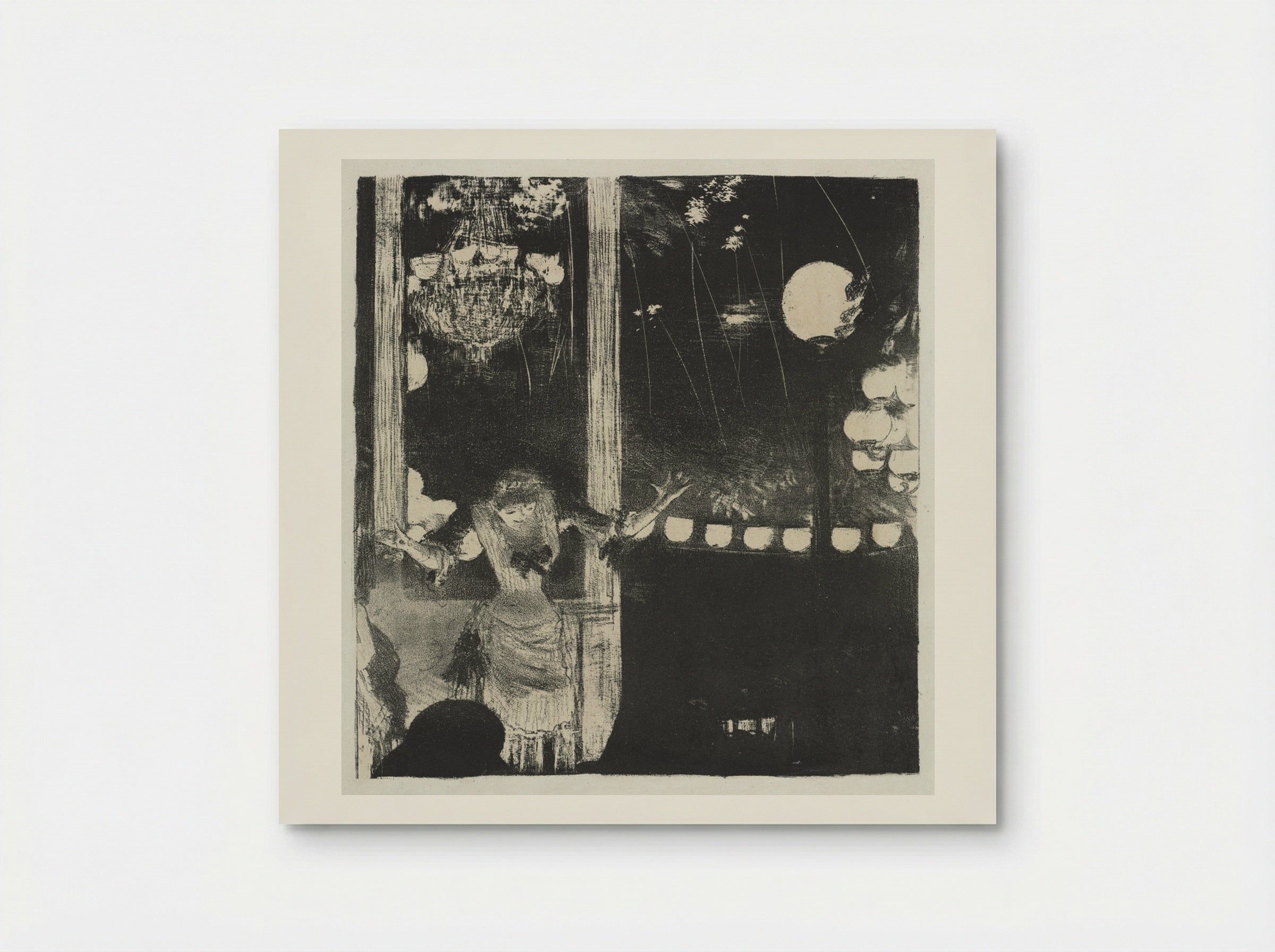
Mlle Bécat på Café des Ambassadeurs - Edgar Degas
Arkivbeständigt giclée-tryck
Ramar levereras klara att hängas upp
Säker utcheckning
Tillverkad på beställning
Beskrivning
En slående litografi av Edgar Degas som föreställer en artist på scenen på Café des Ambassadeurs i Paris, definierad av dramatiska kontraster mellan ljus och skugga.
Edgar Degas producerade denna litografi under en period av intensivt experimenterande med grafiska tekniker. Verket föreställer artisten Mlle Bécat på scenen på Café des Ambassadeurs, en populär parisisk utomhusscen. Degas fokuserar på kaféets artificiella belysning, där kontrasten mellan den mörka natthimlen och de glödande gaslamporna definierar rummet. Artisten är placerad till vänster, med utsträckta armar i en teatralisk gest som antyder energin i hennes framträdande. Degas använder en teknik som efterliknar utseendet av en monotyp, med djupa svarta toner och mjuka, atmosfäriska gråtoner för att skapa ett djup. Kompositionen är okonventionell, med artisten skjuten åt sidan och scenbelysningen som dominerar den högra delen av ramen. Denna inramning återspeglar konstnärens intresse för det moderna livets flyktiga natur och den specifika miljön på de parisiska kafékonserterna. Trycket visar hans förmåga att översätta spontaniteten i hans skisser till ett mer permanent medium. Genom att utelämna fina detaljer i bakgrunden låter Degas betraktaren fokusera på sångerskans silhuett och ljusets spel över scenen. Verket undviker en traditionell porträttstruktur och väljer istället en ögonblicksbild av ett framträdande. Detta tillvägagångssätt överensstämmer med hans bredare intresse för teatern och den sociala dynamiken i det sena 1800-talets Paris. Litografin förblir ett tydligt exempel på hans tekniska skicklighet och hans preferens för ämnen hämtade från stadens upplevelser.
Returpolicy
Eftersom varje tryck görs på beställning erbjuder vi inte returer, återbetalningar eller byten på grund av ändrade åsikter. Om din beställning kommer fram felaktig, skadad eller fel, ersätter vi den kostnadsfritt – kontakta oss bara inom 48 timmar efter leverans. Se vår återbetalningssida för fullständig information.
Frakt
Vi skickar till hela världen och trycker vid den produktionsanläggning som är närmast din leveransadress. Leveranstider och kostnader varierar beroende på destination – du ser tillgängliga alternativ i kassan.
Tillverkning
Varje tryck produceras på beställning med 12-färgs gicléetryck på FSC-certifierat arkivpapper. Designade i Storbritannien och tryckta vid närmaste produktionsanläggning för att minska avfall och snabba upp leveransen.
Mlle Bécat på Café des Ambassadeurs - Edgar Degas

Artist Biography
Edgar Degas
More than half of his entire output depicts dancers. He became a fixture at the Paris Opera, watching from the wings and from boxes above the stage, sketching not the performance but the work behind it: the stretching, the waiting, the adjusting of shoes, the corrections from the ballet master. The backstage fatigue interested him more than the applause.
In 1881, he exhibited Little Dancer Aged Fourteen, a two-thirds life-size wax figure of Marie van Goethem, a real student at the Opera ballet school. She wore a real tutu, real ballet slippers, and a wig of human hair, all coated in wax. Critics called it repulsive. One described the girl as having a face marked by the hateful promise of every vice. Wax was a material for anatomical specimens, not art. It was the only sculpture he exhibited in his lifetime. After his death, 150 more wax figures were found in his studio, many falling apart.
His eyesight began failing during the Franco-Prussian War. By his forties he had lost central vision. By fifty-seven he could not read. The deterioration drove him from fine brushwork to bolder strokes, then to pastels, then to sculpture he could work by touch. He avoided daylight and painted under controlled artificial light. Collectors joked they should chain their Degas paintings to the wall, because he would try to take them back to rework them. He compulsively revised everything.
He disliked being called an Impressionist. He preferred Realist or Independent. He never painted outdoors, which was supposedly the whole point of the movement. Despite this, he co-founded the group, organised their exhibitions, and showed in all eight. He said: there is love and there is art and we only have one heart. He never married.
Våra funktioner
Utformad för varaktig inverkan
Specifika funktioner
Varje Solis-konstverk tillverkas på beställning med arkivbeständiga material av gallerikvalitet som är byggda för att hålla.
- Giclée-tryck i museikvalitet för fylliga, blekningsbeständiga färger
- Arkivbeständigt matt konstpapper, FSC-certifierat
- Flera storlekar och inramningsalternativ tillgängliga
- Ramar i svart, naturträ, mörkt trä eller vitt
- Inramade tryck levereras klara att hänga upp
Skötsel & rengöring
För att bevara ditt konstverk i bästa skick:
- Damma försiktigt med en mjuk, torr trasa
- Undvik långvarigt direkt solljus
- Använd aldrig flytande rengöringsmedel på trycket eller dukytan
- Förvara på en torr plats i rumstemperatur
- Hantera tryck med rena, torra händer
Material och storlek
Gicléeutskrift av museikvalitet på FSC-certifierat matt arkivpapper, med inramade alternativ och alternativ på canvas.
- Pappersstorlekar: A4, A3, A2, A1, A0 och B2 (50×70 cm)
- Canvas: XS (20×30 cm) till Large (60×90 cm)
- Ramar: svart, naturligt trä, mörkt trä eller vit
Varför välja oss?
Leveransgaranti utan skador
Snabb leverans
Material av museikvalitet
Artistbiografi
Edgar Degas
More than half of his entire output depicts dancers. He became a fixture at the Paris Opera, watching from the wings and from boxes above the stage, sketching not the performance but the work behind it: the stretching, the waiting, the adjusting of shoes, the corrections from the ballet master. The backstage fatigue interested him more than the applause.
In 1881, he exhibited Little Dancer Aged Fourteen, a two-thirds life-size wax figure of Marie van Goethem, a real student at the Opera ballet school. She wore a real tutu, real ballet slippers, and a wig of human hair, all coated in wax. Critics called it repulsive. One described the girl as having a face marked by the hateful promise of every vice. Wax was a material for anatomical specimens, not art. It was the only sculpture he exhibited in his lifetime. After his death, 150 more wax figures were found in his studio, many falling apart.
His eyesight began failing during the Franco-Prussian War. By his forties he had lost central vision. By fifty-seven he could not read. The deterioration drove him from fine brushwork to bolder strokes, then to pastels, then to sculpture he could work by touch. He avoided daylight and painted under controlled artificial light. Collectors joked they should chain their Degas paintings to the wall, because he would try to take them back to rework them. He compulsively revised everything.
He disliked being called an Impressionist. He preferred Realist or Independent. He never painted outdoors, which was supposedly the whole point of the movement. Despite this, he co-founded the group, organised their exhibitions, and showed in all eight. He said: there is love and there is art and we only have one heart. He never married.
Du kanske också gillar