

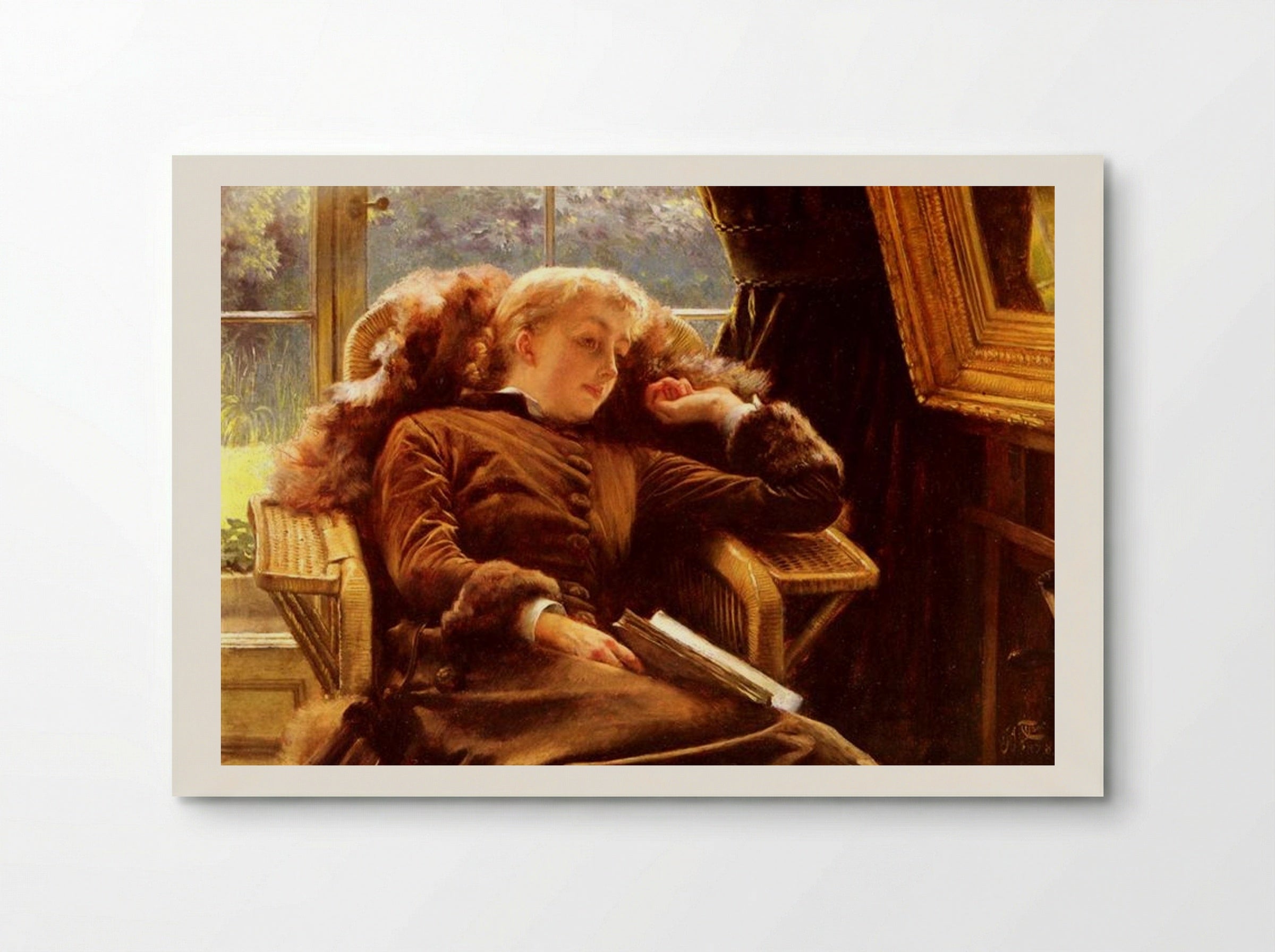
Kathleen Newton i en fåtölj - James Tissot
Arkivbeständigt giclée-tryck
Ramar levereras klara att hängas upp
Säker utcheckning
Tillverkad på beställning
Beskrivning
Ett porträtt av James Tissot av hans musa, Kathleen Newton, sittande i en fåtölj. Målningen fångar ett ögonblick av stillsam kontemplation i en hemmiljö.
James Tissot, en fransk målare som tillbringade en betydande del av sin karriär i Storbritannien, är känd för sina genrescener och porträtt av societeten. Denna målning föreställer Kathleen Newton, Tissots musa och älskarinna, i ett ögonblick av stillsam vila. Newton, en irländsk skild kvinna, bodde med Tissot i flera år tills hennes död av tuberkulos 1882. Hennes närvaro påverkade hans liv och konst djupt. Porträttet fångar Newton sittande i en rottingfåtölj, hennes blick riktad nedåt, kanske försjunken i tankar. Hon bär en mörkbrun, pälsbrämd jacka. Det mjuka ljuset som filtreras genom fönstret belyser hennes ansikte och sidorna i boken hon håller i händerna. Kompositionen är intim och fokuserar på Newtons kontemplativa uttryck. Det omgivande rummet, med glimtar av en trädgård och en delvis synlig målning, antyder en bekväm hemmiljö. Tissots skicklighet i att återge texturer och detaljer är tydlig i skildringen av pälsen, rottingen och vecken i Newtons kläder.
Returpolicy
Eftersom varje tryck görs på beställning erbjuder vi inte returer, återbetalningar eller byten på grund av ändrade åsikter. Om din beställning kommer fram felaktig, skadad eller fel, ersätter vi den kostnadsfritt – kontakta oss bara inom 48 timmar efter leverans. Se vår återbetalningssida för fullständig information.
Frakt
Vi skickar till hela världen och trycker vid den produktionsanläggning som är närmast din leveransadress. Leveranstider och kostnader varierar beroende på destination – du ser tillgängliga alternativ i kassan.
Tillverkning
Varje tryck produceras på beställning med 12-färgs gicléetryck på FSC-certifierat arkivpapper. Designade i Storbritannien och tryckta vid närmaste produktionsanläggning för att minska avfall och snabba upp leveransen.
Kathleen Newton i en fåtölj - James Tissot

Artist Biography
James Tissot
He grew up in the port city of Nantes, the son of a milliner and dressmaker. His mother's trade shows in the paintings: nobody in nineteenth-century art rendered fabric, lace, ribbons and the cut of a sleeve with more attention than Tissot. He studied in Paris under Hippolyte Flandrin and exhibited at the Salon from 1859, shifting quickly from medieval subjects to modern life.
He fought in the Franco-Prussian War and was implicated in the Paris Commune of 1871, though the extent of his involvement remains unclear. What is clear is that he left Paris in a hurry after Bloody Week and turned up in London, where his detailed paintings of Victorian society made him wealthy within a few years. The English liked his work because it showed them as they wished to be seen: well-dressed, leisured, and slightly mysterious. The sexual tension in many of his compositions, the glances exchanged between men and women across the rigid codes of Victorian propriety, is always present and never explicit.
He drew caricatures for Vanity Fair under the pseudonym Coide. He was also a serious collector of Japanese art, and the influence of Japanese composition and textile patterns runs through his work alongside the European tradition.
In London he began a relationship with Kathleen Newton, an Irishwoman who became his constant model and companion until her death from tuberculosis in 1882. He returned to Paris after she died and spent his final years painting a monumental series of 350 gouaches illustrating the life of Christ, based on research trips to the Middle East.
Våra funktioner
Utformad för varaktig inverkan
Specifika funktioner
Varje Solis-konstverk tillverkas på beställning med arkivbeständiga material av gallerikvalitet som är byggda för att hålla.
- Giclée-tryck i museikvalitet för fylliga, blekningsbeständiga färger
- Arkivbeständigt matt konstpapper, FSC-certifierat
- Flera storlekar och inramningsalternativ tillgängliga
- Ramar i svart, naturträ, mörkt trä eller vitt
- Inramade tryck levereras klara att hänga upp
Skötsel & rengöring
För att bevara ditt konstverk i bästa skick:
- Damma försiktigt med en mjuk, torr trasa
- Undvik långvarigt direkt solljus
- Använd aldrig flytande rengöringsmedel på trycket eller dukytan
- Förvara på en torr plats i rumstemperatur
- Hantera tryck med rena, torra händer
Material och storlek
Gicléeutskrift av museikvalitet på FSC-certifierat matt arkivpapper, med inramade alternativ och alternativ på canvas.
- Pappersstorlekar: A4, A3, A2, A1, A0 och B2 (50×70 cm)
- Canvas: XS (20×30 cm) till Large (60×90 cm)
- Ramar: svart, naturligt trä, mörkt trä eller vit
Varför välja oss?
Leveransgaranti utan skador
Snabb leverans
Material av museikvalitet
Artistbiografi
James Tissot
He grew up in the port city of Nantes, the son of a milliner and dressmaker. His mother's trade shows in the paintings: nobody in nineteenth-century art rendered fabric, lace, ribbons and the cut of a sleeve with more attention than Tissot. He studied in Paris under Hippolyte Flandrin and exhibited at the Salon from 1859, shifting quickly from medieval subjects to modern life.
He fought in the Franco-Prussian War and was implicated in the Paris Commune of 1871, though the extent of his involvement remains unclear. What is clear is that he left Paris in a hurry after Bloody Week and turned up in London, where his detailed paintings of Victorian society made him wealthy within a few years. The English liked his work because it showed them as they wished to be seen: well-dressed, leisured, and slightly mysterious. The sexual tension in many of his compositions, the glances exchanged between men and women across the rigid codes of Victorian propriety, is always present and never explicit.
He drew caricatures for Vanity Fair under the pseudonym Coide. He was also a serious collector of Japanese art, and the influence of Japanese composition and textile patterns runs through his work alongside the European tradition.
In London he began a relationship with Kathleen Newton, an Irishwoman who became his constant model and companion until her death from tuberculosis in 1882. He returned to Paris after she died and spent his final years painting a monumental series of 350 gouaches illustrating the life of Christ, based on research trips to the Middle East.
Du kanske också gillar