

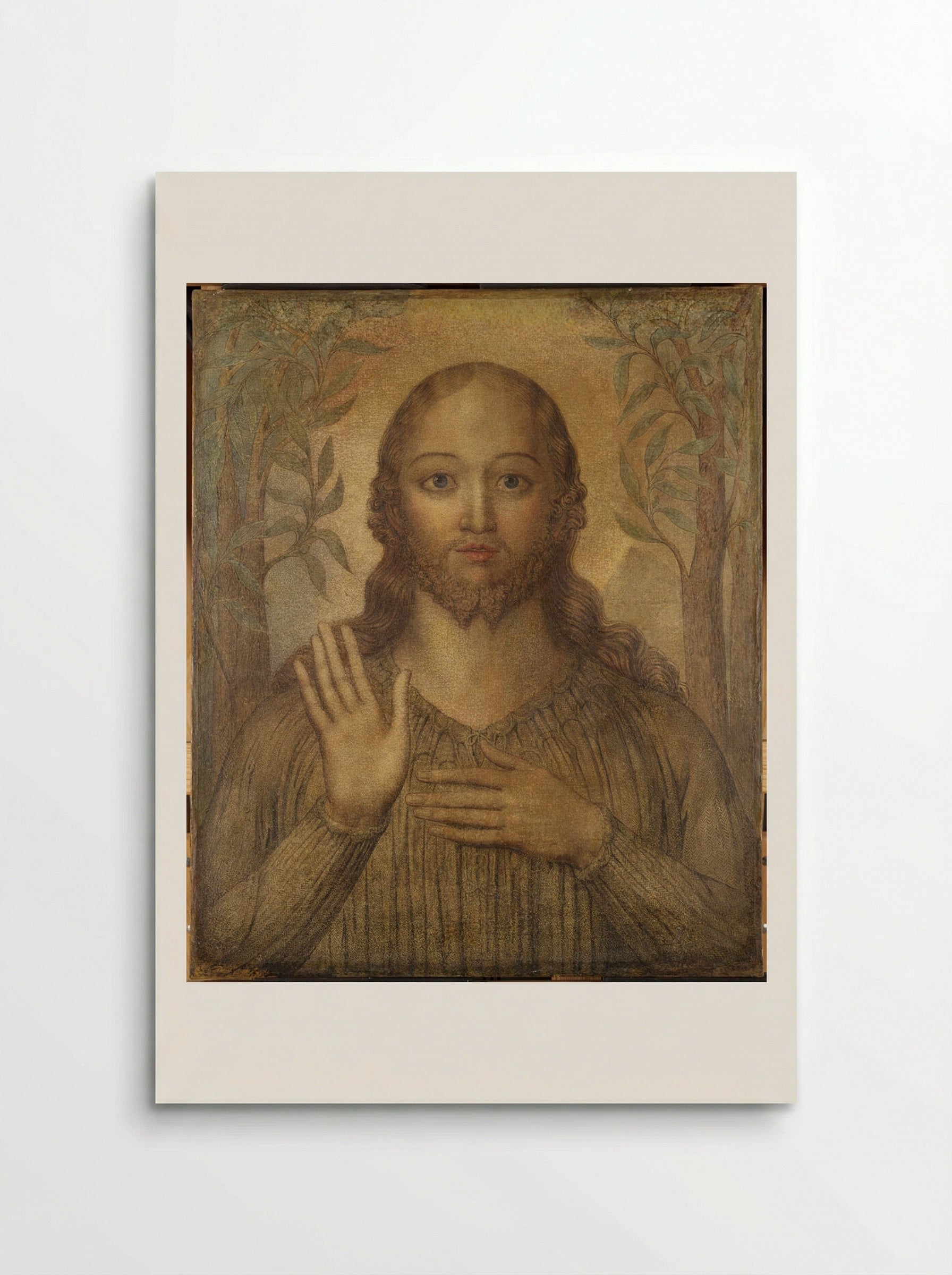
Kristus välsignar - William Blake
Arkivbeständigt giclée-tryck
Ramar levereras klara att hängas upp
Säker utcheckning
Tillverkad på beställning
Beskrivning
Ett fridfullt temperaporträtt av Kristus av den brittiska visionära konstnären William Blake, med en balanserad komposition och dämpade, jordnära toner.
William Blake, en visionär brittisk poet och konstnär, producerade denna temperamålning under en period av intensivt fokus på bibliska teman. Verket visar ett frontalt, symmetriskt porträtt av Kristus, hans högra hand lyft i en välsignande gest medan hans vänstra vilar på hans bröst. Blake använder en dämpad, jordnära palett som riktar uppmärksamhet mot den centrala figuren, vars uttryck är direkt och lugnt. Bakgrunden har två stiliserade träd som ramar in motivet och ger en känsla av inneslutning utan att antyda ett djupt, realistiskt rum. Blake använde ofta tempera, ett medium han berömt experimenterade med under hela sin karriär, för att uppnå en specifik lyster och textur. Färgpåföringen här är kontrollerad, vilket återspeglar hans preferens för tydliga konturer och definierade former framför den atmosfäriska oskärpa som föredrogs av många av hans samtida. Kristusfiguren är återgiven med en medveten enkelhet, och undviker överdriven utsmyckning för att bibehålla fokus på motivets andliga natur. Draperiets och ansiktsdragens linjära kvalitet stämmer överens med Blakes bredare konstnärliga filosofi, som prioriterade fantasins klarhet framför imitationen av naturen. Detta verk visar Blakes unika förhållningssätt till religiös ikonografi, där han rör sig bort från traditionella akademiska representationer mot ett mer personligt, symboliskt visuellt språk. Kompositionen är balanserad och statisk, inbjudande till stilla kontemplation. Genom att placera figuren mot en neutral, guldtonad bakgrund tar Blake bort scenen från en specifik historisk miljö, vilket låter bilden fungera som en tidlös ikon. Verket förblir ett tydligt exempel på hans tekniska process och hans förmåga att syntetisera klassiska influenser med sin egen särpräglade stil, vilket resulterar i en bild som är både tillgänglig och djupt karakteristisk för hans oeuvre.
Returpolicy
Eftersom varje tryck görs på beställning erbjuder vi inte returer, återbetalningar eller byten på grund av ändrade åsikter. Om din beställning kommer fram felaktig, skadad eller fel, ersätter vi den kostnadsfritt – kontakta oss bara inom 48 timmar efter leverans. Se vår återbetalningssida för fullständig information.
Frakt
Vi skickar till hela världen och trycker vid den produktionsanläggning som är närmast din leveransadress. Leveranstider och kostnader varierar beroende på destination – du ser tillgängliga alternativ i kassan.
Tillverkning
Varje tryck produceras på beställning med 12-färgs gicléetryck på FSC-certifierat arkivpapper. Designade i Storbritannien och tryckta vid närmaste produktionsanläggning för att minska avfall och snabba upp leveransen.
Kristus välsignar - William Blake

Artist Biography
William Blake
He married Catherine Boucher in 1782. She was illiterate at the time and signed the marriage register with an X. He taught her to read, write, and engrave, and she became his collaborator for the next forty-five years: mixing paint, operating the printing press, hand-colouring plates, and binding the finished pages into covers.
Their working method was Blake's own invention, revealed to him (he said) in a dream by the spirit of his dead brother Robert. Relief etching reversed the standard printmaking process: instead of cutting lines into copper, Blake wrote and drew on the plate in acid-resistant varnish, then dissolved the surrounding metal with acid, leaving text and image raised. This allowed him to compose poetry and illustration simultaneously on a single plate, print them together, then hand-colour each sheet in watercolour. Every copy was therefore unique. Songs of Innocence and of Experience was produced this way. He sold fewer than thirty copies during his lifetime.
In 1803, he physically threw a soldier named John Schofield out of his garden in Felpham. He was charged with assault and with uttering treasonable expressions against the King. He was acquitted at the Chichester assizes in January 1804.
Newton, painted in 1795, shows the scientist as a young man with the body of a Greek god, bent forward at the bottom of a dark ocean, fixing his gaze on a pair of compasses, measuring and drawing on a scroll that appears to project from his own head. It is a painting about the limits of reason: beautiful, precise, and missing everything beyond the edge of the paper. The Ancient of Days, from the same period, depicts his mythological figure Urizen crouching at the edge of a void, reaching down with a compass to measure the darkness below.
He died on 12 August 1827, working on illustrations for Dante's Divine Comedy. He was buried at Bunhill Fields. The wider recognition came decades later.
Våra funktioner
Utformad för varaktig inverkan
Specifika funktioner
Varje Solis-konstverk tillverkas på beställning med arkivbeständiga material av gallerikvalitet som är byggda för att hålla.
- Giclée-tryck i museikvalitet för fylliga, blekningsbeständiga färger
- Arkivbeständigt matt konstpapper, FSC-certifierat
- Flera storlekar och inramningsalternativ tillgängliga
- Ramar i svart, naturträ, mörkt trä eller vitt
- Inramade tryck levereras klara att hänga upp
Skötsel & rengöring
För att bevara ditt konstverk i bästa skick:
- Damma försiktigt med en mjuk, torr trasa
- Undvik långvarigt direkt solljus
- Använd aldrig flytande rengöringsmedel på trycket eller dukytan
- Förvara på en torr plats i rumstemperatur
- Hantera tryck med rena, torra händer
Material och storlek
Gicléeutskrift av museikvalitet på FSC-certifierat matt arkivpapper, med inramade alternativ och alternativ på canvas.
- Pappersstorlekar: A4, A3, A2, A1, A0 och B2 (50×70 cm)
- Canvas: XS (20×30 cm) till Large (60×90 cm)
- Ramar: svart, naturligt trä, mörkt trä eller vit
Varför välja oss?
Leveransgaranti utan skador
Snabb leverans
Material av museikvalitet
Artistbiografi
William Blake
He married Catherine Boucher in 1782. She was illiterate at the time and signed the marriage register with an X. He taught her to read, write, and engrave, and she became his collaborator for the next forty-five years: mixing paint, operating the printing press, hand-colouring plates, and binding the finished pages into covers.
Their working method was Blake's own invention, revealed to him (he said) in a dream by the spirit of his dead brother Robert. Relief etching reversed the standard printmaking process: instead of cutting lines into copper, Blake wrote and drew on the plate in acid-resistant varnish, then dissolved the surrounding metal with acid, leaving text and image raised. This allowed him to compose poetry and illustration simultaneously on a single plate, print them together, then hand-colour each sheet in watercolour. Every copy was therefore unique. Songs of Innocence and of Experience was produced this way. He sold fewer than thirty copies during his lifetime.
In 1803, he physically threw a soldier named John Schofield out of his garden in Felpham. He was charged with assault and with uttering treasonable expressions against the King. He was acquitted at the Chichester assizes in January 1804.
Newton, painted in 1795, shows the scientist as a young man with the body of a Greek god, bent forward at the bottom of a dark ocean, fixing his gaze on a pair of compasses, measuring and drawing on a scroll that appears to project from his own head. It is a painting about the limits of reason: beautiful, precise, and missing everything beyond the edge of the paper. The Ancient of Days, from the same period, depicts his mythological figure Urizen crouching at the edge of a void, reaching down with a compass to measure the darkness below.
He died on 12 August 1827, working on illustrations for Dante's Divine Comedy. He was buried at Bunhill Fields. The wider recognition came decades later.
Du kanske också gillar