

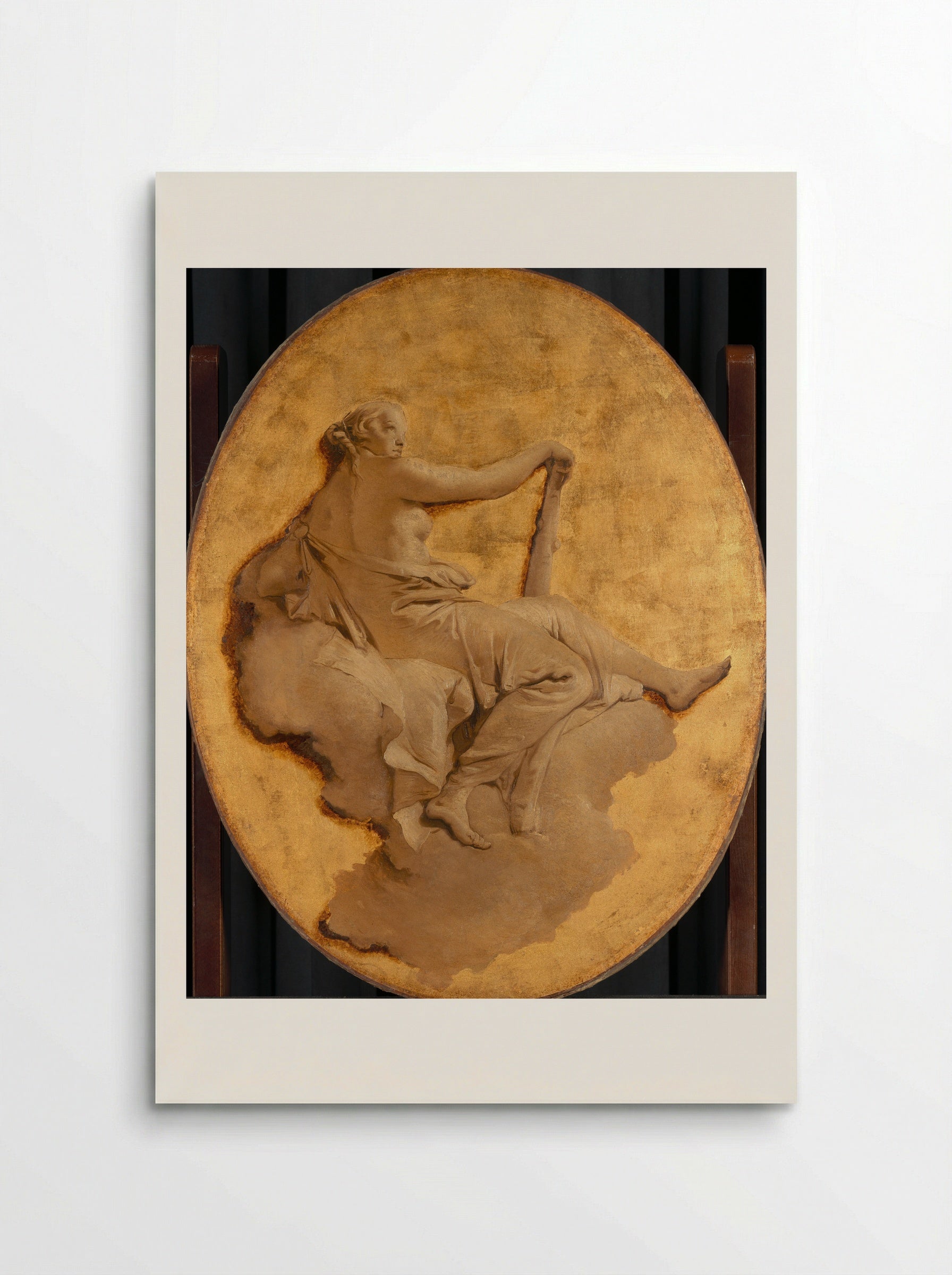
Allegorisk kvinnofigur med klubba (möjligen Styrka) – Giovanni Battista Tiepolo
Arkivbeständigt giclée-tryck
Ramar levereras klara att hängas upp
Säker utcheckning
Tillverkad på beställning
Beskrivning
En allegorisk målning av Giovanni Battista Tiepolo, möjligen föreställande Styrka, med en liggande kvinnofigur med en klubba mot en guldbakgrund. Detta verk exemplifierar Tiepolos rokokostil och hans mästerskap av allegoriska motiv.
Denna oljemålning på duk av Giovanni Battista Tiepolo föreställer en allegorisk kvinnofigur, möjligen föreställande Styrka. Figuren vilar på en molnliknande form, hållande en klubba, en traditionell attribut för styrka och makt. Kompositionen är placerad mot en guldbakgrund, vilket förstärker scenens eteriska kvalitet. Tiepolo, en mästare inom rokokostilen, var känd för sina storslagna fresker och dekorativa målningar, ofta med mytologiska och allegoriska motiv. Dukens ovala format antyder att den kan ha varit avsedd som takdekoration eller del av en större ensemble. Den dämpade paletten, dominerad av varma bruna och guldtoner, är karakteristisk för Tiepolos raffinerade förhållningssätt till färg. Figurens drapering är utförd med flytande penseldrag, vilket bidrar till känslan av rörelse och dynamik. Målningen återspeglar konstnärens skicklighet i att skapa visuellt fängslande och intellektuellt stimulerande verk, som blandar klassiska teman med rokokoperiodens elegans och grace. Tiepolos allegoriska verk utforskade ofta teman som dygd, hjältemod och godhetens triumf över ondskan, vilket tilltalade hans aristokratiska mecenater på den tiden.
Returpolicy
Eftersom varje tryck görs på beställning erbjuder vi inte returer, återbetalningar eller byten på grund av ändrade åsikter. Om din beställning kommer fram felaktig, skadad eller fel, ersätter vi den kostnadsfritt – kontakta oss bara inom 48 timmar efter leverans. Se vår återbetalningssida för fullständig information.
Frakt
Vi skickar till hela världen och trycker vid den produktionsanläggning som är närmast din leveransadress. Leveranstider och kostnader varierar beroende på destination – du ser tillgängliga alternativ i kassan.
Tillverkning
Varje tryck produceras på beställning med 12-färgs gicléetryck på FSC-certifierat arkivpapper. Designade i Storbritannien och tryckta vid närmaste produktionsanläggning för att minska avfall och snabba upp leveransen.
Care and materials
Specific Features
Every Solis piece is made to order with archival, gallery-quality materials built to last.
- Museum-grade giclée printing for rich, fade-resistant colour
- Archival matte fine-art paper, FSC-certified
- Multiple sizes and framing options available
- Frames in black, natural wood, dark wood or white
- Framed prints arrive ready to hang
Care & Cleaning
To keep your artwork looking its best:
- Dust gently with a soft, dry cloth
- Avoid prolonged direct sunlight
- Never use liquid cleaners on the print or canvas surface
- Keep in a dry, room-temperature space
- Handle prints with clean, dry hands
Materials & Sizing
Museum-grade giclée on FSC-certified archival matte paper, with framed and canvas options.
- Paper sizes: A4, A3, A2, A1, A0 and B2 (50×70 cm)
- Canvas: XS (20×30 cm) to Large (60×90 cm)
- Frames: black, natural wood, dark wood or white
Allegorisk kvinnofigur med klubba (möjligen Styrka) – Giovanni Battista Tiepolo

Artist Biography
Giovanni Battista Tiepolo
He was born in Venice in 1696, the youngest of six children. His father died about a year later, leaving his mother to raise the family in difficult circumstances. At fourteen he was apprenticed to Gregorio Lazzarini, a painter of eclectic style. His early work was dark and heavy, but after his marriage to Maria Cecilia Guardi in 1719, his palette brightened and his touch became lighter and more fluid. The transformation was radical: the sombre young painter became the most luminous colourist of the eighteenth century.
His ceiling fresco at the Wurzburg Residence (1750 to 1753), painted for the Prince-Bishop, is the largest fresco in the world and the supreme achievement of Baroque illusionistic decoration. He travelled there with his sons Domenico and Lorenzo, who served as assistants throughout his career. Tiepolo and his wife had nine children in total; four daughters and three sons survived to adulthood.
In 1755 he was elected Director of the Accademia in Venice. In 1762 he moved with his sons to Madrid at the invitation of Charles III of Spain to decorate the Royal Palace. The Spanish court favoured the cooler Neoclassicism of Anton Raphael Mengs, and Tiepolo found himself outmanoeuvred. He died in Madrid in 1770, at seventy-four, his Rococo exuberance already passing out of fashion.
Varför välja oss?
Leveransgaranti utan skador
Snabb leverans
Material av museikvalitet
Du kanske också gillar